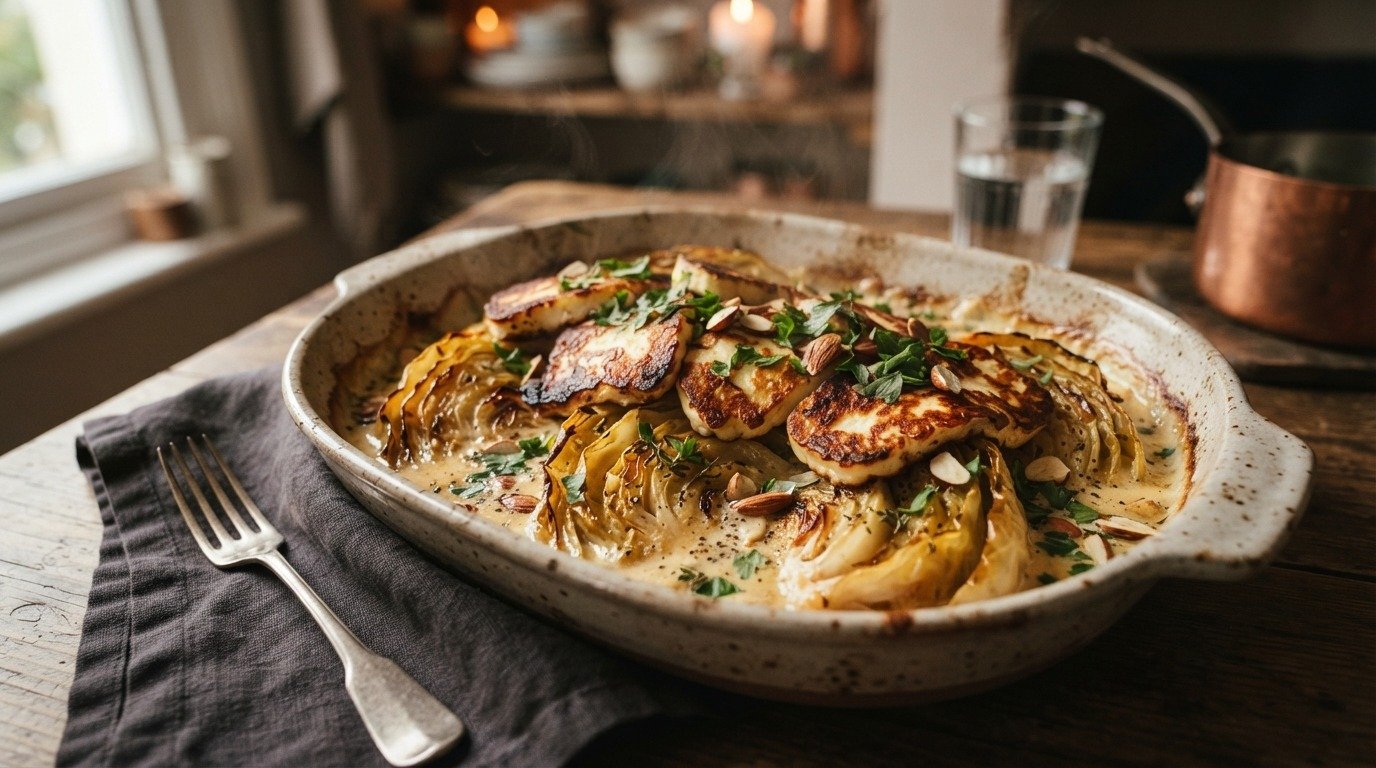
Creamy Roasted Pointed Cabbage With Crispy Halloumi

If you have written cabbage off as a boring boiled side, this dish will change your mind in one bite. Wedges of sweet, tender pointed cabbage get roasted in a rich, savoury cream-cheese sauce until the edges catch and caramelise, then the whole thing is crowned with slices of golden, squeaky halloumi. It is comforting, it is a little bit fancy, and it happens to be gluten-free and low in carbs without trying too hard.
In a nutshell: Creamy roasted cabbage with halloumi is a gluten-free, low-carb vegetarian dinner. Wedges of tender pointed (hispi) cabbage are baked in a rich cream-cheese and broth sauce until golden, then topped with pan-fried halloumi. It takes about 15 minutes of prep, roasts hands-off, and serves two as a proper main.
This is not another mixed-vegetable tray bake, and it is not a shredded keto casserole drowning in heavy cream. It is pointed cabbage treated with a bit of respect — kept in wedges so it stays juicy inside and crisp at the edges — with a sauce that is lighter and brighter than the usual gratin, and halloumi doing the job that meat usually does. Let’s get into it.
Why this creamy cabbage and halloumi bake works
A lot of creamy cabbage recipes shred the cabbage into ribbons and cook it down until it disappears into a cheese sauce. That is tasty, but you lose all the texture. Roasting the cabbage in wedges is the smarter move. The outside edges brown and turn nutty and sweet, while the layers inside steam gently and stay tender. You get contrast in every forkful instead of one soft, uniform mush.
The sauce is built on cream cheese loosened with vegetable broth rather than a flour-thickened white sauce. That single swap does three useful things at once: it keeps the dish naturally gluten-free (no roux, no breadcrumbs), it keeps the carbs down, and it gives you a silky, tangy sauce that clings to the cabbage without feeling heavy.
Then there is the halloumi. Most creamy cabbage dishes are sides — something you serve next to a piece of chicken or fish. Adding pan-fried halloumi turns this into a complete vegetarian halloumi dinner. Halloumi is high in protein, holds its shape under heat, and brings a salty, savoury hit that plays beautifully against the sweet roasted cabbage. It is the piece that makes the plate feel finished.
[internal link: high-protein vegetarian dinners]
What is pointed cabbage (hispi / sweetheart cabbage)?
If the recipe title has you picturing a heavy round cabbage, look for something different at the shop. Pointed cabbage is the cone-shaped, loosely packed one. Depending on where you live it goes by a few names:
- Pointed cabbage — the plain English name (and a direct translation of the German Spitzkohl).
- Hispi cabbage — the common name in the UK and Ireland.
- Sweetheart cabbage — another UK supermarket label for the same thing.
It is milder and sweeter than a standard green or white cabbage, the leaves are more tender, and it cooks faster. That tenderness is exactly why it roasts so well: it softens through in under an hour without needing to be boiled first. If you genuinely cannot find it, a small regular green cabbage works too — just expect a slightly firmer bite and give it a little more time in the oven.
[internal link: how to cut cabbage into wedges that hold together]
Ingredients you’ll need
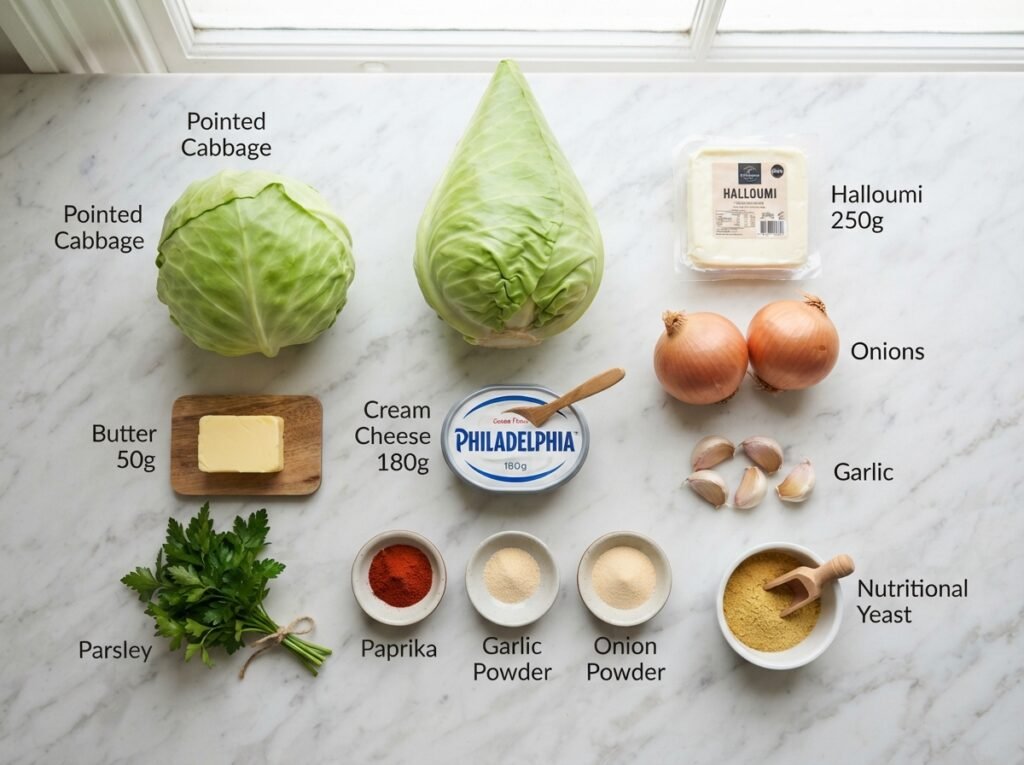
This is a short, honest shopping list — most of it is probably in your kitchen already. Quantities below make 2 generous main-course portions.
For the cabbage and sauce
- 1 pointed (hispi) cabbage
- 1 tbsp butter or ghee (clarified butter)
- 2 small onions, diced
- 3 garlic cloves, finely chopped
- 150 g cream cheese (full-fat gives the richest sauce)
- 120–150 ml strong vegetable broth (stock)
- ½ tsp sweet paprika
- ½ tsp garlic powder
- ½ tsp onion powder
- Salt and black pepper, to taste
- 2–3 tbsp nutritional yeast
Optional, but recommended: a small grating of nutmeg and a squeeze of lemon juice to lift the sauce.
For the protein
- 100 g halloumi
To serve: a handful of fresh parsley, roughly chopped.
A quick note on two ingredients you might not recognise:
Nutritional yeast (sometimes sold as yeast flakes) is a deactivated yeast with a savoury, cheesy, slightly nutty flavour. It is a favourite in vegetarian cooking because it adds a Parmesan-like umami depth without any actual cheese. Here it seasons the top of the bake and helps the surface brown. If you don’t have it, a light dusting of grated Parmesan does a similar job — though that changes the vegetarian-friendly, dairy-light profile slightly.
Ghee is butter with the milk solids cooked out, which gives it a higher smoke point and a gentle nutty flavour. Butter and ghee are interchangeable here — use whichever you have.
How to make creamy roasted cabbage with halloumi
Total time is roughly 55–60 minutes, but most of that is hands-off oven time. Active work is about 15 minutes.
Step 1 — Prep the cabbage
Quarter the pointed cabbage lengthways, cutting straight down through the stem. Trim the stem end only slightly — you want to leave enough of the core intact so each wedge holds together during roasting. If the core is fully cut away, the leaves fall apart and you lose those neat, saucy layers. Set the wedges aside.
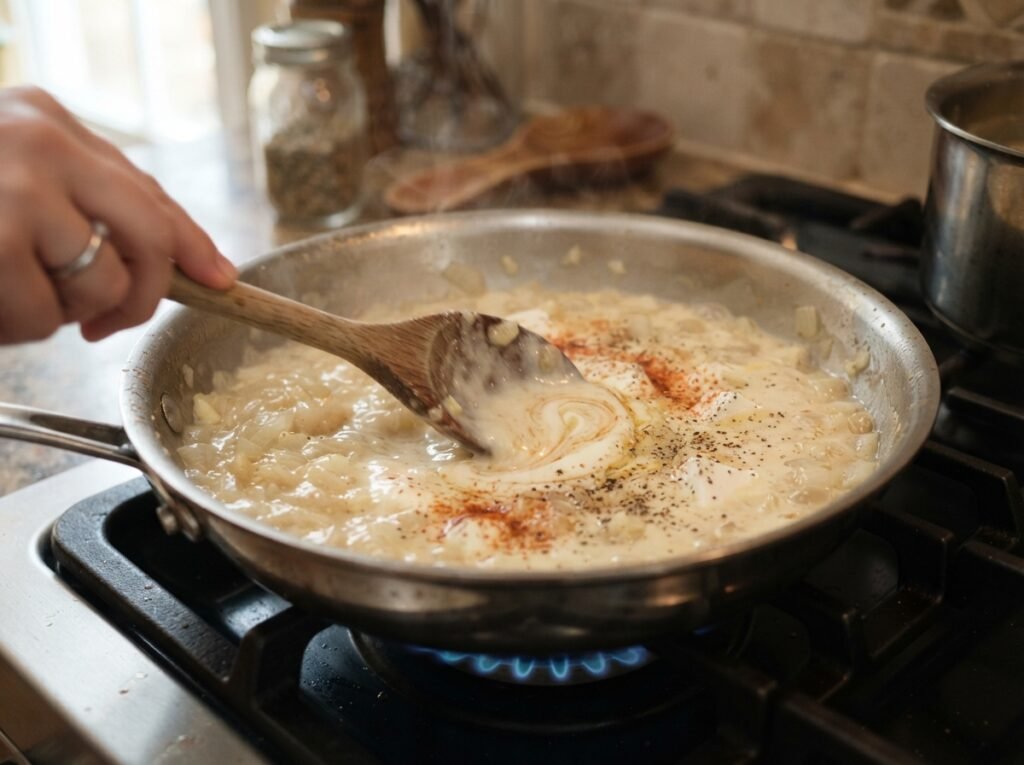
Step 2 — Build the sauce
Melt the butter or ghee in a pan over medium heat. Add the diced onions and cook gently until soft and translucent, about 5 minutes — you want them sweet, not browned. Add the chopped garlic and let it cook for under a minute, just until fragrant.
Stir in the sweet paprika, garlic powder, onion powder, and a good pinch of salt and pepper. Now add the cream cheese and stir until it melts into the onions. Pour in the vegetable broth a little at a time, whisking or stirring until you have a smooth, glossy, pourable sauce. Start with 120 ml and add the rest only if you want it looser. This is the moment to add the optional nutmeg and a squeeze of lemon — the nutmeg adds warmth and the lemon cuts through the richness.
Step 3 — Assemble the bake
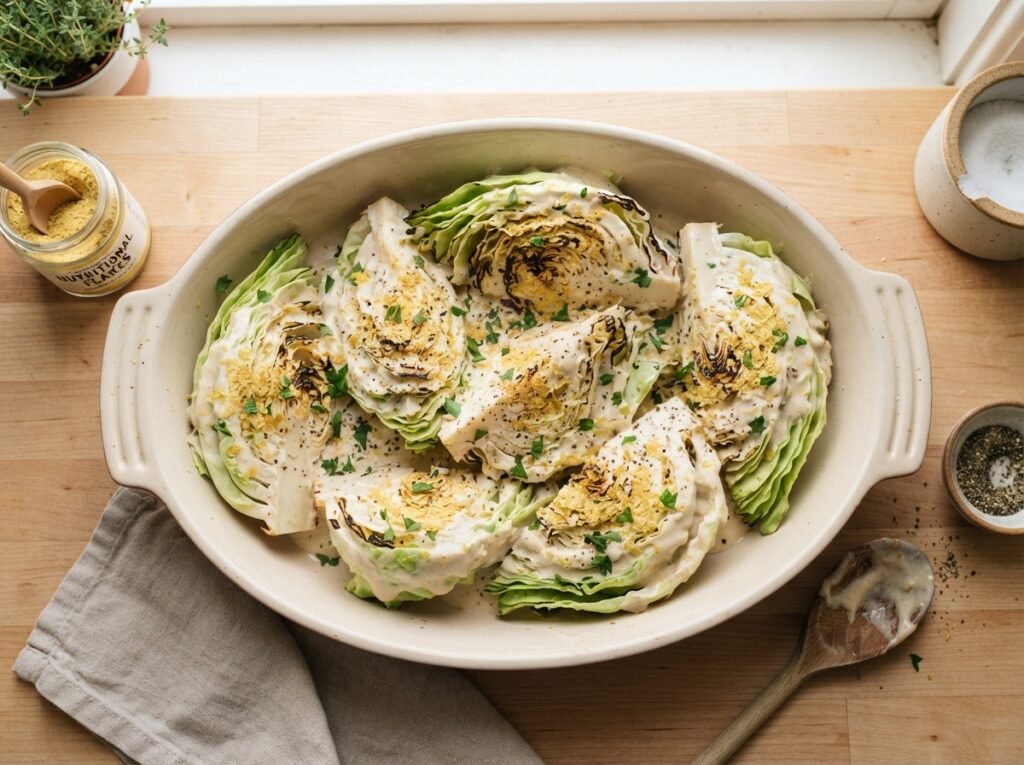
Arrange the cabbage wedges in an ovenproof dish, cut-side up where possible. Pour the creamy sauce evenly over the top, making sure every wedge gets coated and some sauce runs down between the layers. Scatter the nutritional yeast over the surface.
Step 4 — Roast
Bake in a fan oven at 180°C (about 200°C / 400°F conventional):
- 30 minutes covered — cover the dish with foil or a lid so the cabbage steams and turns tender all the way through.
- 10–15 minutes uncovered — remove the cover and let the top brown lightly and the sauce reduce and catch at the edges.
The cabbage is done when a knife slides easily into the thickest part of a wedge and the surface is golden in patches.
Step 5 — Fry the halloumi
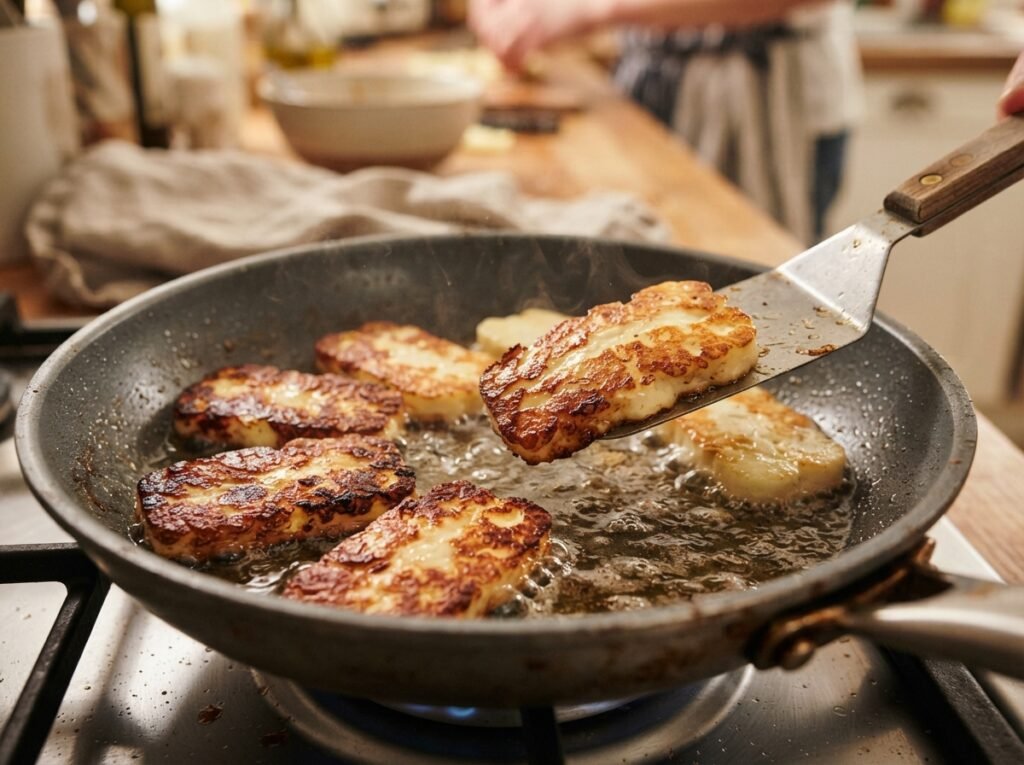
While the cabbage finishes, slice the halloumi into pieces about a centimetre thick. Heat a dry or very lightly oiled non-stick pan over medium-high heat and fry the slices for 1–2 minutes on each side, until deeply golden and crisp at the edges. Halloumi is high in fat and salt on its own, so it rarely needs extra oil. Don’t walk away — it goes from golden to too-dark quickly.
Step 6 — Serve
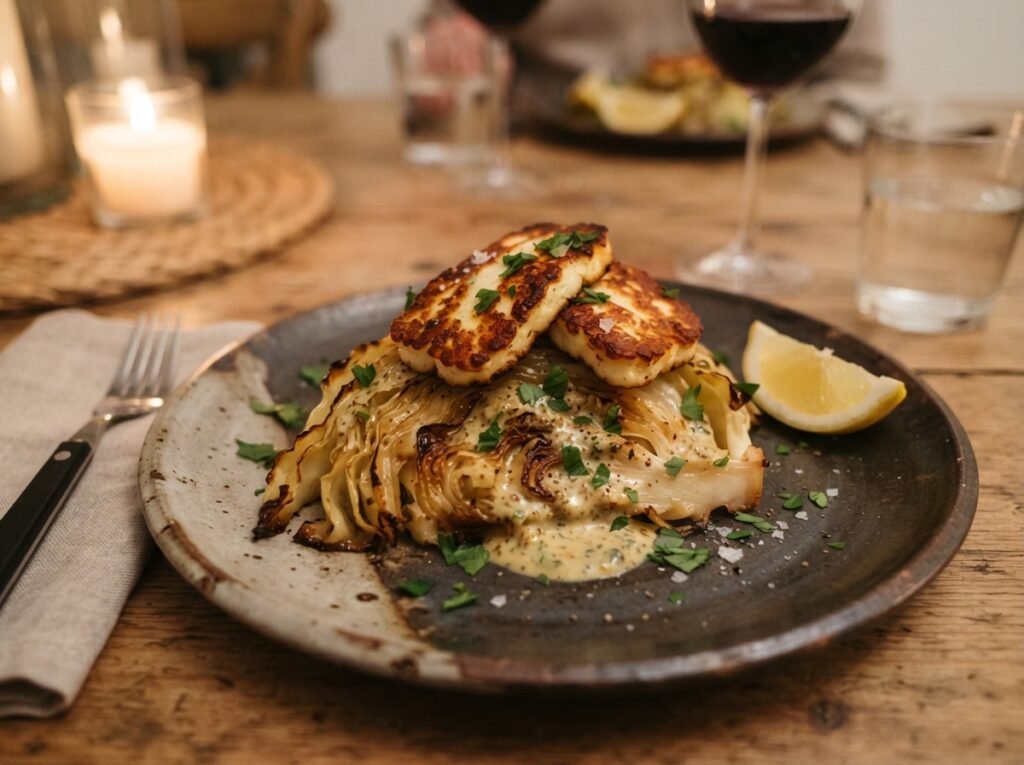
Take the cabbage out of the oven and spoon any extra sauce from the dish back over the wedges. Arrange the fried halloumi on top of or alongside the cabbage. Finish with a scatter of fresh parsley and serve straight away, while the halloumi is still hot and squeaky.
Tips for the best results
- Keep the core in. It is the single most important tip. The stem is what stops your wedges collapsing into loose leaves.
- Don’t rush the onions. Sweating them slowly until soft and sweet is what gives the sauce its depth. Burnt garlic will make the whole sauce taste bitter, so add it late and keep the heat moderate.
- Cover, then uncover. Skipping the covered stage leaves the inside of the cabbage tough. Skipping the uncovered stage leaves you with a pale, saucy dish and no caramelisation. You want both.
- Fry halloumi last. It is best eaten within a few minutes of coming out of the pan. Sitting around, it turns rubbery as it cools.
- Taste the sauce before it goes in. Cream cheese brands vary in saltiness, and so does your broth. Season the sauce properly before pouring it over — it is much harder to fix later.
Easy swaps and variations
One of the best things about this dish is how forgiving it is. A few ideas:
- Different protein. Not vegetarian? Crispy pan-fried bacon or shredded rotisserie chicken folded through works well. Want to keep it veggie but change it up? Roasted chickpeas add crunch and fibre.
- Extra cheese, extra indulgence. A handful of grated cheddar or Gruyère over the top in the last 10 minutes turns this into more of a gratin. It adds carbs and calories, but it is delicious.
- A little heat. A pinch of chilli flakes or a swirl of chilli oil at the end gives the sweet cabbage a lovely kick.
- Different cabbage. Regular green cabbage or savoy both work — just cut smaller wedges and add 5–10 minutes of roasting time, since they are firmer than pointed cabbage.
- Dairy-free. Swap the cream cheese for a plant-based cream cheese and the halloumi for a firm plant-based alternative, and use a vegan-friendly nutritional yeast. The texture shifts a little but the idea holds.
What to serve it with
As written, this is a full low-carb, gluten-free dinner for two on its own — the cabbage is the vegetable and the halloumi is the protein. If you want to stretch it to feed more people or make it more filling, it pairs nicely with:
- A simple green salad with a sharp lemon dressing to keep things bright.
- Warm flatbread or crusty bread for anyone not watching carbs, to mop up the sauce.
- A spoon of garlicky yoghurt or tzatziki on the side.
- Roasted new potatoes if you want a heartier, non-low-carb plate.
Storage and make-ahead
The roasted cabbage keeps well in an airtight container in the fridge for up to 3 days. Reheat it gently in the oven or microwave until warmed through. Fry the halloumi fresh each time rather than storing it cooked — reheated halloumi loses its crisp edge and turns tough. You can dice and refrigerate the raw halloumi ahead of time so it is ready to fry.
The sauce can be made a day in advance and kept in the fridge; loosen it with a splash of broth when you reheat, as cream cheese firms up when cold. Freezing is not recommended — cream-cheese sauces tend to split when thawed, and cabbage goes watery.
Nutrition (per serving, approximate)
Based on the ingredients above, split across 2 portions:
| Nutrient | Per portion (approx.) |
|---|---|
| Calories | ~540 kcal |
| Fat | ~35 g |
| Protein | ~25 g |
| Carbohydrates | ~29 g |
| Fibre | ~13 g |
That works out to roughly 16 g net carbs per portion once the generous fibre from the cabbage is subtracted, which is what keeps this comfortably in low-carb territory. These figures are estimates and will shift with the exact size of your cabbage and the brands of cream cheese and halloumi you use — the fibre in particular depends heavily on how big your pointed cabbage is. Treat them as a guide, not a lab result.
This article is for general information and is not medical or dietary advice. If you are managing a specific health condition or following a strict eating plan, check the labels on your own ingredients.
Key takeaways
- Creamy roasted cabbage with halloumi is a gluten-free, low-carb vegetarian main for two, ready in about an hour with only 15 minutes of active work.
- Use pointed (hispi) cabbage in wedges, keeping the core intact so they hold together and roast up sweet and tender.
- The sauce is cream cheese loosened with broth — no flour, so it stays naturally gluten-free and lower in carbs than a classic gratin.
- Halloumi is what turns a creamy cabbage side into a satisfying dinner; fry it fresh and serve immediately.
- It is endlessly adaptable — swap the protein, add cheese, bring the heat, or make it dairy-free.
FAQ
Can I use regular cabbage instead of pointed cabbage?
Yes. Pointed (hispi) cabbage is sweeter and more tender, so it is ideal, but a small regular green cabbage or a savoy cabbage works too. Cut slightly smaller wedges and add about 5–10 extra minutes of roasting time, as firmer cabbages take longer to become tender.
Is creamy roasted cabbage with halloumi gluten-free?
As written, yes. The sauce is thickened with cream cheese rather than flour, so there is no gluten in the recipe. Always double-check that your specific broth, halloumi, and any optional additions are certified gluten-free if you are cooking for someone with coeliac disease.
How do I stop the cabbage wedges from falling apart?
Leave the core in. When you quarter the cabbage, cut straight through the stem and trim it only minimally. The intact core holds the leaves together through roasting. If you cut the core out completely, the wedges collapse into loose leaves.
Can I make this ahead of time?
You can make the sauce a day ahead and refrigerate it, then loosen it with a splash of broth before using. The roasted cabbage also reheats well for up to 3 days. Fry the halloumi fresh each time, though — it loses its crisp texture once cooled and reheated.
Why is my halloumi rubbery?
Halloumi turns rubbery when it sits after cooking or is overcooked. Fry it over medium-high heat for just 1–2 minutes per side until golden, and serve it within a few minutes. Eating it hot, straight from the pan, gives you that signature crisp-outside, soft-inside bite.
Is this recipe keto-friendly?
It is low in carbs and fits most low-carb plans at roughly 16 g net carbs per portion. Strict keto eaters should check the total against their daily limit and can reduce it slightly by using less onion, which is the main carb contributor after the cabbage.