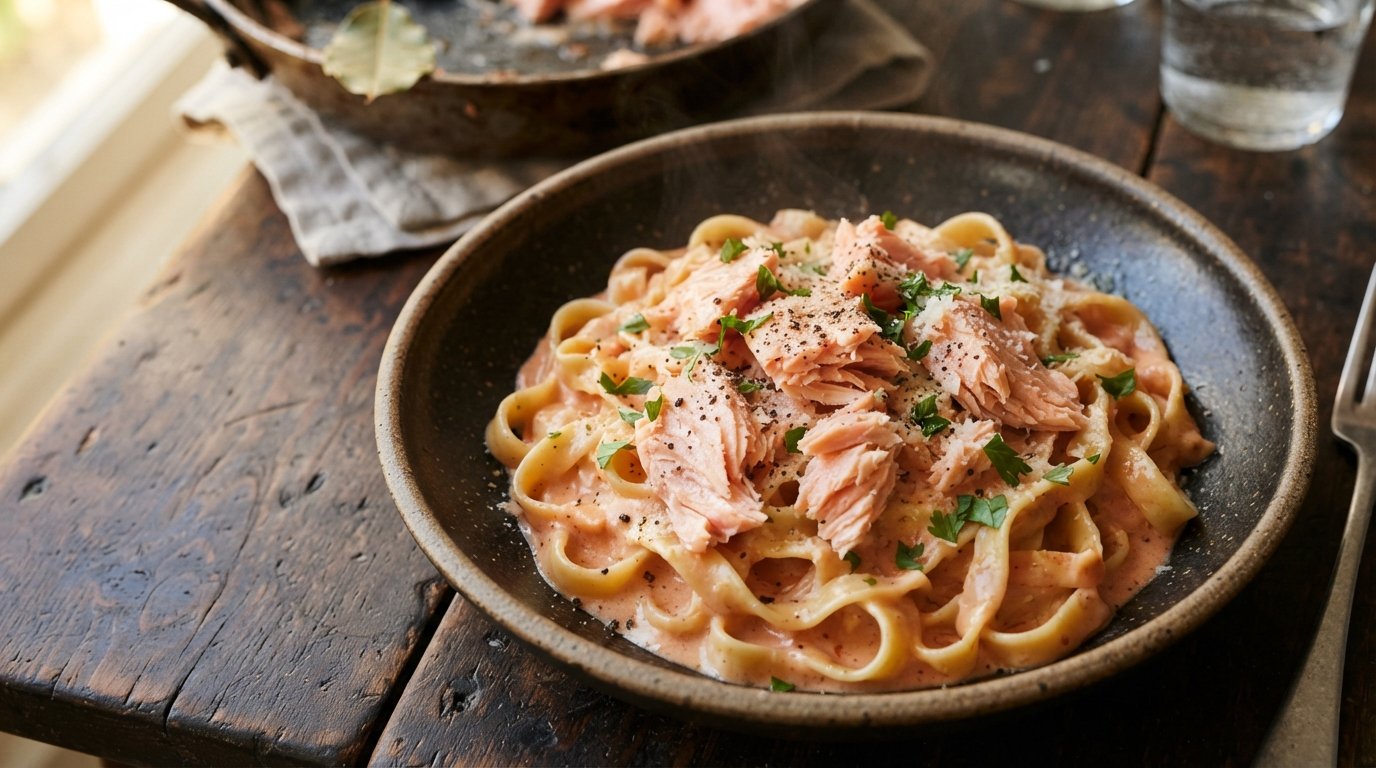
Frozen Salmon Pasta — The Step That’s Drying Out Your Fish
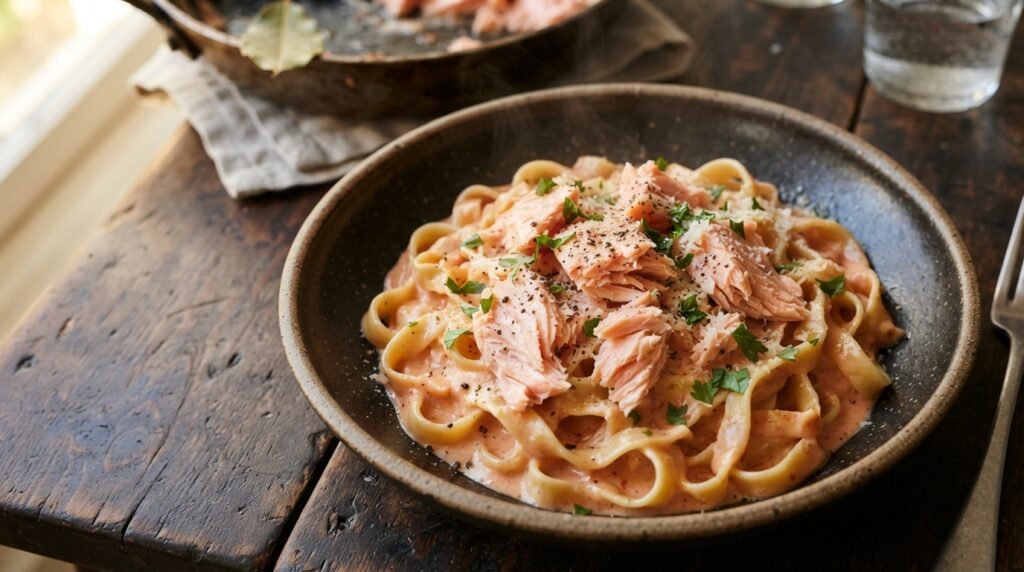
Frozen salmon pasta is one of the best-value dinners in the freezer aisle — a packet of fillets, some cream, and twenty-five minutes gets you something that costs three times as much in a restaurant.
It’s also the dish most people quietly ruin, and almost always at the same step.
Here’s the version circulating widely: brown the salmon, break it up, then let everything simmer together for fifteen minutes so the flavours can mingle. It sounds sensible. It’s the single worst thing you can do to a piece of salmon. Fifteen minutes in a simmering pan turns tender fish into chalk, and by the time you notice, you’re eating it.
This guide fixes that, deals honestly with the fact that frozen salmon is a different ingredient to fresh, and builds a tomato-tinted cream sauce that looks nothing like the lemon-and-parmesan version everyone else makes.
The 40-Second Answer
Yes, you can make excellent frozen salmon pasta. Thaw the fillets fully in the fridge, then pat them completely dry — frozen salmon holds water, and wet fish steams instead of searing. Cook the salmon first, remove it from the pan, build the cream sauce, and fold the flaked salmon back in at the very end. Never simmer salmon in the sauce.
Key Takeaways
- Cook the salmon, then take it out. Fold it back at the end. This is the whole recipe.
- Thaw fully, pat bone dry. Frozen salmon’s problem is water, and water kills a sear.
- Reserve a mug of pasta water. The starch is what makes the sauce cling.
- Tomato paste + bay leaf is the differentiator here — savoury depth instead of lemon brightness.
- Fix the ratio. 350g pasta to 250g salmon, not 500g. You’re making salmon pasta, not pasta with a rumour of salmon.
Frozen Salmon Isn’t Second-Best — But It Is Different
Let’s clear this up first, because it’s the question that brought most people here.
Frozen salmon is fine. Nutritionally it’s a non-issue — <cite index=”34-1″>thawed frozen salmon is just as nutritious as fresh</cite>. It’s cheaper, it’s always there, and for a dish where the fish gets flaked into a sauce anyway, the textural premium you pay for fresh is largely wasted.
But it behaves differently, and the difference is water.
Freezing forms ice crystals inside the flesh. Those crystals rupture cell walls, and when the fish thaws, the water that was locked inside those cells comes out. So you’re not starting with a dry piece of fish — you’re starting with a wet one, sitting in its own liquid.
That matters because of what happens in the pan. Water has to boil off before browning can begin. Put a wet fillet in a hot pan and the first minute isn’t searing, it’s steaming. You get pale, slightly rubbery fish and no crust.
Two rules follow, and both are near-universal among people who cook this well:
Thaw it fully, in the fridge, overnight. <cite index=”39-1″>Take it out of the freezer, put it in the fridge, let it thaw completely — don’t cook it while it’s still frozen</cite>. And it isn’t about convenience: <cite index=”33-1″>cooking salmon from frozen takes longer, and that extra time is what makes the texture tough</cite>.
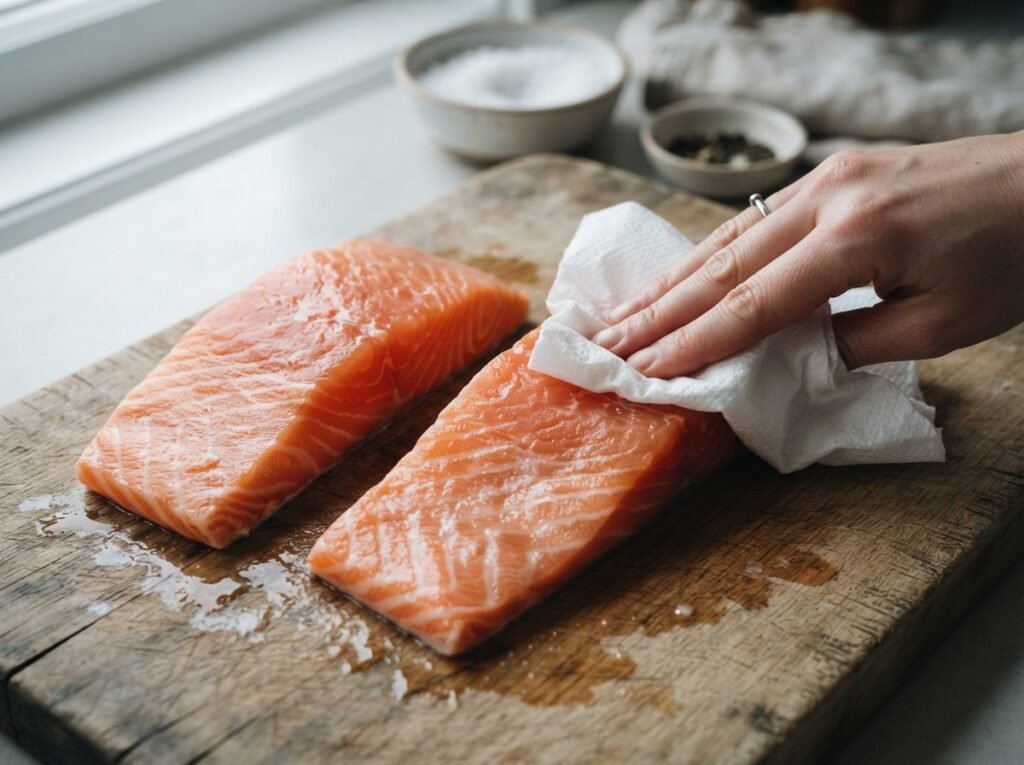
Then pat it very dry. <cite index=”37-1″>Removing the excess moisture is what lets the salmon sear properly instead of steaming</cite>. Kitchen paper, both sides, firmly. Do it again right before it hits the pan — it will have wept more while you weren’t looking.
That’s the entire frozen salmon problem. Solve the water and frozen behaves like fresh.
Ingredients
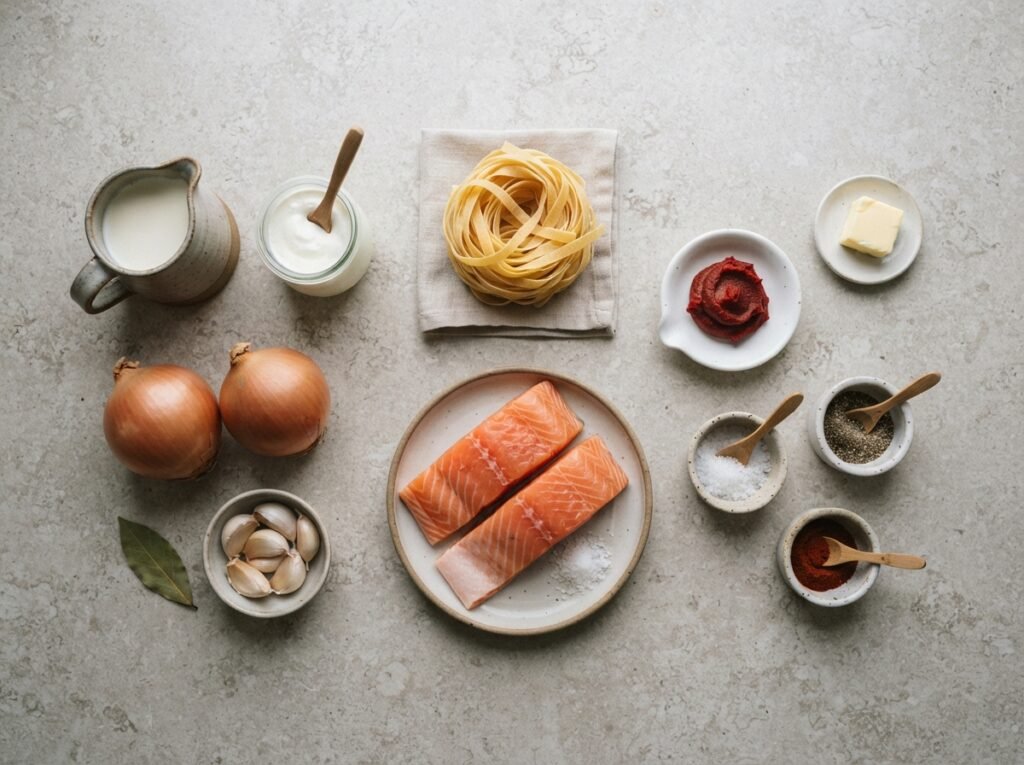
Serves 4 generously
- 350g dried pasta — long shapes are best
- 220–250g salmon fillets (roughly 2 fillets), thawed
- 250ml double cream / heavy cream
- 2 tbsp crème fraîche
- 2 large onions, sliced
- 2–3 garlic cloves, crushed
- 1 bay leaf
- 1 heaped tbsp tomato paste
- 2 tbsp butter
- A good splash of milk
- Salt, pepper, sweet paprika
- A little fish stock (optional)
About that pasta quantity. The version of this recipe going around calls for 500g of pasta with the same 220–250g of salmon and calls it 3–4 portions. That maths doesn’t work. 500g of dry pasta is realistically five to six generous plates, and if you served it as four, each person gets about 60g of salmon — a garnish, not a protein. For scale, most English-language salmon pasta recipes work at around <cite index=”36-1″>2 ounces of pasta per person</cite>, and the most popular one on the internet uses <cite index=”38-1″>three-quarters of a pound to a pound of salmon</cite> for a similar yield.
I’ve dropped it to 350g. If you want it closer to the original, use 500g pasta and buy a second packet of salmon. What you shouldn’t do is stretch 250g of fish across half a kilo of noodles and expect it to taste like salmon pasta.
Long pasta, not shapes. <cite index=”37-1″>Wide, flat shapes like pappardelle or linguine hold creamy sauces better than thin noodles, because the surface area lets the sauce cling evenly</cite>. Tagliatelle, fettuccine and linguine all work. Penne is fine but you’ll lose sauce to the bottom of the bowl.
Crème fraîche is doing real work. It’s not just cream with a different name. <cite index=”35-1″>It’s thicker and richer, you need less of it than regular cream, and its slight sourness gives the sauce a zing that cuts the fat</cite>. Cream cheese is the listed alternative and it works — slightly different texture, slightly less tang.
Step 1: Get the Onions Properly Soft
Slice the onions and cook them gently in a little butter or oil until soft and translucent.
Take your time. Two large onions is a lot of onion, and rushed onions are the difference between a sauce with a savoury foundation and a sauce that’s just cream. <cite index=”37-1″>Cooking alliums gently releases their natural sugars, and that’s what makes the sauce taste like something</cite>.
Eight minutes on a medium-low heat. Not three on high. This is where the flavour of the finished dish is decided, and it’s the step people skip because nothing appears to be happening.
Step 2: Sear the Salmon — Then Get It Out of the Pan
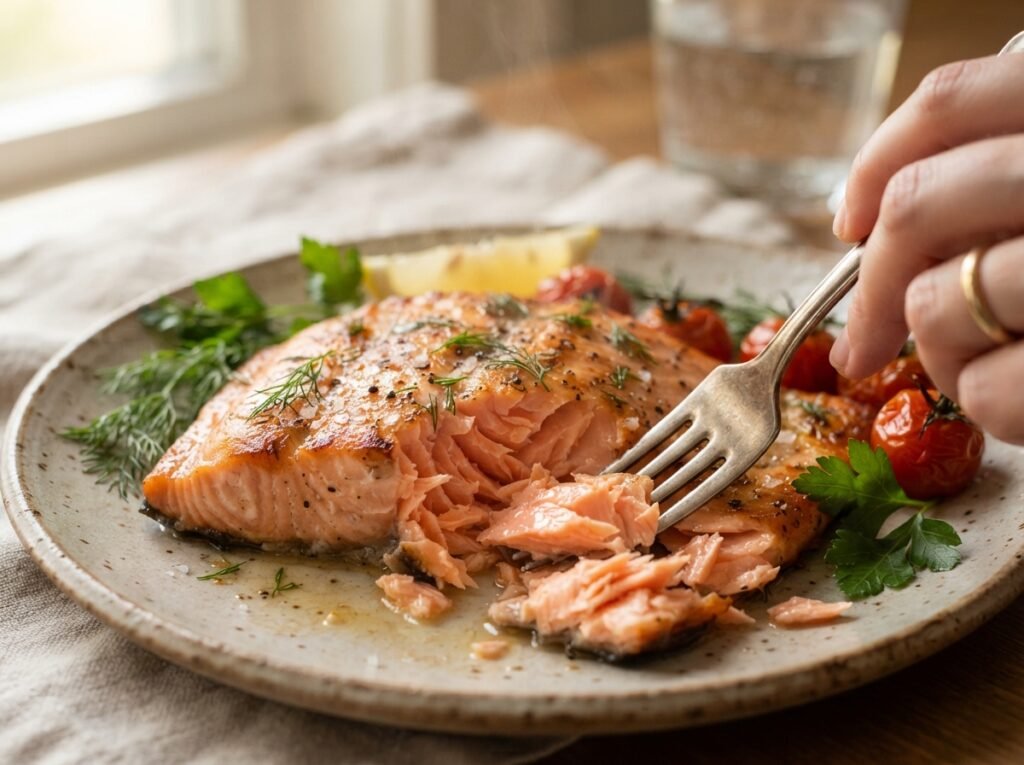
Pat the thawed salmon dry one more time. Season it. Sear it in the hot pan, both sides, until just cooked through. Then take it out, set it aside, and leave it alone.
This is the step. Everything else is details.
The recipe this article is based on breaks the salmon up in the pan at this point and leaves it there while the sauce simmers for the next fifteen minutes. Do not do that. Salmon goes from perfect to ruined in a very narrow window, and the whole English-language recipe world is unanimous on this — <cite index=”39-1″>cook the fish, don’t overcook it or it goes dry, and once it’s cooked through remove it from the pan and set it aside</cite>. The most popular salmon pasta recipe on the internet cooks the salmon entirely separately and <cite index=”38-1″>breaks it into big chunks on top of the finished pasta at the very end</cite>.
How to know when it’s done. Aim for an internal temperature of <cite index=”34-1″>130–135°F (54–57°C), which will rise a little during a five-minute rest</cite>. Some cooks prefer <cite index=”33-1″>140–145°F</cite> — either is defensible, but 135 gives you room to reheat it in the sauce later without crossing into dry. Without a thermometer: <cite index=”34-1″>it’s ready when it’s just turning opaque and still warm pink inside, not dry and flaky white</cite>.
Then let it rest. <cite index=”33-1″>Rest it a couple of minutes, then press gently into the thickest part with a fork — it should separate naturally into tender pieces</cite>. Flake it into big chunks. Big. Small flakes disappear into the sauce and you lose the point of the dish.
About the white stuff. If pale white curds appear on the surface while it cooks, that’s albumin. <cite index=”36-1″>It’s protein coming to the surface, it’s completely harmless, and once the salmon is mixed into the pasta you won’t see it</cite>. It’s more visible on frozen salmon, and it’s a mild signal you’re cooking a touch hot.
Step 3: Build the Sauce
Into the onion pan: the crushed garlic, then salt, pepper and sweet paprika. Optional fish stock now if you want a deeper savoury note.
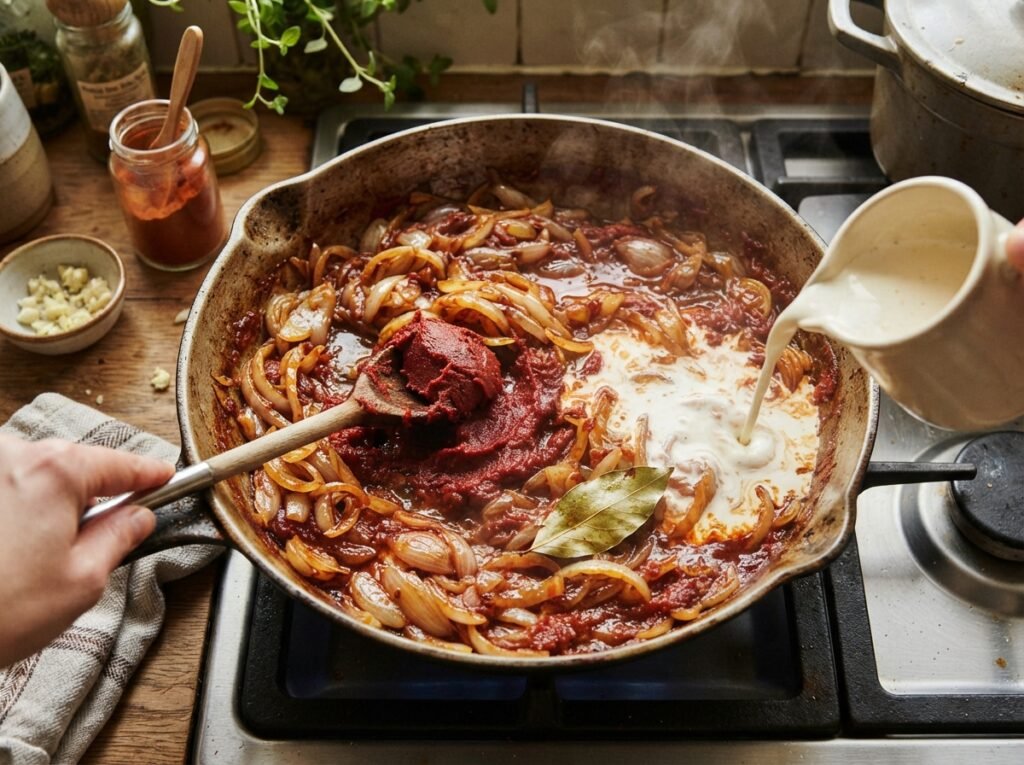
Then the butter and the tomato paste. Stir the paste in properly — let it cook for a minute or two until it darkens slightly and stops smelling raw. This is the step that separates this recipe from every other salmon pasta on the internet, and if you undercook the paste you get a sauce that tastes faintly of tinned tomato instead of savoury depth.
Then the crème fraîche and the cream. Then the bay leaf and a splash of milk.
Now let it simmer gently for about 15 minutes — with the salmon safely out of the pan. This is where the fifteen minutes belongs. The flavours do need time to marry; the fish just doesn’t need to be there while they do it.
Keep the heat low. <cite index=”33-1″>High heat breaks a cream sauce</cite>. A cream sauce doesn’t need a rolling simmer, it needs a lazy one. Bubbles at the edge, not across the surface.
Why tomato and bay? Because almost nobody does it. Scroll the first page of Google for salmon pasta and you’ll find lemon, garlic, parmesan and white wine, repeated a dozen times. It’s a good combination and it’s also the only one anyone makes. Tomato paste plus bay gives you something warmer and rounder — less bright, more savoury, closer to a ragù that happens to contain fish. It’s genuinely a different dish, and it’s the reason to make this one.
Step 4: Cook the Pasta — And Save the Water
While the sauce simmers, cook the pasta in well-salted water until al dente.
Undercook it by a minute. <cite index=”35-1″>Pulling it a minute early lets it finish in the sauce, where it absorbs flavour and stays properly al dente</cite>. <cite index=”36-1″>Overcooked pasta going into a sauce that will cook it further ends up mushy</cite>.
And before you drain it — reserve a mugful of the water.
This is the second correction to the source recipe, and it’s the one that will change your sauce the most. Starchy pasta water is the emulsifier. It’s what turns cream-and-pasta into a sauce that grips every strand, rather than a bowl of noodles sitting in cream. Every strong recipe in this category insists on it: <cite index=”36-1″>the starchy water is what makes the sauce silky and helps it stick to the pasta</cite>, and <cite index=”33-1″>adding reserved pasta water at the end is how you get a glossy, balanced sauce</cite>.
<cite index=”37-1″>Add it gradually until the sauce coats the noodles like velvet.</cite> Never dump it in.
Salt the water properly, too. <cite index=”35-1″>It makes an enormous difference</cite> — and it’s your only chance to season the pasta itself rather than the sauce around it.
Step 5: Bring It Together
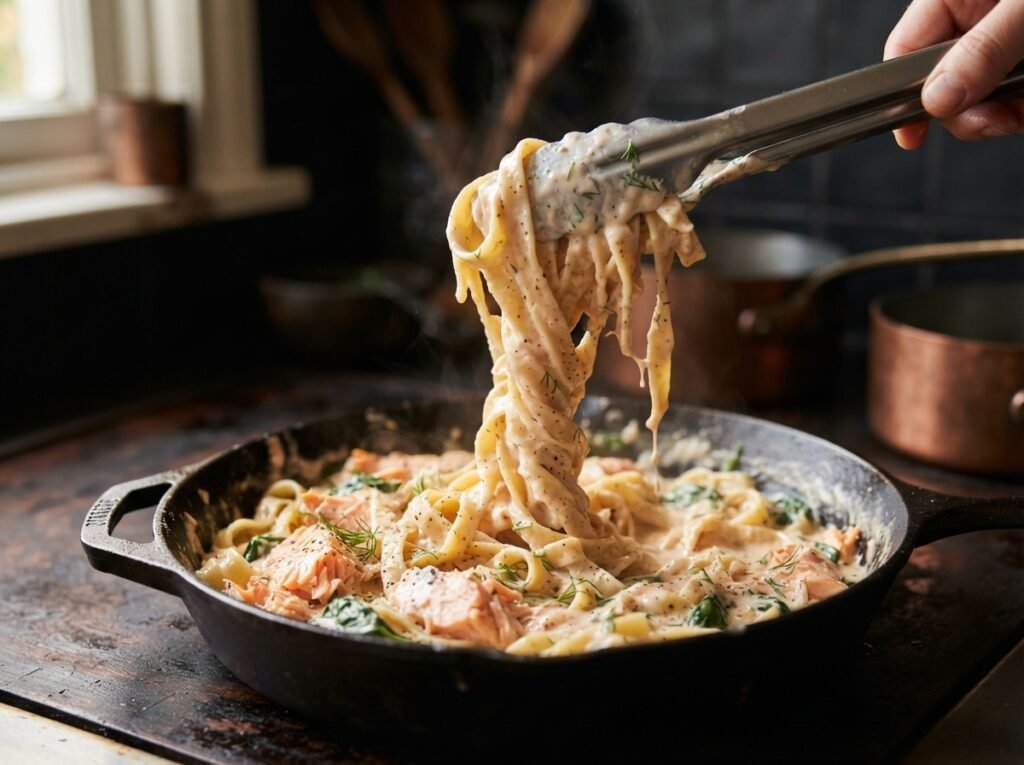
Drain the pasta. Fish out the bay leaf. Add the pasta to the sauce with a splash of the reserved water and toss until glossy.
Now fold the flaked salmon back in, gently, and only until it’s warmed through. Thirty seconds. It’s already cooked — you are reheating, not cooking.
Make it looser than looks right. <cite index=”35-1″>A cream sauce keeps thickening after it leaves the heat, so aim for slightly too loose in the pan and it’ll be perfect on the plate.</cite> This is the most common last-second mistake: a sauce that looked ideal in the pan arrives at the table claggy.
If it splits or thickens too far, more pasta water, off the heat. <cite index=”40-1″>Tossing off the heat helps avoid the sauce splitting in the first place.</cite>
Serve immediately.
Optional but recommended: a squeeze of lemon at the table. <cite index=”33-1″>A fresh squeeze at the end adds brightness</cite>, and against a tomato-cream base it works even harder than it does in the lemon-forward versions, because it’s the only acid in the dish.
What This Costs vs What It Replaces
The honest pitch for this recipe is economic. A packet of frozen salmon fillets, a pot of cream, an onion, some pasta — that’s a restaurant plate for a fraction of restaurant money, and the fish is the only ingredient that costs anything meaningful.
That said, let’s not pretend it’s a health food. It’s cream, crème fraîche, butter and pasta. <cite index=”36-1″>It’s a calorie-heavy dish, though salmon does bring genuinely useful heart-healthy fats along with it</cite>. It’s a proper dinner, not a light one, and the tomato paste and lemon are there to stop it feeling as heavy as it is.
Who This Doesn’t Work For
- You want it light. You don’t want this recipe. Cream is the entire point.
- You want to make it ahead. You can’t, really. <cite index=”33-1″>Freezing it doesn’t work — the high dairy content makes the sauce separate.</cite> Fridge leftovers keep a couple of days and reheat with a splash of milk or cream, but reheated salmon is a compromise and you should know that going in.
- You’re nervous about fish. Salmon’s window is narrow and this dish punishes overcooking. Buy a £10 thermometer or accept some variance.
- You only have salmon still frozen solid tonight. Then make something else tonight. Thaw it overnight and make this tomorrow. Cooking from frozen is exactly how you get tough fish.
Troubleshooting
“My salmon was dry.” You simmered it in the sauce, or you cooked past 145°F. Cook it, take it out, fold it back at the very end.
“My salmon didn’t brown, it went pale and rubbery.” It was wet. Thaw fully, pat dry, pat dry again right before the pan.
“My sauce is thin and won’t cling.” No pasta water. It’s the starch that does it, not the cream.
“My sauce split.” Heat too high, or you tossed it over a live flame. Cream sauces want a lazy simmer, and the final toss should be off the heat.
“There’s white stuff all over my fish.” Albumin. Harmless protein. It’ll vanish into the sauce. Slightly lower heat next time.
“It tastes flat.” Underdone onions, or raw tomato paste, or unsalted pasta water. Usually the onions.
The Verdict
Frozen salmon pasta is a genuinely excellent weeknight dinner and it deserves better than the version doing the rounds. The tomato-and-bay base is worth making for its own sake — it’s the one thing in this dish that the entire English-language internet has somehow missed.
But the recipe lives or dies on one decision. The salmon comes out of the pan. The sauce simmers alone. The fish goes back in at the end, warmed through and no further.
Everything else you can improvise.
7. FAQ
Can you use frozen salmon for pasta?
Yes, and it’s a good choice for this dish since the fish gets flaked into the sauce anyway. Thawed frozen salmon is just as nutritious as fresh. Thaw it fully in the fridge overnight and pat it very dry before cooking — frozen salmon releases water as it thaws, and wet fish steams rather than sears. Don’t cook it from frozen; the extra cooking time toughens the texture.
Why is my salmon dry in creamy pasta?
Almost always because it stayed in the sauce while it simmered. Salmon has a very narrow window between tender and chalky. Cook it separately, remove it from the pan, build the sauce, and fold the flaked salmon back in only at the end, warming it through for around thirty seconds.
Do I need to reserve pasta water for a cream sauce?
Yes. Starchy pasta water is what emulsifies the sauce and makes it cling to the pasta rather than pooling around it. Save a mugful before draining and add it gradually at the end, off the heat, until the sauce coats the noodles glossily.
What’s the white stuff on my salmon?
It’s albumin — protein that rises to the surface as the fish cooks. It’s completely harmless and disappears once the salmon is folded into the sauce. It shows up more on frozen salmon and is a mild sign you’re cooking a little hot.
What temperature should salmon be cooked to?
Around 130–135°F (54–57°C) for a tender result, rising slightly as it rests. Some cooks prefer 140–145°F. For pasta, aim lower — the salmon will warm again in the sauce. Without a thermometer, it’s done when it just turns opaque and is still warm pink inside, not flaky white.
Can you freeze creamy salmon pasta?
No. The high dairy content causes the sauce to separate when frozen. Leftovers keep in the fridge for a couple of days and can be reheated gently on the stovetop with a splash of milk, cream or pasta water to loosen the sauce.