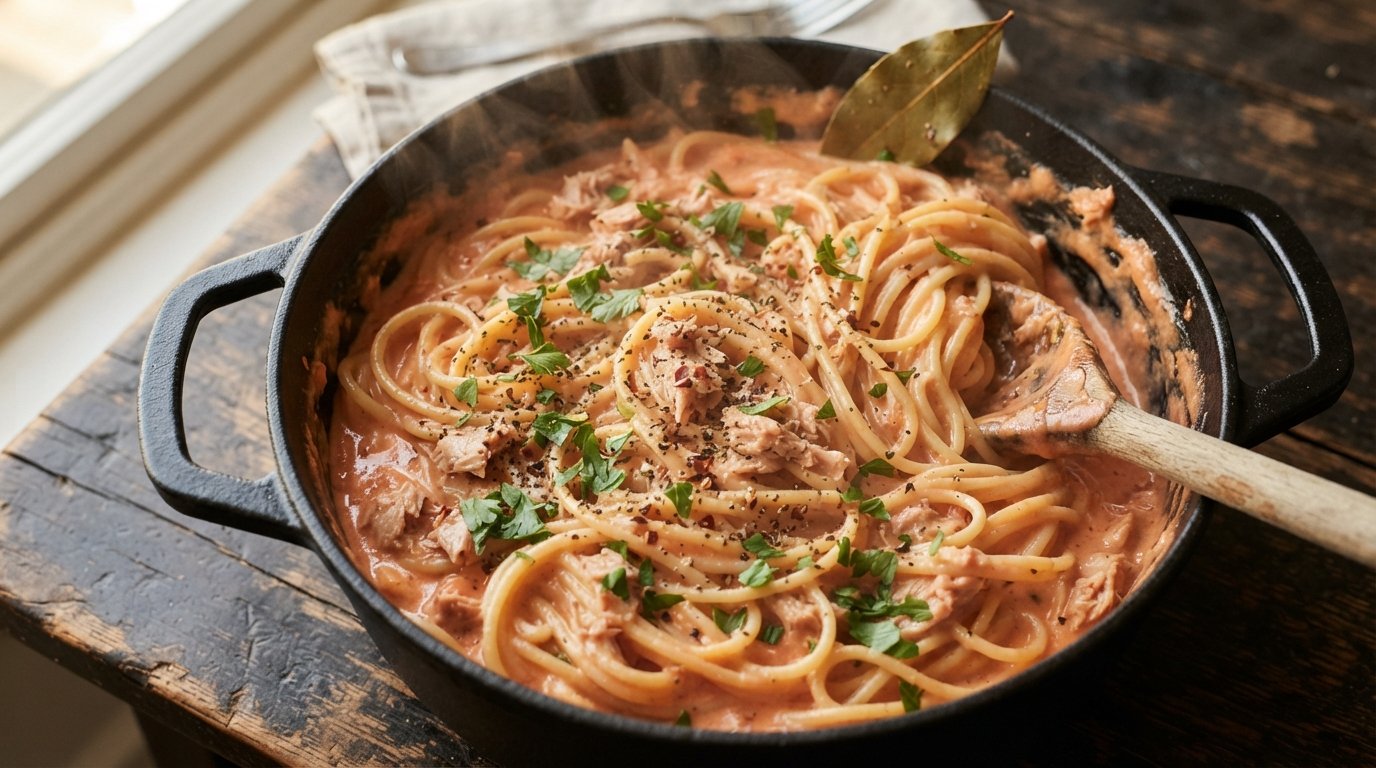
One Pot Tuna Pasta — The Order You Add the Cream Decides Everything
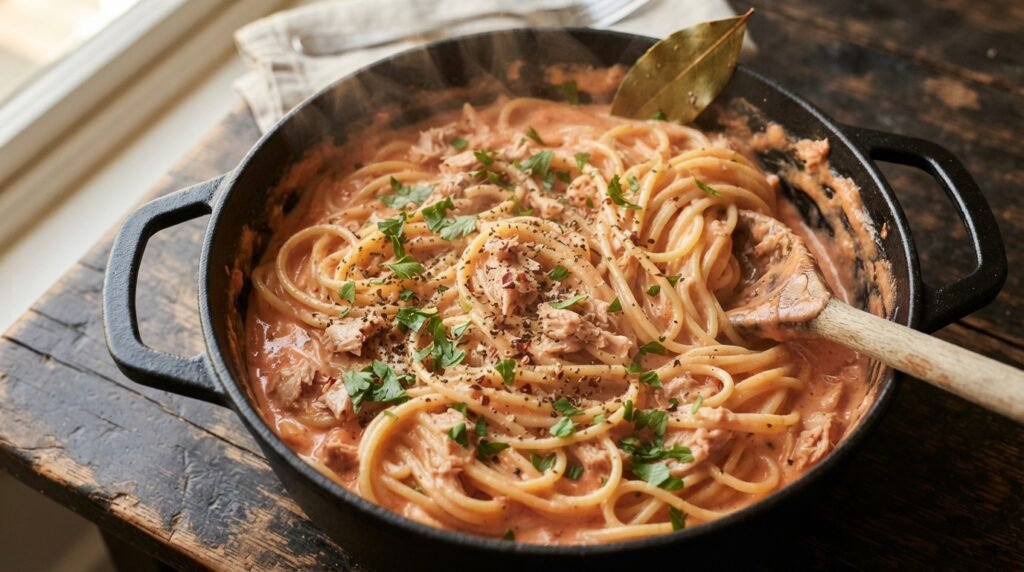
One pot tuna pasta is the best argument the store cupboard has. Two tins, some spaghetti, an onion, and twenty minutes later you have a creamy, tomato-rich dinner and exactly one pan to wash.
But there’s a version of this recipe going around that will eventually betray you, and when it does you’ll have no idea why.
It tells you to pour the cream and the tomato in together at the start, then bring the whole pot to the boil and cook the pasta in it. Most of the time that works. Some of the time you lift the lid to grey, grainy flecks floating in a thin pink liquid — a split sauce, unfixable, dinner gone.
You don’t have to take that bet. The fix costs nothing, changes nothing about the flavour, and keeps it a genuine one-pot.
The 40-Second Answer
One pot tuna pasta cooks spaghetti directly in a tomato base with hot water, so the pasta’s own starch thickens the sauce and nothing needs draining. Add the cream at the end, off the heat, once the pasta is al dente — boiling cream with acidic tomato is what causes the sauce to curdle. Fold the drained tuna in last.
Key Takeaways
- Cream goes in last, off the heat. Cream + tomato acid + rolling boil = split sauce.
- Cook the pasta in water and tomato. The starch is what makes it creamy, before any cream arrives.
- Rest it 5 minutes before serving. This is where soupy becomes velvety.
- Drain the tuna properly and fold it in at the very end. It’s already cooked.
- Stir often. No colander means nothing is stopping the spaghetti welding to the base.
Why One Pot Pasta Works At All
Normally you throw the best part away. Pasta cooks in water, that water fills with released starch, and then you tip it down the sink and try to rebuild the same effect with cream.
One-pot skips the loss. The pasta cooks in a measured amount of liquid that it partly absorbs and partly thickens, and by the time it’s al dente that liquid has become the sauce. It isn’t a shortcut in the pejorative sense — it’s a different mechanism, and it’s why one-pot pasta gets creamy before you’ve added a drop of dairy.
Which is exactly why the dairy doesn’t need to be there for the ride.
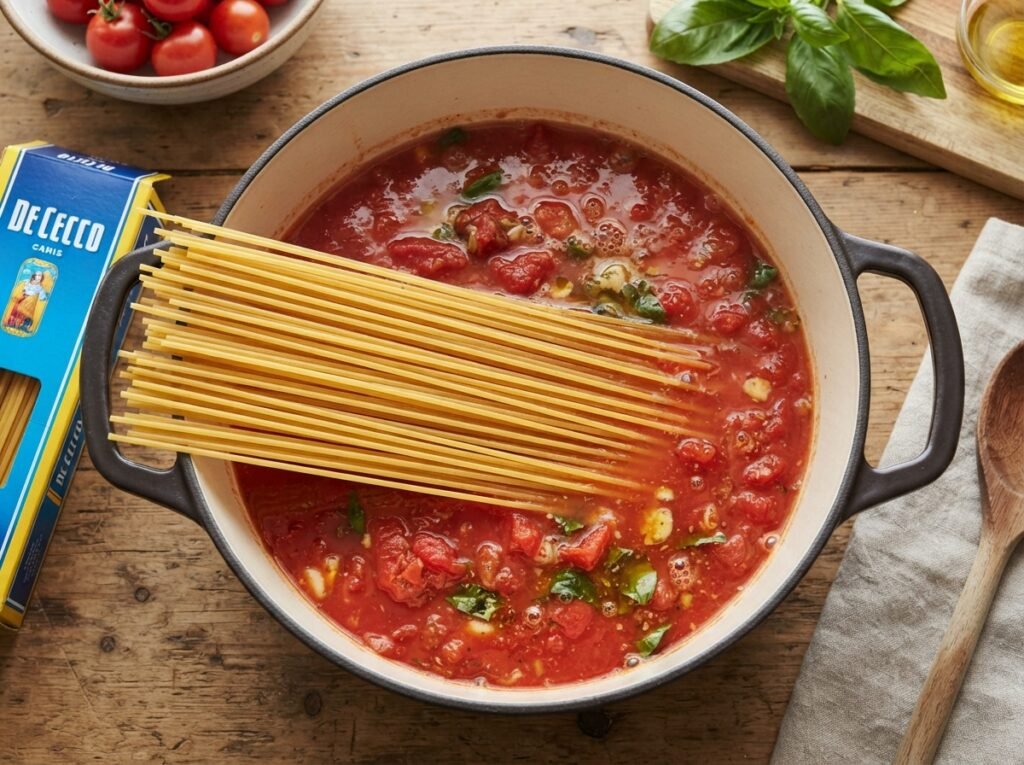
The Cream Problem — Explained Properly
Here’s the science, and it’s worth thirty seconds because it applies far beyond this recipe.
Cream is an emulsion: fat suspended in water, held stable by casein proteins. Those proteins are robust under normal cooking. They are not robust against acid and aggressive heat arriving together.
<cite index=”43-1″>The proteins in cream are highly sensitive to sudden change, and when they meet boiling acid their protective outer layers strip away almost instantly, causing them to curdle.</cite> Tomato is acid. A one-pot at a rolling boil is aggressive heat. Put them together for twelve minutes and you’re running a slow experiment on your own dinner.
Two things are true at once here, and I’m not going to overstate the risk:
Higher-fat cream is fairly tough. <cite index=”45-1″>Dairy with a higher fat percentage — heavy cream, double cream — is much less likely to curdle over heat; you could nearly boil it straight and it would mostly just thicken.</cite> German Schlagsahne sits around 30–32% fat, which is decent armour. This recipe often survives.
But “often survives” is a strange thing to build a dinner on. Because the failure is terminal: <cite index=”43-1″>once a sauce has actually split, bringing it back to a proper emulsion is extremely difficult</cite>. There’s no recovery step. You either got away with it or you didn’t.
And now the part that convinced me. Look at what everyone who does this professionally actually does.
The closest recipe to this one on the English internet — one pan, tomato, tuna, creamy — <cite index=”52-1″>boils the pasta in hot water and chopped tomatoes, and only stirs the crème fraîche in afterwards</cite>. A one-pot tuna pasta with a decade of reviews behind it <cite index=”53-1″>cooks the pasta first and stirs in the milk or cream at the end, with the mustard and lemon</cite>. And the one recipe that does put dairy in from the start uses <cite index=”51-1″>milk with no tomato at all, and explicitly instructs you to keep it lightly bubbling and never at a rolling boil</cite>.
Every developer who combines tomato and dairy adds the dairy last. The one who adds dairy early removes the acid. Nobody does both and boils it.
That’s not a coincidence. That’s a rule everyone learned the hard way and nobody bothered to write down.
Ingredients
Serves 5–6
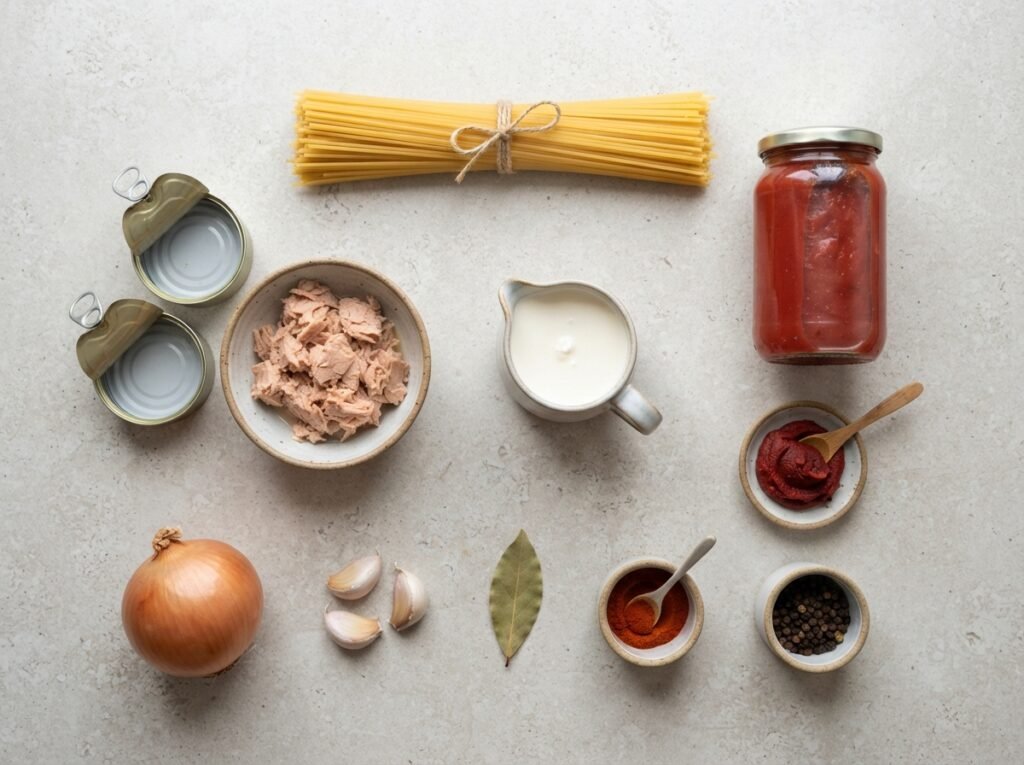
- 500g spaghetti
- 2 tins tuna, drained
- 1 tbsp tomato paste
- 1 medium-large onion, finely diced
- 2–3 garlic cloves, crushed
- A little oil, for frying
- 300ml tomato sauce or passata
- 500ml cream
- 2 tsp sweet paprika
- 1 bay leaf
- Around 1 litre hot water
- Fish stock or salt, to taste
- Black pepper, to taste
- Optional: a pinch of sugar
A word about the tuna, since it’s the title ingredient and every recipe on this subject gives it one line.
Drain it properly, and fluff it. <cite index=”51-1″>Draining thoroughly and fluffing with a fork gets it distributed evenly</cite> instead of arriving as three wet clumps. Undrained tuna also dumps its packing liquid straight into a sauce you’ve spent twenty minutes getting right.
Oil, water or brine? All three work here. Oil-packed has the most flavour and the richest texture. Spring water is lighter and lets the tomato lead. Brine is the saltiest — if you use it, hold back on the salt until you’ve tasted at the end.
Check the label. <cite index=”52-1″>Look for tuna that’s certified sustainable, pole-and-line caught, or responsibly sourced — that’s the environmentally sound choice</cite>, and in the UK you’ll typically find 145g tins, so two is right for this quantity.
On the sugar: a pinch with the tomatoes is <cite index=”52-1″>a standard move in this style of one-pot</cite>, and it’s doing double duty here — it rounds the tomato’s edge, and slightly taming the acidity gives your cream an easier landing later.
Step 1: Build the Base
Soften the onion and garlic in a little oil until translucent.
Then add the tomato paste and fry it for a minute or two. Not stir-and-move-on — actually cook it, until it darkens a shade and stops smelling sharp and raw. Tomato paste is concentrated and it needs heat to convert from tinny to savoury. This is a ten-second decision that shows up in every mouthful.
Add the tomato sauce or passata, the paprika, pepper, the bay leaf, and the pinch of sugar if you’re using it.
Step 2: Cook the Pasta — In Water, Not Cream
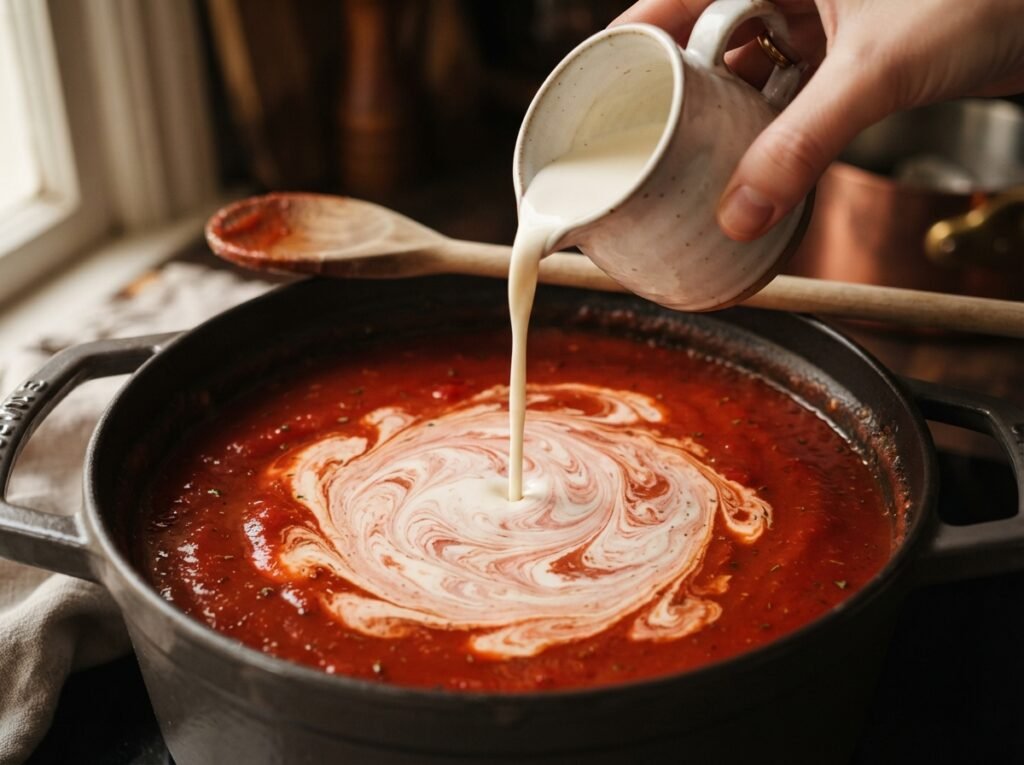
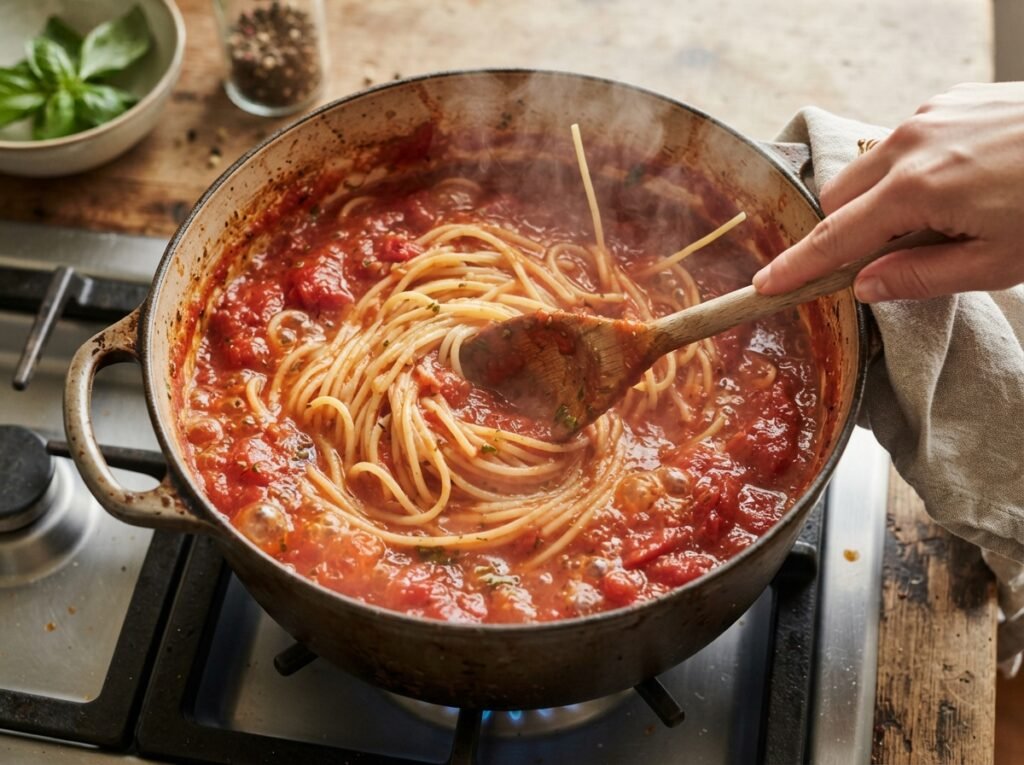
Add the spaghetti — broken in half if your pot demands it — and pour over roughly a litre of hot water. Stir in the fish stock or salt.
Bring it to the boil, then drop to a medium simmer and cook for the packet time, around 8–12 minutes.
Note what’s absent: the cream. This is the whole change. The pasta cooks in water and tomato, which is exactly what a one-pot is supposed to be, and the sauce thickens from released starch rather than dairy. <cite index=”52-1″>Cook at a steady boil, stirring regularly, until the pasta is tender and nearly all the liquid has gone.</cite>
Stir often, and mean it. There’s no colander here — anything that catches on the base stays there and burns. Spaghetti in particular will bond to the bottom of a pot the moment your back is turned.
The litre is a starting point, not a law. Brands absorb differently, pot widths differ, and evaporation rates vary. If it’s drying out before the pasta’s done, add hot water in splashes. If it’s swimming at al dente, let it bubble uncovered for a minute or two. You’re aiming for a little more liquid than looks right, because the cream is still to come and the rest will thicken it further.
Step 3: The Cream — Off the Heat
Once the pasta is al dente, take the pot off the heat. Let it settle for a moment. Then stir the cream through.
If you want to be properly careful, temper it: spoon a ladle of the hot sauce into the cream, stir, then pour that back into the pot. <cite index=”45-1″>Don’t just tip cold cream into the pot — warm it with a few spoonfuls of the hot sauce first.</cite> <cite index=”43-1″>Tempering is the professional solution to this problem, it needs no equipment, and it’s the only genuinely reliable method.</cite>
It takes fifteen seconds and it removes the last of the risk.
Fish out the bay leaf. Fold in the drained tuna and let the residual heat warm it through — it’s already cooked, you’re not cooking it again.
Taste. Adjust salt and pepper now, at the end, once everything’s in.
Step 4: Let It Rest — Don’t Skip This
Five to ten minutes, off the heat, before it hits the bowls.
This is the least glamorous instruction in the article and possibly the most useful. Right now the sauce looks loose and you’ll be tempted to panic. Don’t. <cite index=”53-1″>Let the pasta rest for five to ten minutes — it thickens up and turns properly creamy.</cite>
Starch continues to swell and set as it cools slightly. The pasta absorbs a final measure of liquid. What was soupy becomes glossy. Serve it straight off the hob and you’ll be eating pasta in soup and wondering what you did wrong; wait five minutes and it’s the dish you were promised.
Almost nobody mentions this. It’s a free upgrade.
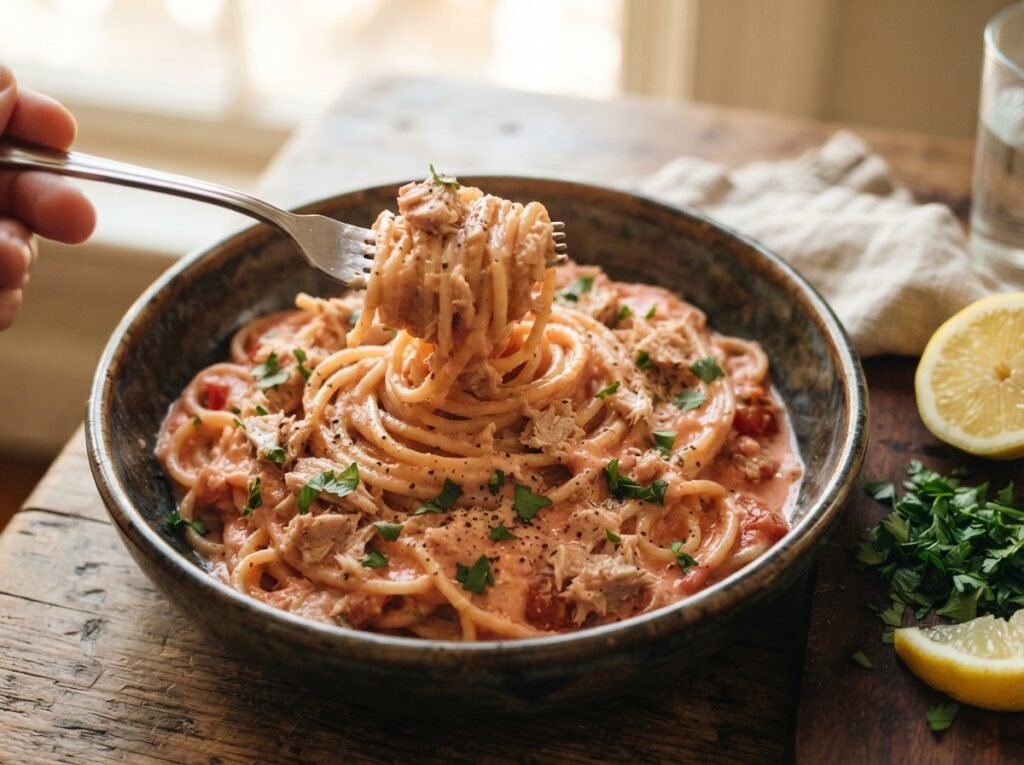
Serve hot, with chopped parsley or a squeeze of lemon. The lemon is genuinely worth it — <cite index=”53-1″>it’s delicious drizzled over individual servings</cite>, and against a cream-and-tomato base it’s the only bright note in the dish.
The Honest Assessment
This is cheap, fast, and about as pantry-friendly as dinner gets. Two tins and a bag of spaghetti is a meal for five or six people, and the ingredients keep for a year.
It’s also 500ml of cream. Let’s not pretend that’s a light dinner. If you want it lighter, the source’s own suggestion is sound: swap some or all of the cream for milk, or go half cream and half stock. Be aware of the trade — <cite index=”45-1″>lower-fat dairy curdles more readily than cream does</cite>, so if you go that route the off-the-heat rule stops being optional and becomes essential. Crème fraîche is the smartest swap of all: it’s what the closest competitor uses, it’s more stable in acidic sauces than cream is, and it brings a tang that cuts the richness.
On the ratio: 500g of spaghetti to two tins of tuna is honest for five or six portions, but it’s not a tuna-forward dish — it’s a tomato-cream pasta with tuna through it. If you want the fish to lead, add a third tin. The comments on similar recipes are full of people who did exactly that and were glad.
Who This Doesn’t Work For
- You want it light. 500ml of cream. There’s no reading of this that’s light.
- You want to reheat it tomorrow. It’ll be fine but not great — dairy sauces reheat sulkily and thicken hard in the fridge. Loosen with a splash of milk over low heat. Don’t microwave it on full and expect grace.
- You dislike canned tuna. The dish is 60% tomato-cream sauce, but the tuna is unmistakably there.
- You’re cooking for two. Halve it. 500g of spaghetti is a lot of spaghetti.
- You want to walk away from the pan. You can’t. Unstirred one-pot pasta welds itself to the base.
Troubleshooting
“My sauce went grainy and split.” Cream met acid at a boil. It’s not recoverable — off the heat, whisking in a splash of starchy water is the only long shot, and prevention is the real answer. Next time: cream last, off the heat, tempered.
“It’s soupy.” You didn’t rest it. Five minutes. If it’s still loose after that, you overshot the water — bubble it uncovered for a minute.
“It’s claggy and dry.” Not enough water, or you rested it too long. A splash of hot water over low heat brings it back.
“The spaghetti stuck to the bottom and burnt.” Not stirred enough. There’s no colander to save you here.
“It tastes flat and a bit tinny.” Undercooked tomato paste. Give it two full minutes in the pan next time. It’s the single biggest flavour lever in the recipe.
“The tuna disappeared.” It went in too early and broke up, or two tins across 500g of pasta was always going to be subtle. Fold it in at the very end, gently, and consider a third tin.
The Verdict
One pot tuna pasta deserves its reputation. It’s fast, it’s cheap, it uses things you already own, and the starch mechanic means it gets creamy honestly rather than by brute force.
The version circulating just makes one unnecessary bet. Cream and tomato at a rolling boil is a coin-flip you never needed to call — and every experienced recipe developer on the internet quietly avoids it, even if none of them tell you why.
Cook the pasta in water and tomato. Cream at the end, off the heat. Tuna last. Rest five minutes.
Same pot. Same twenty minutes. No coin flip.
7. FAQ
Why did my tuna pasta sauce curdle?
Cream met tomato acid at a rolling boil. The casein proteins in cream are stripped by hot acid and separate from the fat, leaving grainy flecks in a thin liquid. A split sauce is very difficult to bring back, so the answer is prevention: cook the pasta in water and tomato, then stir the cream in at the end with the pot off the heat.
Can you put cream in one pot pasta?
Yes, but add it at the end rather than cooking the pasta in it — especially in a tomato-based recipe. Higher-fat creams are reasonably stable and often survive a simmer, but combining acid with prolonged aggressive heat is the riskiest configuration and there’s no benefit to it. The pasta’s own starch does the thickening anyway.
How much liquid do you need for one pot pasta?
Roughly a litre of hot water for 500g of pasta, plus your tomato base, is a reliable starting point. Treat it as a guide rather than a rule — brands absorb differently and pans evaporate at different rates. Add hot water in splashes if it dries out early, and bubble it uncovered briefly if it’s still loose at al dente.
Should you drain canned tuna for pasta?
Yes. Drain it thoroughly and fluff it with a fork so it distributes evenly instead of clumping. Undrained tuna releases its packing liquid into a sauce you’ve just balanced. Oil-packed gives the richest flavour, spring water is lighter, and brine is saltiest — if using brine, season at the end.
When should you add tuna to one pot pasta?
At the very end, off or nearly off the heat. Canned tuna is already cooked, so it only needs warming through. Adding it early makes it break down and disappear into the sauce, which defeats the point of the dish.
Why is my one pot pasta soupy?
Almost always because it was served immediately. Resting it for five to ten minutes off the heat lets the starch set and the pasta absorb the last of the liquid, turning a loose sauce velvety. If it’s still thin after resting, simmer it uncovered for a minute or two.