Mince and Potato Bake — Most Recipes Name the Wrong Potato
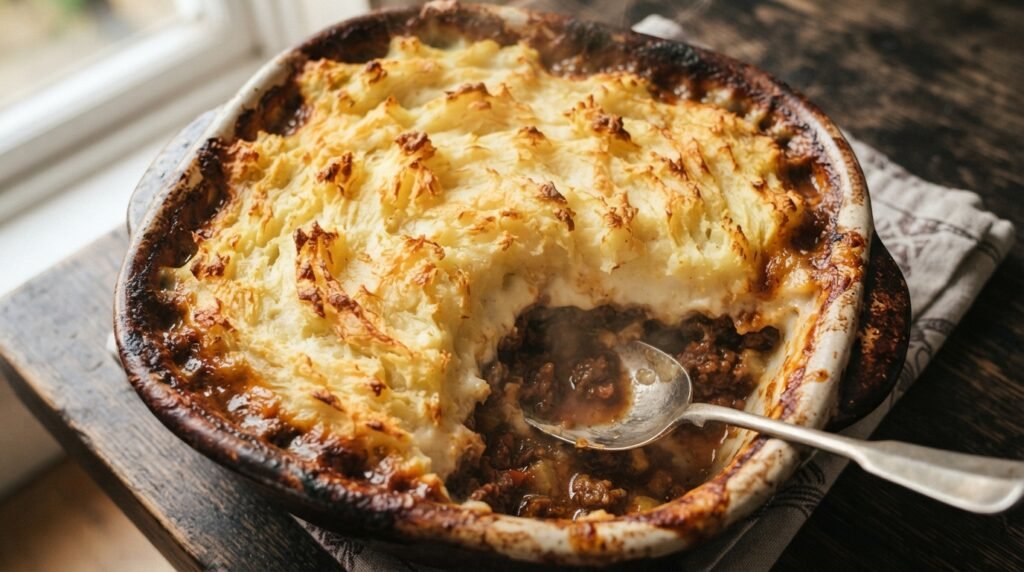
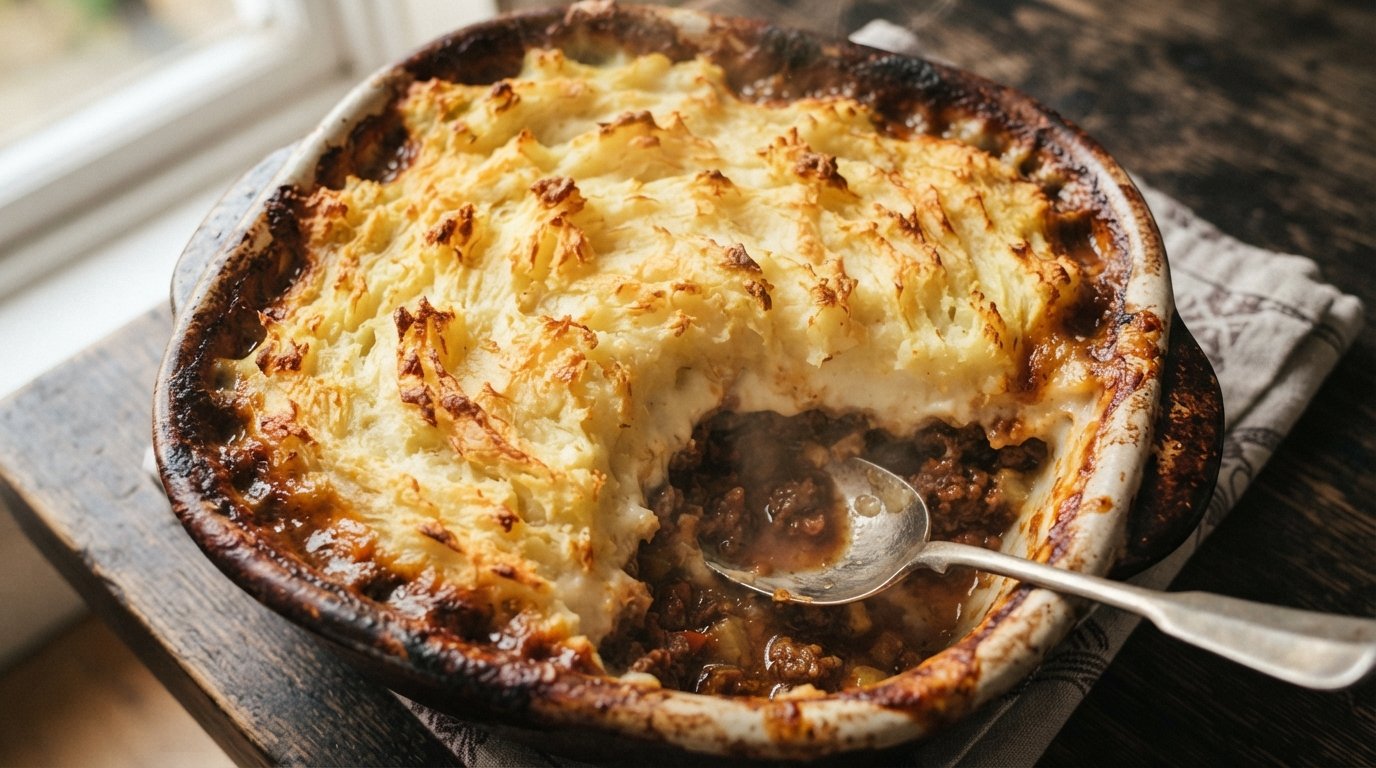
A mince and potato bake is seasoned beef under a béchamel, under a mash, baked until the top goes golden. It feeds four, children eat it without negotiation, and the whole thing is built from things you already own.
It also fails at the shopping stage more often than at the cooking stage — and the recipe going around gets the very first ingredient wrong.
It says waxy potatoes. For a mash.
Waxy potatoes are, specifically and by definition, the potatoes that don’t mash. That’s not a preference. It’s what the word means.
The 40-Second Answer
A mince and potato bake layers seasoned beef mince, béchamel and mashed potato, baked until golden. Use floury or all-rounder potatoes for the topping, never waxy ones — waxy potatoes are low in starch and hold their shape, so they turn gluey or chunky instead of fluffy. All-rounders are the best choice here because the mash has to hold up in the oven.
Key Takeaways
- Don’t use waxy potatoes. They’re built to resist mashing. That’s their whole job.
- All-rounders beat floury ones for this dish — floury is best for mash on a plate, but this mash gets baked.
- Mash them while they’re hot. Let them cool and you get glue.
- Don’t overwork it. The other route to gluey mash, and it’s faster than you think.
- The béchamel isn’t optional decoration. It’s what stops the mince drying out under a sealed lid.
Waxy, Floury, All-Rounder: What the Words Mean
Potatoes sort into two camps and one useful middle.
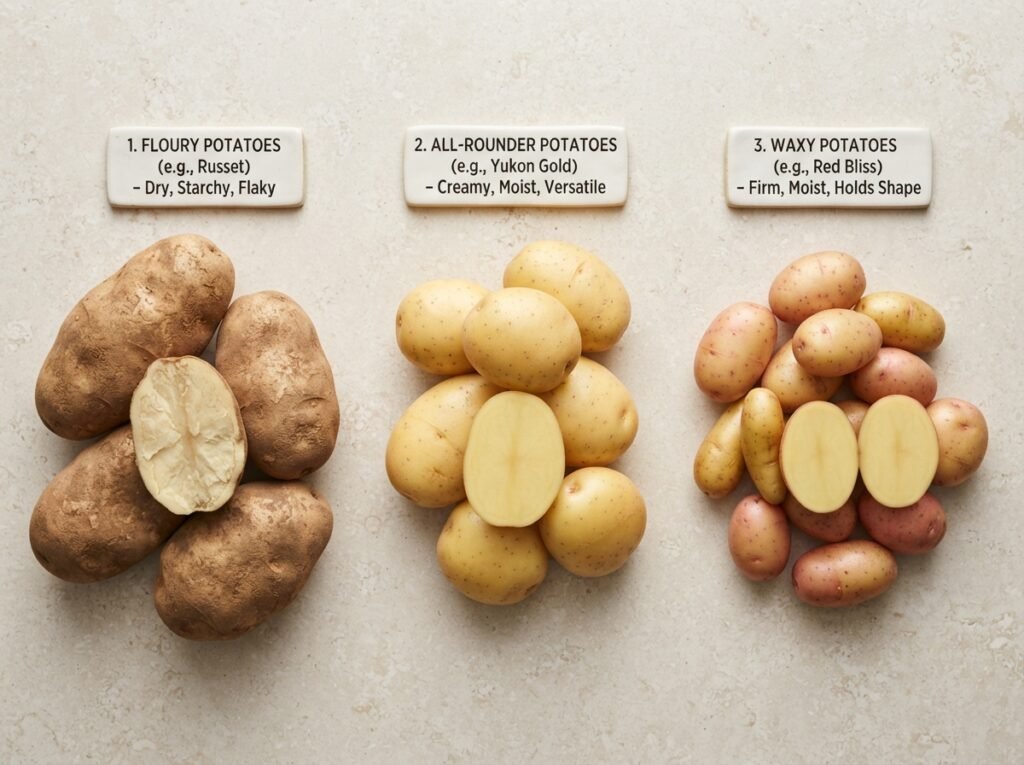
Floury (or starchy) potatoes are high in starch and low in moisture. <cite index=”102-1″>Their starchy flesh breaks apart more easily than waxy varieties, which is what makes them ideal for fluffy, soft mashed potatoes.</cite> Think Russet, King Edward, Maris Piper. <cite index=”100-1″>They need to be cooked to come into their own, and their flouriness means they fall apart easily — but it also means they absorb flavour better than waxy potatoes.</cite>
Waxy potatoes are the opposite: low starch, high moisture. <cite index=”98-1″>They hold their shape when cooked and don’t break apart easily.</cite> Charlotte, Red Bliss, fingerlings, new potatoes.
And then the middle. <cite index=”101-1″>Some varieties hold both waxy and firm qualities — these make great all-rounders, and they tend to have the creamy consistency needed for a smooth mash.</cite> Yukon Gold, Desiree, Maris Peer.
Now the part that matters. <cite index=”97-1″>Try to mash waxy potatoes and you’ll be met with disappointment — they turn gluey, and their stubbornness renders them unfit for the fluffy embrace of a proper mash.</cite> <cite index=”103-1″>Waxy potatoes are not good for mashing because they hold their form and produce a chunky mash.</cite>
That’s the source recipe’s first ingredient. <cite index=”101-1″>Sick of gluey mash? You might be using the wrong type of spud.</cite>
So Use Floury? Not Quite — And Here’s Where It Gets Interesting
The obvious correction is “use floury potatoes instead,” and if you were making mash for a plate that would be the end of it. <cite index=”100-1″>If you want fluffy mashed potatoes, you definitely want floury potatoes.</cite>
But you’re not making mash for a plate. You’re making a lid. It’s going in the oven, under heat, on top of a wet filling, and it has to hold together while it browns.
That changes the question, and almost nobody asks it — because the potato guides are written about mash, and the bake recipes just say “potatoes.”
Two complications are worth knowing.
First, floury potatoes aren’t automatically safe. <cite index=”103-1″>Starchy potatoes can be mashed but are susceptible to becoming stodgy when overworked</cite> — and the same source warns to <cite index=”103-1″>avoid using starchy potatoes in dishes that require boiling, roasting or slicing, like casseroles, potato bakes and gratins, because they don’t hold together very well when cooked.</cite> That warning is about sliced potatoes rather than mash, so don’t over-apply it. But the instinct behind it is sound: a bake asks for structure.
Second, there’s a genuine minority view on the floury orthodoxy. <cite index=”100-1″>Mashed potato is traditionally made from floury potatoes, although there are chefs who say that waxy potatoes give a better, smoother mash.</cite> And one mash-focused source picks the all-rounder outright: <cite index=”98-1″>Yukon gold potatoes have a wonderful creamy, buttery texture without being too waxy, which makes them great for mashed potatoes.</cite>
So: all-rounders. They’re the answer to a question the two camps aren’t having. Creamy enough to mash smoothly, sturdy enough not to slump under béchamel and heat. <cite index=”101-1″>Red-skinned potatoes with a fairly waxy texture work well as an all-rounder — their creamy yellow flesh makes a good mash.</cite>
Yukon Gold, Desiree, Maris Peer. If your shop only has two options, floury still beats waxy comfortably — the failure mode of floury (stodgy if overworked) is one you control, and the failure mode of waxy (gluey by nature) isn’t.
If you want the best of both, there’s a hedge: <cite index=”98-1″>half Yukon Gold and half Russet gives you the fluffier lighter texture with the creaminess.</cite>
Ingredients
Serves 4
Mashed potato:
- 1kg potatoes — all-rounder or floury, not waxy
- 250ml milk
- 100g butter
- Salt, pepper, nutmeg
Mince:
- 500g beef mince
- 1 onion
- 1 garlic clove
- Salt, pepper
- Oregano, paprika
Béchamel:
- 300ml milk
- 50g butter
- 2–2.5 tbsp flour
- Salt, pepper, nutmeg
On the béchamel quantities: taste and check the consistency as you go rather than trusting the numbers blindly. A roux is conventionally equal parts butter and flour by weight, and this leans fat-heavy against that, so if your sauce comes out loose or greasy, add flour a teaspoon at a time or pull the butter back. Sauces are forgiving if you’re paying attention and unforgiving if you’re not.
On the nutmeg — appearing twice is not a typo. It’s in the mash and the béchamel, and it should be. Nutmeg is the traditional partner to both dairy and potato in German cooking and it’s doing the same job in both places: it stops a very rich, very pale dish tasting flat. Use it in both. Grate it fresh if you can.
Step 1: The Mash — Timing Is the Whole Thing
Peel and cut the potatoes, then boil them in well-salted water. <cite index=”100-1″>Use a big enough pan, pour in water so it just covers the potatoes, add about a teaspoon of salt per litre, and bring to the boil at high heat. Turn the heat down once it boils — it should boil but not madly. Estimate about 20 minutes. They’re ready when you prod them with a skewer and feel no resistance.</cite>
Drain them. Then mash them immediately.
This is the single most important instruction in the recipe and the source doesn’t mention it: <cite index=”100-1″>always make the mash at once while the potatoes are warm — if you put them aside for a moment, your mash will be gluey. The same goes for purée.</cite>
There is no waiting. Drained potatoes cool fast, the starch sets as they do, and cold potato mashes into paste. If you’re going to prep anything ahead, prep the mince — never the potatoes.
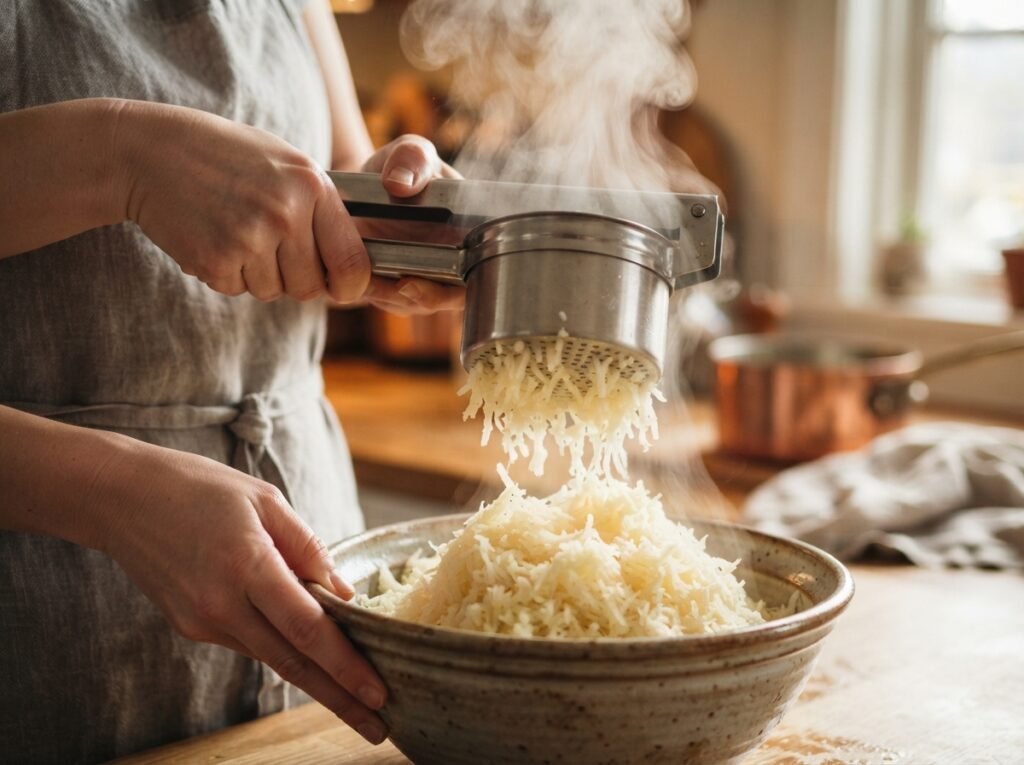
Then butter and milk, seasoning, nutmeg. <cite index=”100-1″>Mash with a masher, add the butter, pour in some milk — be careful with the milk so the mash isn’t too runny — then season and beat until light and airy.</cite>
Don’t overwork it. This is the second route to glue and it’s independent of which potato you bought. <cite index=”98-1″>It’s important not to over-mash starchy potatoes, or they can get gummy and pasty due to their high starch levels.</cite> Every stroke past “smooth” releases more starch and takes you closer to wallpaper paste. Stop early.
The tool matters more than people think. <cite index=”98-1″>A potato ricer is the perfect tool for high-starch potatoes</cite> — <cite index=”98-1″>it keeps their airy texture while breaking them down.</cite> If you own one, this is what it’s for. If you don’t, a masher and restraint will do. A food processor will not: it’s a starch-destruction machine and it will hand you glue in about nine seconds.
A note on the butter. 100g for 1kg of potatoes looks extravagant and it’s within normal range for a proper purée. It’s also, along with the milk, what keeps the topping from drying out under oven heat. Don’t cut it and then wonder why the crust is dusty.
Step 2: The Mince
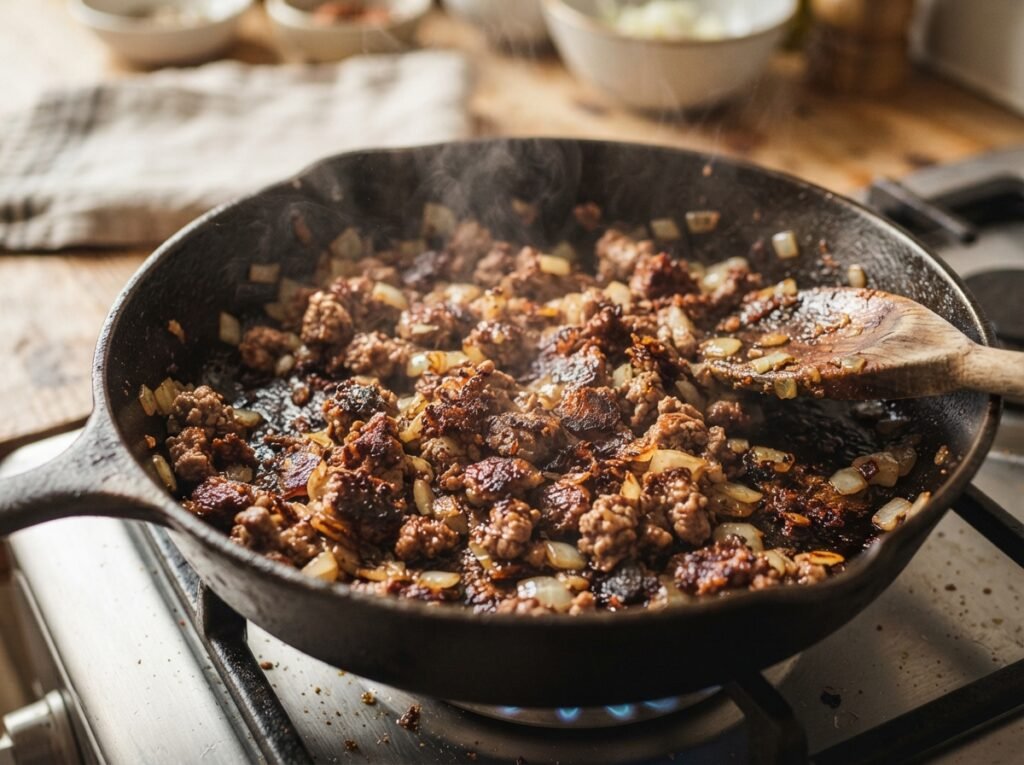
Dice the onion finely and mince the garlic. Soften the onion in a hot pan, add the garlic for the last thirty seconds, then add the beef.
Brown the mince properly. Hot pan, don’t crowd it, don’t stir it constantly. Let it sit and catch colour before you move it. Grey mince tastes like grey mince, and in a dish this pale and rich the browning is most of the savoury depth you’re going to get.
Season with salt, pepper, oregano and paprika.
Get the moisture right. This is the balance point of the whole bake. Too wet and it soaks the mash from below and you get a sludgy layer where the crust should be. Too dry and it’s sawdust under a lid. You want it juicy but not swimming — if there’s liquid pooling, let it bubble off before it goes in the dish.
Taste it now. Once it’s under two other layers you will never season it again. This is your only chance and everyone forgets.
Step 3: The Béchamel — And What It’s Actually For
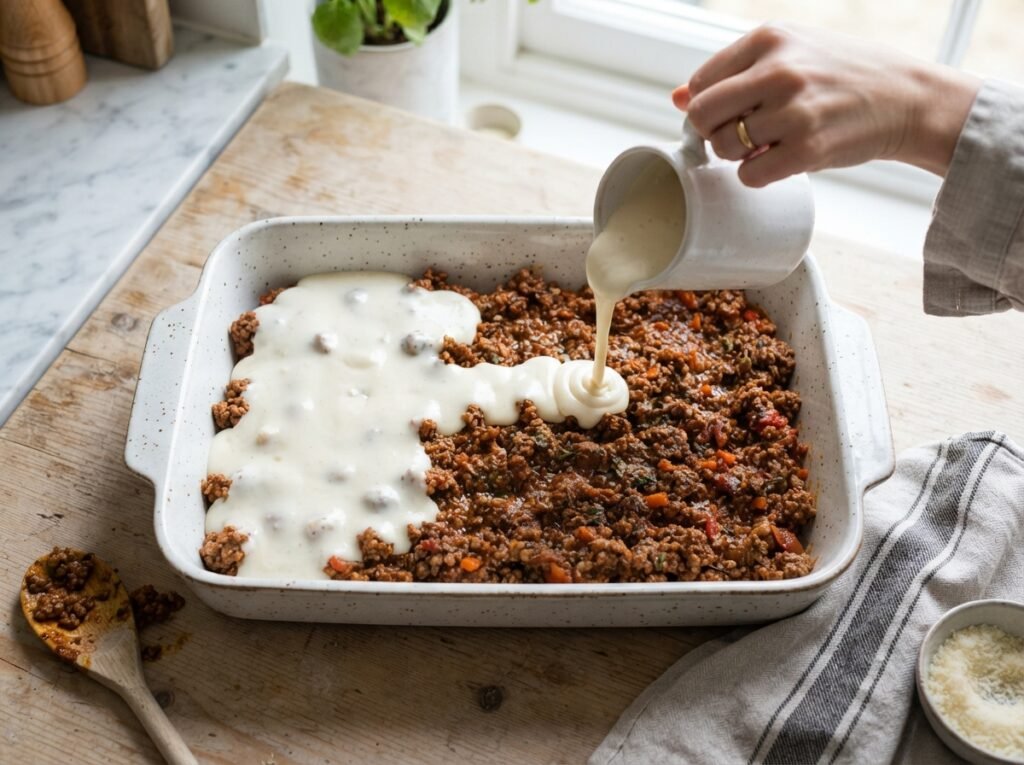
Melt the butter, whisk in the flour, cook the roux out for a minute or two until it stops smelling of raw flour. Then add the milk gradually, whisking, until smooth. Season with salt, pepper and nutmeg.
Why is there a béchamel at all? Worth asking, because a shepherd’s pie doesn’t have one — mince, mash, done. Adding a white sauce between the layers is a moussaka move, and it’s not decoration.
It’s insurance against dryness. A mash lid seals the dish. The mince underneath then bakes in a closed environment with nothing to keep it moist except its own juices, and lean beef doesn’t have many to spare. The béchamel is a reservoir. It keeps the middle of the bake succulent through a long oven session, and it’s what makes this different from — and honestly better than — a plain mince-and-mash.
It also does a second job: it’s the mortar. It binds a loose crumbly layer to a soft heavy one so the whole thing holds together on a serving spoon instead of collapsing into components.
Take the roux seriously. Cook the flour out. An undercooked roux tastes of raw flour and no amount of nutmeg hides it. A minute or two of gentle heat, whisking, until it smells nutty rather than floury.
Step 4: Layer and Bake
Mince on the bottom. Béchamel over it. Mash on top, spread to the edges and sealed against the sides of the dish.
Rough up the surface with a fork. Every ridge you make is a peak that browns. A flat mash top bakes pale; a scruffed one comes out golden and crisp in patches. This is a five-second decision with a large visual return, and it’s the difference between a bake that looks like a photograph and one that looks like a hospital.
Bake at around 200°C until the top is golden and the edges are bubbling — roughly 25–35 minutes, depending on your dish and how deep you built it.
Judge it by the edges, not the clock. You want to see the filling actively bubbling up at the sides. That tells you the middle is hot, which is the only thing the timer can’t.
Then rest it. Ten minutes out of the oven before you cut into it. It’s molten when it comes out and it will run off the spoon in three directions. Ten minutes and it sets enough to serve in squares instead of ladlefuls.
Feeding This to Children
This recipe comes from a children’s cooking series, and that framing is worth taking seriously rather than treating “serves 4” as the whole story.
It’s a genuinely good kids’ dinner and the reasons are structural. There’s nothing to pick out — no visible onion once it’s diced small, no herbs to negotiate with, no texture surprises. The flavours are mild and familiar. And it’s one of the few ways to get a full portion of beef into a child who has opinions about beef, because it arrives under mashed potato rather than as a recognisable lump of meat.
Two small adaptations if you’re cooking for younger eaters:
Go easy on the paprika. It’s the only assertive flavour in the dish and a heavy hand turns it from savoury to spicy in a child’s mouth. Start at half and taste.
Grate the onion instead of dicing it. Diced onion still has texture. Grated onion disappears entirely into the mince and does its job invisibly. Nobody finds it. Nobody complains.
And the honest note: this is 100g of butter, 550ml of milk and a béchamel. It’s a comfort dinner, not a light one, and there’s nothing wrong with that — but it’s a Tuesday-in-February dish, not an every-week one.
Who This Doesn’t Work For
- You only have waxy potatoes. Genuinely, buy different potatoes. This is the one ingredient you can’t work around.
- You want it quick. Boiling 1kg of potatoes, browning mince, making a sauce and baking for half an hour is not a fast dinner. It’s a good weekend-cooking, weeknight-eating dish — the assembled bake keeps in the fridge and goes in the oven cold.
- You’re avoiding dairy. Milk in the mash, butter in the mash, milk and butter in the béchamel. There’s nothing left.
- You want to skip the béchamel to save time. You can. You’ll have a shepherd’s pie, which is a fine dish, but it’s a different one and the mince will be drier.
- You’re making it ahead and reheating slices. It reheats well as a whole dish, poorly as portions. Cover it and go low.
Troubleshooting
“My mash was gluey.” Waxy potatoes, or you let them cool before mashing, or you overworked them. In that order of likelihood.
“My mash was stodgy and heavy.” Overworked floury potatoes. Stop at smooth. Use a ricer if you have one.
“The topping was dry and crusty all the way through.” Not enough butter and milk in the mash, or baked too long. It should be crisp on top and soft underneath.
“The mince underneath was dry.” No béchamel, or a béchamel that was too thin to survive the bake. It’s a reservoir — it needs body.
“It collapsed when I served it.” Didn’t rest it. Ten minutes.
“The top wouldn’t brown.” You spread the mash flat. Scruff it with a fork next time — ridges brown, flat surfaces don’t.
“The sauce was greasy and split.” Too much butter for the flour. Adjust the roux towards equal weights and cook it out properly.
The Verdict
This is a good family dinner built on one bad instruction. Everything else about it works — the béchamel is a genuinely smart addition that most mince-and-mash recipes don’t bother with, the nutmeg in both layers is correct, and the proportions feed four people properly.
But it starts by telling you to buy the one potato that cannot do the job it’s being asked to do. Waxy potatoes are engineered by nature to resist exactly what you’re about to do to them.
Buy all-rounders. Mash them hot. Stop when they’re smooth. Scruff the top.
Then it’s the dish it was always meant to be.
7. FAQ
What potatoes are best for a mashed potato topping?
All-rounders like Yukon Gold, Desiree or Maris Peer. They mash creamily but hold enough structure to survive being baked on top of a wet filling. Floury potatoes like Maris Piper or Russet are the classic mash choice and work well too, though they go stodgy if overworked. Avoid waxy potatoes entirely — they’re low in starch and hold their shape, so they turn gluey or chunky rather than fluffy.
Why is my mashed potato gluey?
Three causes. You used waxy potatoes, which resist mashing by nature. You let them cool before mashing — mash must be made while the potatoes are still hot, because cooled potato turns to paste. Or you overworked them, which releases too much starch, especially with floury varieties. A food processor will do this in seconds; a ricer avoids it entirely.
Can you use waxy potatoes for mash?
Not well. Waxy potatoes are low-starch and high-moisture and are specifically the ones that hold their shape when cooked, which produces a dense, gluey or chunky mash rather than a fluffy one. A minority of chefs argue waxy gives a smoother purée, but for a mashed topping that needs to be light and then baked, they’re the wrong choice.
What’s the difference between this and shepherd’s pie?
The béchamel. A shepherd’s pie is mince with a mash lid; this adds a white sauce between the layers, which is closer to a moussaka. It isn’t decoration — a mash lid seals the dish, so the mince underneath bakes with nothing to keep it moist. The béchamel acts as a reservoir and stops the filling drying out, and it binds the layers so the bake holds together when served.
How long do you bake a mince and potato bake?
Around 25 to 35 minutes at 200°C, until the top is golden and the filling is visibly bubbling at the edges. Depth matters more than the clock — judge it on the bubbling rather than the timer, since that’s what tells you the centre is hot. Rest it for ten minutes before cutting or it will run off the spoon.
Can you make a mince and potato bake ahead?
Yes, and it’s the best way to cook it. Assemble the whole thing, refrigerate it, and bake it from cold — add ten minutes or so to the time. It reheats well as a whole dish and poorly as individual portions. What you can’t prep ahead is the mash on its own; it has to be made and used hot.