How to Grill Sausages — The Fork Trick Everyone Does Is Drying Them Out
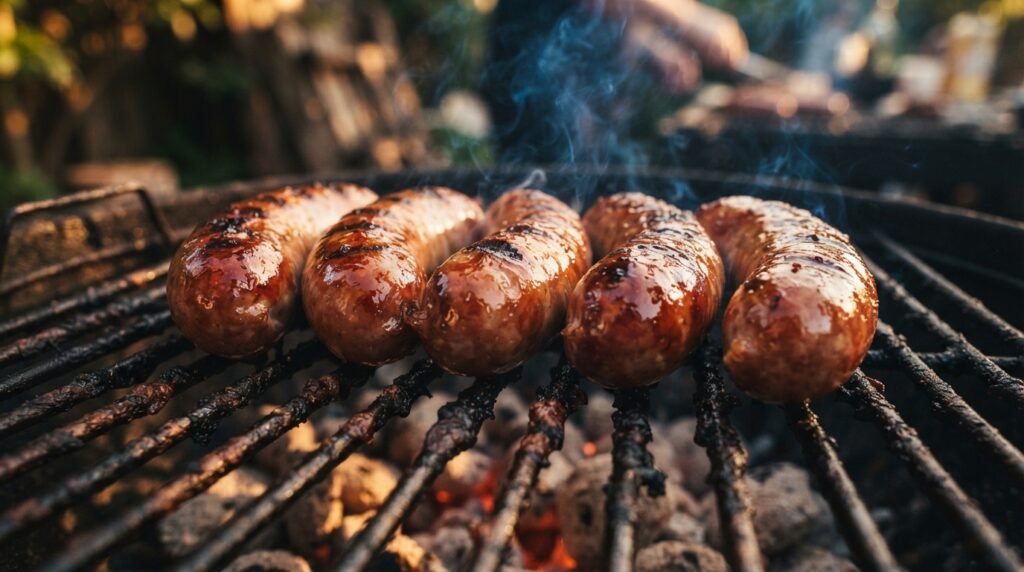
You’ve been told to prick your sausages before they hit the grill. Fork, a few holes, stops them bursting. Your dad did it, his dad did it, half the recipes online still say it.
It’s wrong. It’s been wrong for a long time, and it’s the single fastest way to turn a good sausage into a dry one.
Here’s the thing that gives the game away: the same recipes that tell you to prick them also tell you to avoid fierce direct heat because the sausages will burst. Both instructions, in the same list, two lines apart. One of them is the actual answer. The other is a superstition doing a costume change.
Sausages don’t burst because pressure builds up. They burst because your grill is too hot.
The 40-Second Answer
To grill sausages properly, don’t prick them — the casing is what holds the fat and juices in, and piercing it drains the flavour out. Start them over medium heat, turn them regularly, and finish briefly over direct heat for colour. Bursting is caused by heat that’s too high, too fast, not by internal pressure.
Key Takeaways
- Don’t prick them. The casing is doing a job. Puncture it and the fat leaves.
- Bursting is a heat problem, not a pressure problem. Medium first, direct heat last.
- Don’t grill them straight from the fridge. Cold sausage + hot grate = split casing.
- Turn them regularly. Uneven cooking is the other cause of splitting.
- One real exception: very high-fat sausages like chorizo. See below.
- Check the internal temperature — and know that the guidance genuinely varies by sausage type.
What the Casing Is Actually For
Start here, because once you understand the casing the rest of the argument makes itself.
<cite index=”90-1″>The casing is probably the secret to a great sausage — it doesn’t just keep the moisture in, it protects the texture and the flavour.</cite> It’s not packaging. It’s a component.
<cite index=”91-1″>The casing traps the food’s juices — water, fat, and the aromatic compounds — and those are exactly the elements that keep the meat tender and flavourful as it cooks.</cite> As the sausage heats, the fat melts and redistributes through the meat. The casing is what keeps it in there doing that.
Butchers have a word for this. <cite index=”90-1″>Traditional butcher’s-quality sausages are designed to self-baste</cite> — the fat renders, the casing holds it, and the sausage effectively cooks itself in its own juices. That’s the whole design.
Now put a fork through it.
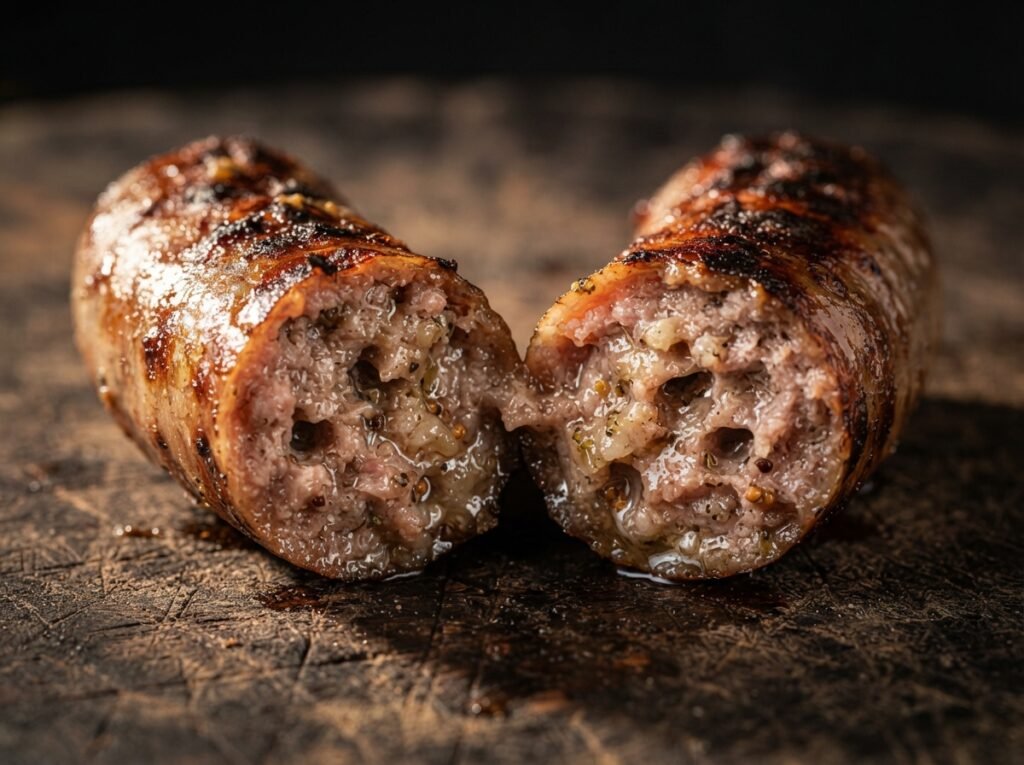
<cite index=”90-1″>When you pierce a sausage, those valuable juices escape and the fat that should be basting the meat leaves instead. The result is shrinkage and a dry eat.</cite> <cite index=”91-1″>Pricking removes much of the juice and fat, making the meat dry and flavourless</cite> — and it doesn’t stop there: <cite index=”91-1″>it also increases the risk of burning the surface.</cite>
You didn’t degrease the sausage. You drained it.
Why Sausages Actually Burst
So if pressure isn’t the problem, what is?
<cite index=”90-1″>The truth is it’s not a problem with the sausage — it’s a problem with the cooking. The common causes are a pan that’s too hot, sausages cooked straight from the fridge, or not being turned enough for an even cook.</cite>
Read that list again. Not one of those is fixed by a fork.
An expert view puts it even more plainly: <cite index=”89-1″>high heat is one of the main reasons sausages burst during cooking, and cooking them low and slow means you never need to prick them for fear of bursting in the first place.</cite> <cite index=”93-1″>The real reason sausages burst has to do with the temperature they’re cooked at.</cite>
And the pressure argument itself doesn’t hold up. <cite index=”91-1″>The internal pressure that develops is normal — if cooking is gradual and at a moderate temperature, the casing holds up without problems.</cite> The casing is built for it.
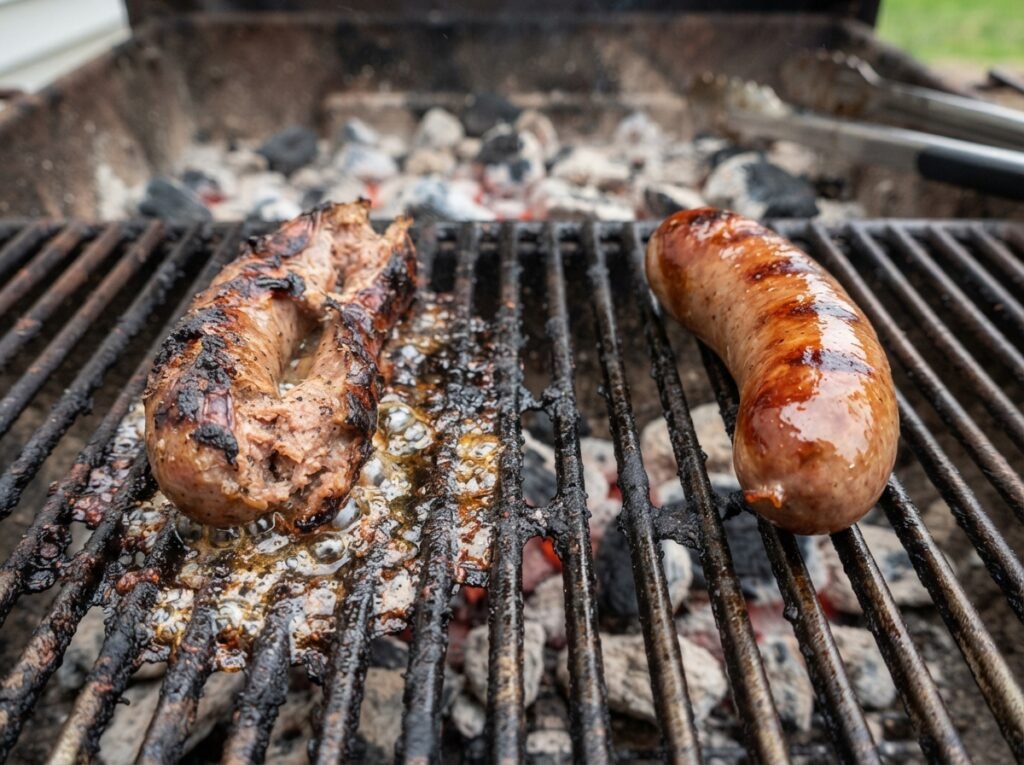
There’s a second-order problem too, and it’s the one that ruins the sausage next to yours. <cite index=”92-1″>When fat and juices drip out of a compromised casing and hit the flames below, the fire can rise up dramatically, covering your food in soot or even causing an injury.</cite> <cite index=”91-1″>Fat dripping onto the heat source causes flare-ups and localised overheating — you get a burnt exterior and a less evenly cooked interior.</cite>
So pricking doesn’t just dry the sausage. It creates the flare-ups that then char it.
Why the myth survives is worth thirty seconds, because it explains why your dad believed it and why you will struggle to stop doing it. <cite index=”91-1″>The error persists because it’s visually convincing — seeing the liquid drain out gives the impression of improving the result, when in fact essential components are being lost.</cite>
You watch the juice run out and it feels like something is working. That’s the trap. Something is working. It’s working against you.
How to Grill Sausages Properly
Now the method, which is short because the hard part was unlearning the fork.
1. Take them out of the fridge first. This is the most-skipped step and it’s free. <cite index=”90-1″>Bringing sausages out of the fridge early to come up to room temperature transforms them.</cite> A fridge-cold sausage hitting a hot grate is a thermal shock, and the casing is what pays for it.
2. Start over medium heat, not high. <cite index=”90-1″>Bursting comes from heat that’s too high, too fast — start gently on a medium heat.</cite> This is where the source recipe was already right: medium first, and avoid fierce direct heat. It just didn’t trust itself.
3. Turn them regularly. <cite index=”90-1″>Turn your sausages regularly to let the casing do its job.</cite> <cite index=”91-1″>Turning them is essential for distributing the heat evenly</cite> — and uneven cooking is one of the three causes of splitting.
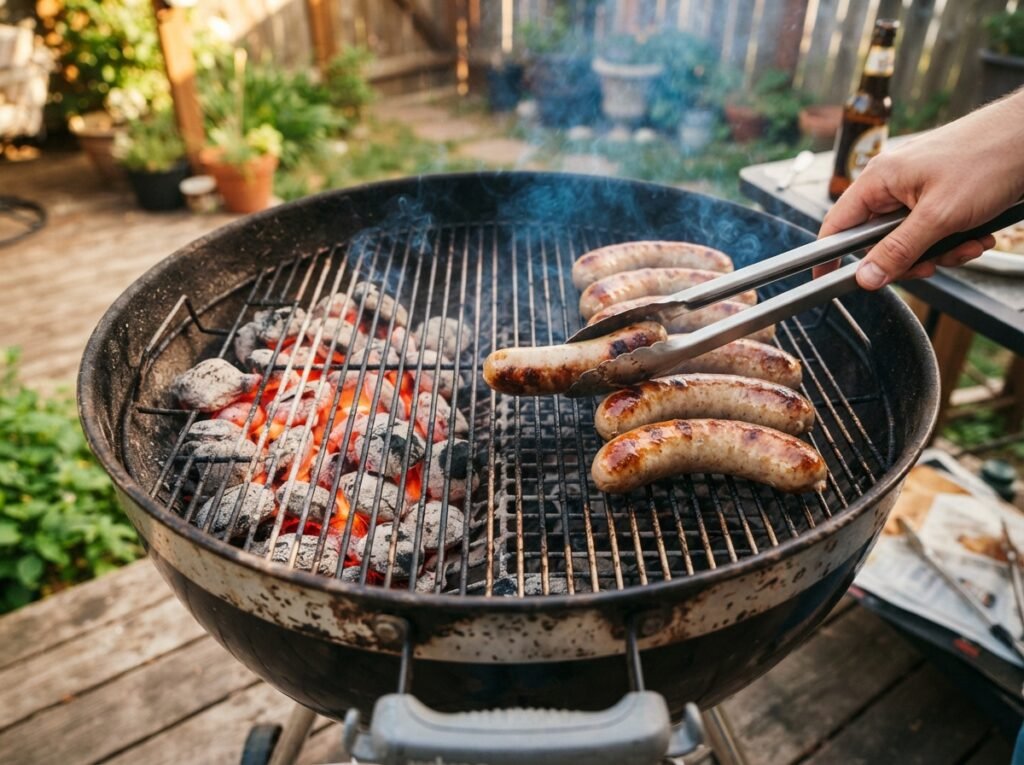
4. Use indirect heat, then finish direct. <cite index=”91-1″>When grilling, avoid direct contact with open flames — put the sausages in an area of indirect heat and turn them regularly.</cite> Then a short spell over direct heat at the end for colour and Maillard browning. Cook indirect, colour direct. Never the reverse.
5. Time it by thickness, then check. Around 6–12 minutes depending on thickness is the working range, and it lines up with the wider guidance — <cite index=”92-1″>on the grill, sausages should be fully cooked in about 10 minutes, though the time varies with size.</cite> Turn regularly until the skin takes colour evenly.
6. Judge it on the casing. Crisp outside, juicy inside. If the casing is blistered black and split, the heat was too high. If it’s pale and flabby, it needs longer somewhere gentler.
The Two-Stage Method (If You Want to Be Certain)
There’s a professional approach that removes most of the risk, and it’s the one to use if you’re cooking for people you want to impress.
<cite index=”89-1″>Place uncooked sausage in a foil pan with a small amount of water or beer and put it on the grill until it reaches an internal temperature of 145°F. Then take it out of the pan and put it on the grill to finish cooking and get the colour and snap you want.</cite>
This is the same logic behind the beer bath that bratwurst gets, and <cite index=”89-1″>this method of cooking sausages in flavourful liquid before grilling works for most types of sausage — the slow cooking in liquid infuses flavour and helps ensure the sausage doesn’t dry out.</cite>
<cite index=”93-1″>For the most precisely cooked sausages, par-poach them before finishing them off.</cite>
Gentle heat does the cooking. Direct heat does only the colour. The casing never has to survive a fight.
One caution on the liquid: <cite index=”91-1″>avoid water — it dilutes the juices too much and slows the browning. Deglaze with white wine, red wine or beer instead.</cite> The sources differ slightly here (one suggests water or beer, the other warns against water), so if you have beer, use beer.
The One Legitimate Exception
Everything above deals in absolutes and almost everything written on this subject does. There’s one honest exception, and only one source I found bothers to mention it.
<cite index=”89-1″>If you’re cooking a sausage that’s high and rich in fat — chorizo, for example — you might consider a small piercing to release some of the fat and let the sausage cook in its own juices.</cite>
That’s a narrow, specific carve-out from the same expert who otherwise says never to prick, and it’s worth knowing precisely because it isn’t a general licence. Very high-fat sausages carry more fat than the meat can absorb, and a single small pierce lets the excess out rather than the whole lot.
Note what it isn’t: it isn’t a fork, it isn’t “all over,” and it isn’t your standard pork banger or bratwurst. If you’re piercing at all, use a thin needle or skewer rather than a fork — <cite index=”94-1″>smaller holes made with a thin needle result in less flavour loss than the larger holes a fork makes.</cite>
For everything else: leave the casing alone.
Internal Temperature — Where I’d Rather Be Honest Than Confident
This is the one place I’m not going to hand you a single number and sound sure about it, because the sources genuinely conflict and it’s a food safety question.
<cite index=”93-1″>One view holds that the perfect sausage lands at around 150–160°F, and recommends pulling them at 145–150°F and letting carryover cooking finish the job.</cite> Another, from a working smokehouse owner, says to par-cook to 145°F and then <cite index=”89-1″>finish on the grill until the internal temperature reaches 165°F.</cite>
That’s a 15-degree spread between two credible sources, and it isn’t a rounding error.
The likely reason is that “sausage” isn’t one thing. Fresh pork, poultry, beef and pre-cooked sausages all carry different safety requirements, and a number that’s right for one is wrong for another. Poultry in particular sits higher than pork.
So here’s the honest instruction: use a thermometer, and check the food safety guidance from your national authority for the specific type of sausage you’re cooking rather than trusting a figure from a recipe blog — this one included. Carryover cooking is real, so pulling a few degrees early and resting is sound technique, but the safety floor for your sausage type is not something to eyeball.
What everyone does agree on is the direction: get there gradually. The temperature target and the myth are connected — low and slow is what makes the casing survive, and it’s also what gives you the control to hit a number instead of blowing past it.
Serving
The source’s suggestions are sound and I’m not going to pretend otherwise:
- Classic: in a roll with mustard or ketchup.
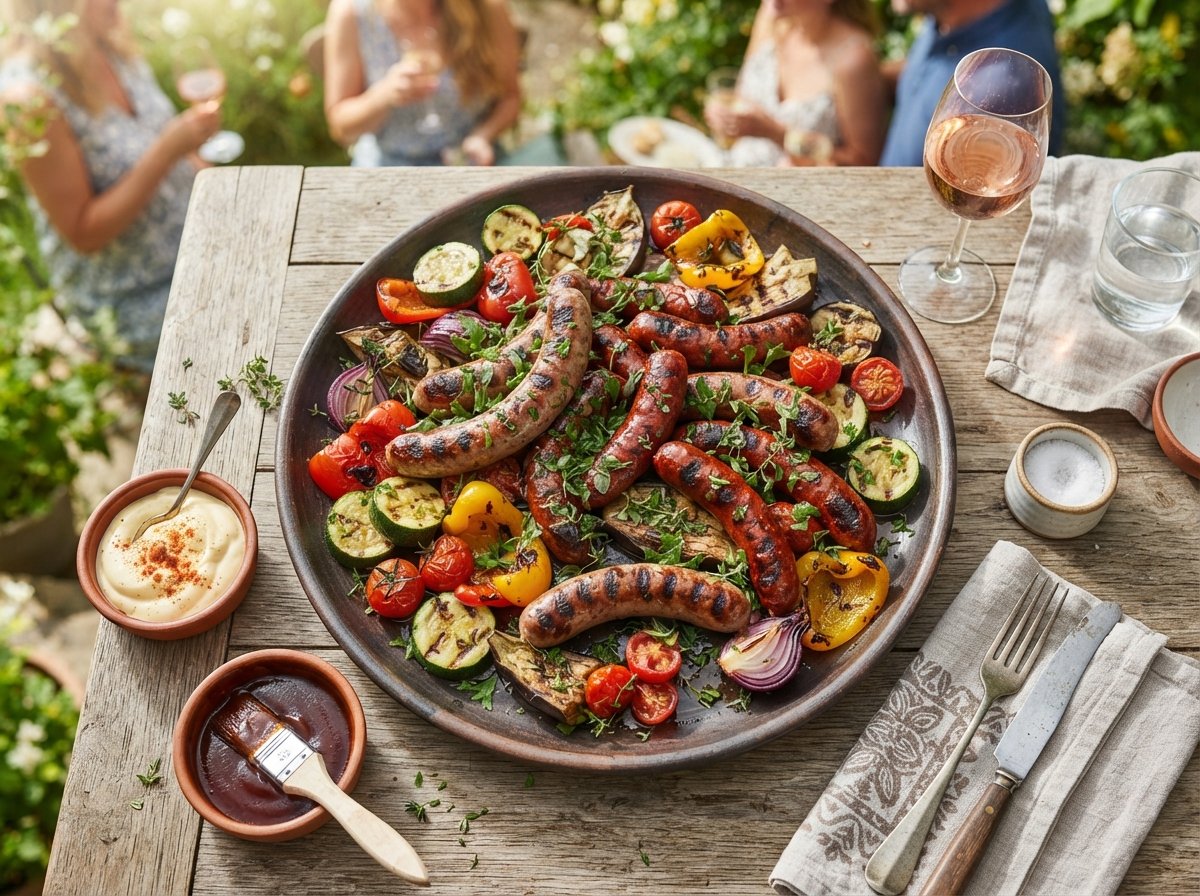
- As a platter: with grilled vegetables and dips — aioli, BBQ sauce.
- Finger food: sliced and served on skewers.
One addition worth making. <cite index=”91-1″>You can cook sausages directly with something that keeps the meat moist — cabbage, broccoli rabe, or a mix of summer vegetables like tomatoes, aubergine, courgette and peppers, depending on the season.</cite> That’s a better platter than grilling the vegetables separately, because the sausage fat ends up in the vegetables where it belongs rather than on the coals.
And a thought on the “different varieties” advice: offering beef, pork and poultry sausages side by side is a nice hosting idea and a genuinely bad grilling idea, because they have different cooking times and different safety temperatures. If you’re doing a mix, cook them in separate batches. Don’t crowd four sausage types onto one grate and hope.
Who This Doesn’t Work For
- You’re grilling over a raging fire. The whole method is heat control. If your coals are white-hot and you can’t move the food, you’ll burst them whatever you do.
- You have one heat zone. Two-zone grilling is the backbone of this. A single-zone grill can be worked around with the foil-pan method, but not ignored.
- You want it fast. Low and slow is the entire point. Sausages punish impatience.
- You’re cooking pre-cooked sausages. Different problem entirely — you’re reheating and colouring, not cooking. Everything above about internal temperature is moot.
- You genuinely want the fat out. Then grill something else. A sausage without its fat isn’t a lean sausage, it’s a bad one.
Troubleshooting
“They burst and split down the side.” Too hot, too fast. Medium heat first, indirect zone, direct only at the end.
“They’re black outside and cold inside.” Same problem. The heat was doing surface work while the middle sat there. Move them to indirect and be patient.
“They came out dry.” You pricked them. Or you cooked them well past temperature. Usually the first.
“The grill kept flaring up.” Fat is hitting the flames — because you pricked them, or because they’re straight over direct heat. Both fixable.
“They cooked unevenly.” Not turned enough, or straight from the fridge, or both.
“The casing was tough and chewy.” Under-rendered. It needed longer at a gentler heat, not hotter and faster.
The Verdict
Grilling a good sausage is almost entirely about restraint. Not the fork, not the fierce heat, not the rush.
The casing is the sausage’s own basting system. Leave it intact and it renders the fat back into the meat and hands you something juicy with a snap. Puncture it and you’ve drained the thing you were trying to cook, then set fire to the drainage.
Fridge out early. Medium heat. Turn often. Indirect first, direct last. Thermometer, not guesswork.
And put the fork down. Your dad was wrong. Kindly, but wrong.
7. FAQ
Should you prick sausages before grilling?
No. The casing holds in the fat and juices that keep the sausage moist and flavourful, and traditional sausages are designed to self-baste as that fat renders. Piercing the casing lets it all escape, leaving a dry, shrunken sausage — and the escaping fat drips onto the heat and causes flare-ups that char the outside. The one narrow exception is very high-fat sausage like chorizo.
Why do my sausages burst on the grill?
Heat that’s too high, too fast — not internal pressure. The other common causes are cooking them straight from the fridge, which shocks the casing, and not turning them enough, which cooks them unevenly. Internal pressure is normal, and a casing will hold it comfortably if the heat is gradual and moderate. Pricking doesn’t prevent bursting; heat control does.
How long do you grill sausages for?
Roughly 6 to 12 minutes depending on thickness, turning them regularly until the skin colours evenly — around 10 minutes is typical on a grill. Time is a guide rather than a rule, since thickness and grill temperature both change it. Start over medium or indirect heat and finish briefly over direct heat for colour.
What temperature should grilled sausages be inside?
Guidance genuinely varies, and it depends on the sausage. One view puts the ideal at around 150–160°F with a pull at 145–150°F to allow for carryover; another recommends finishing at 165°F. Fresh pork, poultry and beef sausages have different safety requirements, so check your national food safety guidance for the type you’re cooking and use a thermometer rather than a recipe blog’s number.
Do you need to prick chorizo?
This is the one real exception. Very high-fat sausages such as chorizo carry more fat than the meat can absorb, and a single small piercing can release some of it so the sausage cooks in its own juices rather than swimming in them. Use a thin needle or skewer rather than a fork — smaller holes lose far less flavour than the larger ones a fork makes.
Should you grill sausages on direct or indirect heat?
Indirect for the cooking, direct only briefly at the end for colour. Direct flame contact is what splits casings and causes flare-ups. Cook them through in the cooler zone, turning regularly, then move them over the heat for the last minute or two to get the browning and the snap.