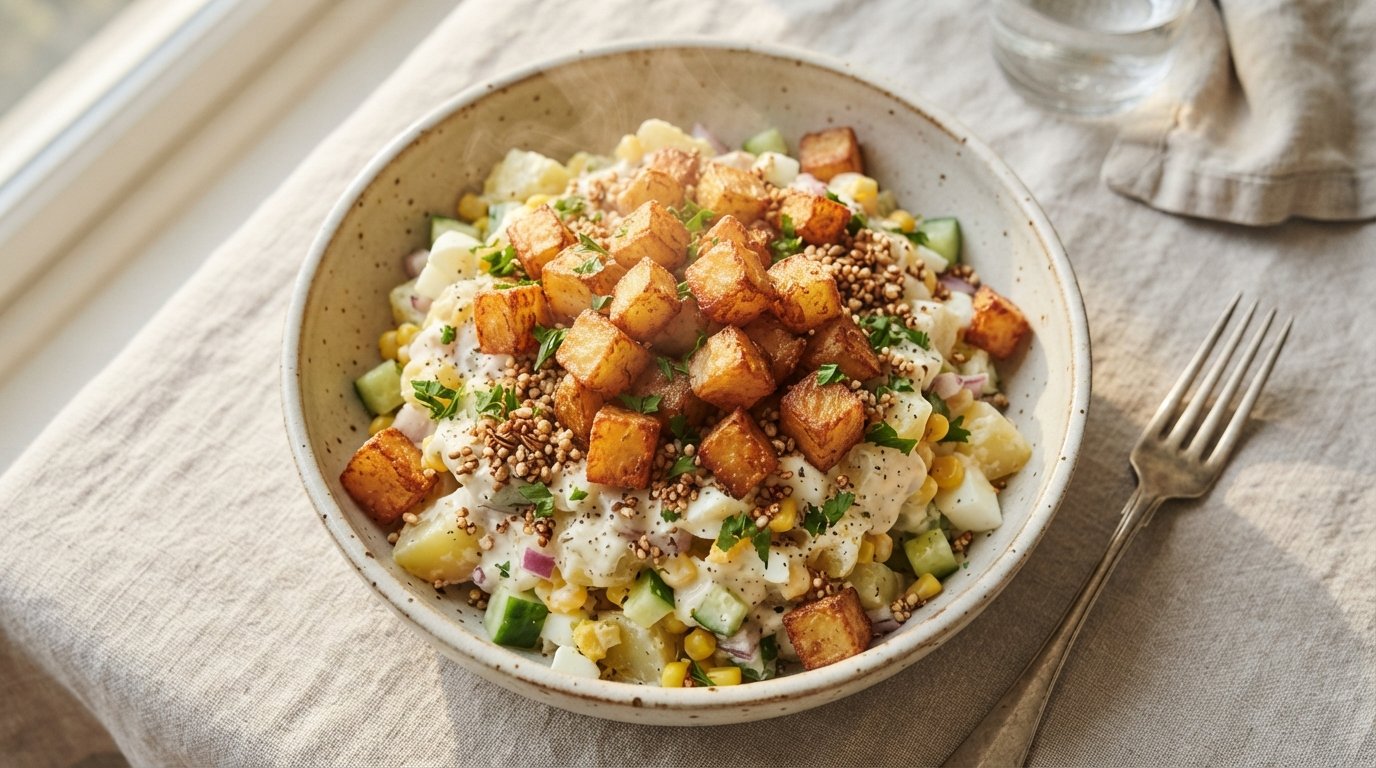
Crispy High-Protein Potato Salad — And the Free Upgrade Almost Everyone Skips
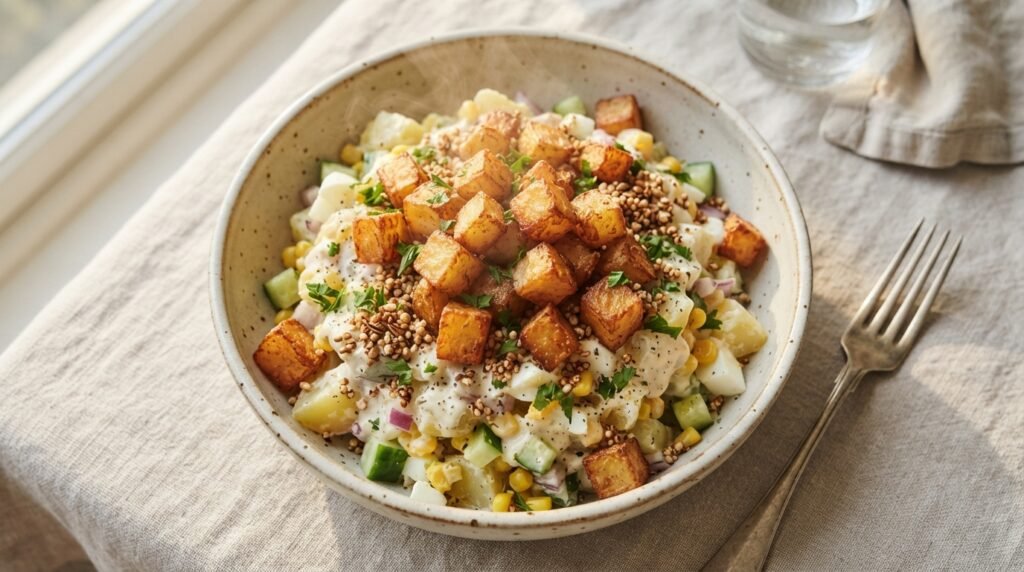
This high protein potato salad delivers 46 grams of protein for 615 calories, with crispy air-fried potatoes instead of the soft boiled ones, and a quark-mustard-honey dressing instead of mayonnaise. It’s a genuinely good recipe.
It also throws away the single best thing about potato salad, and almost nobody making it has any idea.
Potato salad has one real, measurable, evidence-backed nutritional advantage over nearly every other carb dish on earth — and it comes from a step so boring that recipe blogs don’t even list it as a step. This version skips it in exchange for crunch.
The good news: you can have both. It costs you one night of planning and nothing else.
The 40-Second Answer
High protein potato salad swaps mayonnaise for quark, delivering around 46g of protein and 615 calories per portion. Cook the potatoes a day ahead and chill them overnight before crisping them in the air fryer — cooling cooked potatoes forms resistant starch, a prebiotic fibre that feeds gut bacteria, and reheating preserves a meaningful share of it.
Key Takeaways
- 46g protein, 615 kcal, 14g fat — and unlike most fitness recipes, these numbers hold up.
- Quark, not mayo. That single swap is where the protein and the calorie saving both come from.
- Cook the potatoes the day before and chill them overnight. This is the free upgrade.
- Then air fry them crispy. You keep the crunch and most of the benefit.
- Dress the cold stuff, top with the hot stuff. Don’t fold crispy potatoes into wet dressing.
The Thing Nobody Tells You About Potato Salad
Start with the science, because it’s the reason this article exists.
Starch is made of long glucose chains. When you cook a potato, those chains unwind and become easy for your digestive enzymes to break apart — which is why a hot potato hits your bloodstream fast. But something interesting happens when you cool it down.
<cite index=”61-1″>When cooked starch molecules cool, they curl back up and form crystalline structures that resist digestion. That’s precisely why a potato salad made from cooked and then cooled potatoes has more resistant starch than a boiled potato</cite> — and the same applies to cooled pasta and rice. The process is called retrogradation, and <cite index=”65-1″>at a molecular level it’s the amylose chains re-crystallising as the temperature drops, locking tighter than they were before — tight enough that digestive enzymes can no longer break them apart efficiently.</cite>
What you get is a portion of the carbohydrate that behaves less like sugar and more like fibre. <cite index=”62-1″>It resists digestion in the small intestine and travels to the large intestine, where it acts as a prebiotic and feeds your beneficial gut bacteria.</cite>
And here’s the number. <cite index=”65-1″>Chilled potatoes contain roughly 40% more resistant starch than hot ones — measured at 4.27g per 100g chilled, versus 3.00g per 100g freshly cooked and hot.</cite>
Now read the recipe you came here for. Freshly air-fried potatoes, eaten immediately, hot.
That’s the 3.00. The worst case. A recipe positioned as a fitness meal, forfeiting the one nutritional edge its headline ingredient actually has.
Nobody’s done this maliciously. They just didn’t know. But once you know, the fix is almost free.
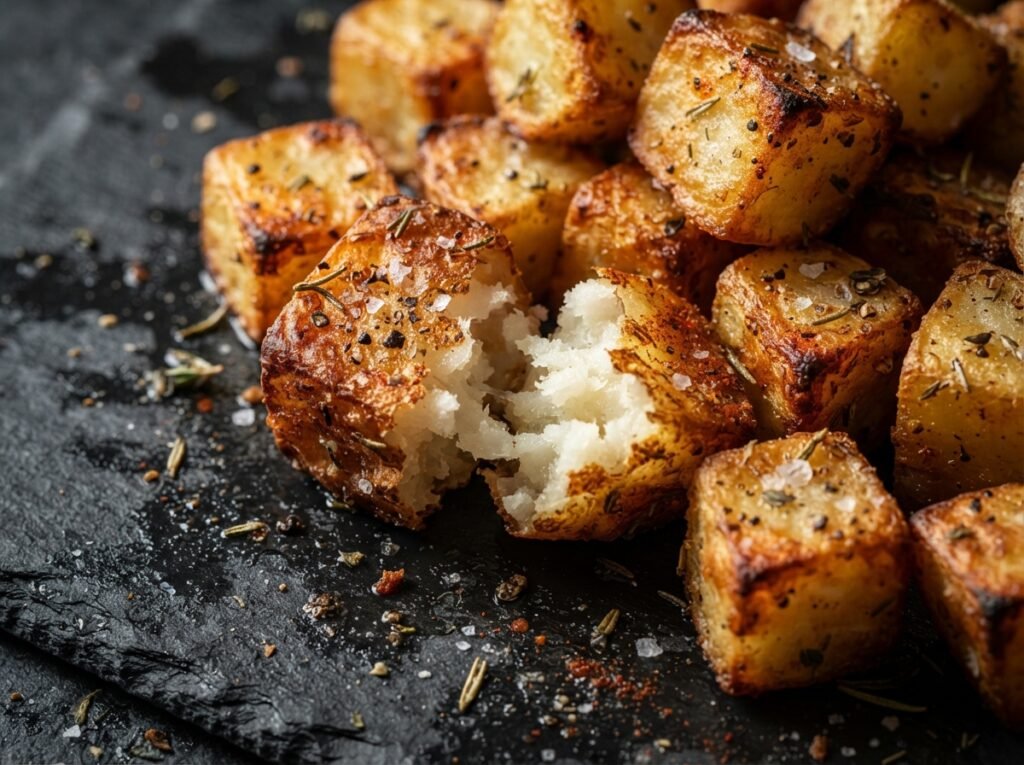
The Fix: Cook Tonight, Crisp Tomorrow
Cook the potatoes the day before. Cool them completely, chill them overnight in the fridge, and then air fry them crispy when you’re ready to eat.
You keep the crunch. You keep most of the benefit.
Here’s why that works, and it’s the detail that makes this practical rather than a lecture about eating cold potatoes. <cite index=”65-1″>Reheating a cooled potato retains about a third of the extra resistant starch formed during cooling — reheated potatoes measure 3.45g per 100g, against 3.00g for freshly cooked hot.</cite> So a chill-then-crisp potato beats a straight-from-raw crispy potato, every time, for free.
Where the sources genuinely disagree — and I’m not going to paper over it. <cite index=”62-1″>One dietitian-authored source states that cooked, cooled and then reheated potatoes tend to have the highest resistant starch content of all</cite> — which sits awkwardly against the measurements above, where chilled-and-eaten-cold comes out on top. <cite index=”63-1″>Elsewhere the disagreement plays out openly, with readers being told both that reheating doesn’t reduce resistant starch and that reheating makes it less resistant again, in the same comment thread.</cite>
What all of them agree on is the direction: cook-then-cool beats cook-and-eat-hot. The argument is only about how much survives reheating. So the honest instruction is the one that’s true under every reading: chill it overnight. Whether you then eat it cold or crisp it up, you’re ahead of where you started.
And one more piece of honesty, because this is where health content usually oversells. The mechanism is real and the resistant starch numbers are measured. The downstream health claims are softer than the internet suggests. <cite index=”65-1″>Insulin and GIP responses do drop significantly after eating chilled potatoes — but in the only controlled trial, the primary outcome, total blood sugar across three hours, was not significant.</cite> <cite index=”59-1″>Research does show chilled potatoes improving post-meal glucose and insulin responses compared with hot boiled potatoes, particularly in adults with elevated fasting glucose and insulin — but that doesn’t make potatoes a free food, and total carbohydrate intake still matters.</cite>
So: this is a real, cheap, evidence-based improvement. It is not a transformation. Chill your potatoes because it costs nothing and the science points one way — not because it turns chips into medicine.
Ingredients
Serves 1 — this is a full meal
For the crispy potatoes:
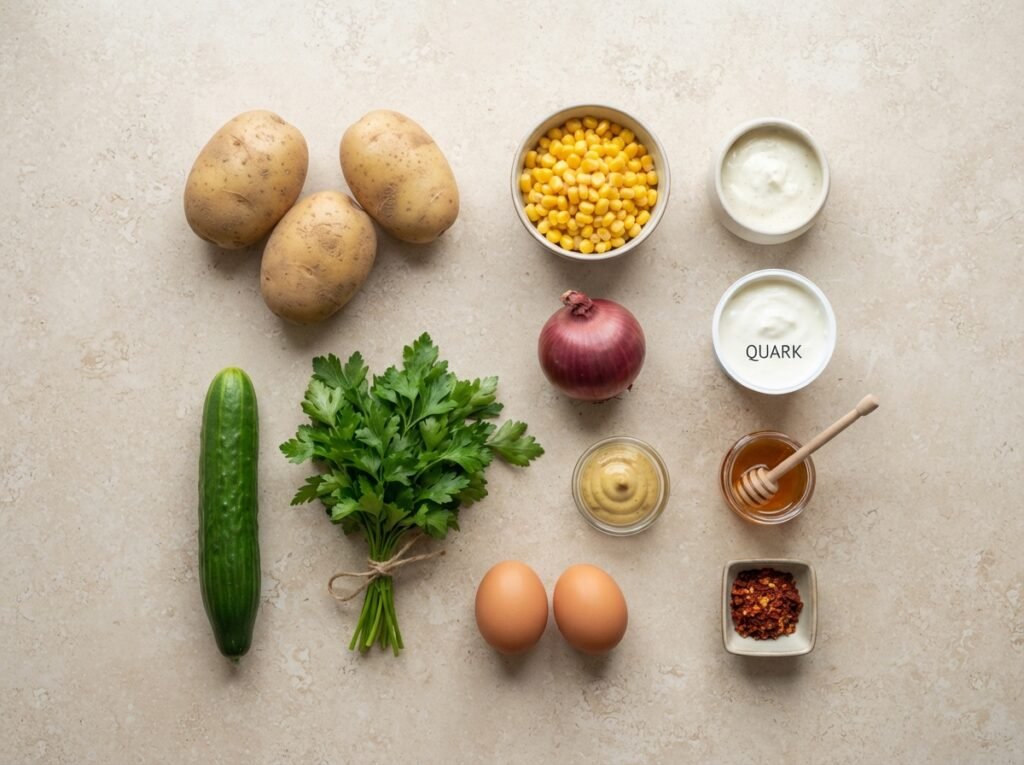
- 250g potatoes
- 2g olive oil spray
- Seasoning of choice (a tomato-based seasoning salt works well)
For the salad:
- 150g cucumber
- 70g sweetcorn
- 10g red onion
- 10g fresh parsley
- 2 eggs (100g)
- 8g crispy soy protein puffs
For the dressing:
- 150g quark (low-fat / Magerquark)
- 25g mustard
- 10g honey
- Dried tomato flakes
Notes on three ingredients that are doing more than they look.
The quark is the entire recipe. 150g of low-fat quark brings roughly 18g of protein for about 100 calories. The same volume of mayonnaise brings zero protein and around 1,000 calories. That one swap is where both the 46g protein and the 14g fat come from — everything else is assembly. If you can’t find quark, plain 0% Greek yogurt is the standard substitute: slightly thinner, slightly tangier, does the job.
The honey isn’t a cheat. 10g is about 30 calories and it’s load-bearing. Quark and mustard together are sharp and acidic; without something sweet the dressing is aggressive rather than balanced. This is the same logic behind the sugar in a classic vinaigrette. Don’t cut it.
The soy puffs are optional and I’ll say so. 8g adds around 5g of protein and some crunch, and the original recipe reaches for a branded fitness product to get there. It’s fine, but it isn’t essential — the salad works without it, and if you don’t have crispy protein puffs in your cupboard, don’t buy them for this. Toasted seeds do a similar textural job.
Step 1: Cook and Chill the Potatoes (The Night Before)
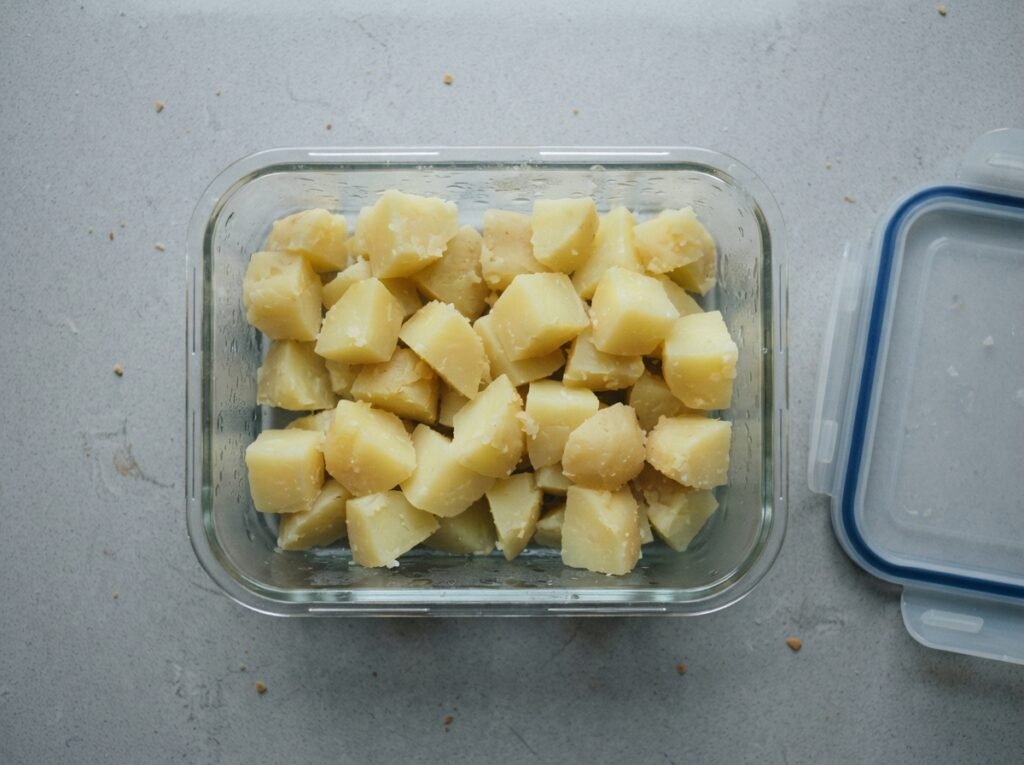
Dice the potatoes small. Cook them through — boil or air fry, it doesn’t matter for this step, they just need to be fully cooked.
Then cool them completely and refrigerate them overnight.
Two things about this. First, <cite index=”59-1″>cooling in the fridge for 12 to 24 hours is what drives the retrogradation</cite> — this isn’t a five-minute rest on the counter, it needs real time at real cold. Second, <cite index=”59-1″>the potatoes must be cooked fully before cooling for the process to start.</cite> Half-cooked and chilled gets you nothing but half-cooked cold potatoes.
If you skip this step the recipe still works. You just get the 3.00 instead of the 3.45, and you gave up something for nothing.
Step 2: Crisp Them
The next day, toss the chilled potato cubes with the olive oil spray and your seasoning, and air fry at 180°C for 20 minutes until crisp.
This is where roasting-then-chilling recipes usually stop and eat them cold. You’re going the other way — chilled first, crisped second — and it’s a better ordering than either camp uses. <cite index=”64-1″>The overnight-chill approach is exactly what the resistant starch potato salads do, roasting until golden and crispy, cooling completely, then chilling overnight before assembly.</cite> The only thing this recipe changes is putting the crisping after the chill instead of before it, so the crunch is fresh when it reaches the bowl.
Don’t crowd the basket. Circulating air is the whole mechanism of an air fryer. Packed potatoes steam each other soft — which is a particularly bitter outcome given what you’re doing here.
Small dice matters. More surface area, more crisp edges, and faster even cooking. This isn’t a garnish note; it’s the difference between crispy potatoes and hot potato cubes.
Step 3: Eggs and Vegetables
Hard boil the eggs, then cool them in cold water and chop them.
The cold water isn’t optional fussiness — it stops the cooking and it makes them peel properly. Skip it and you’ll be picking shell fragments out of your dinner.
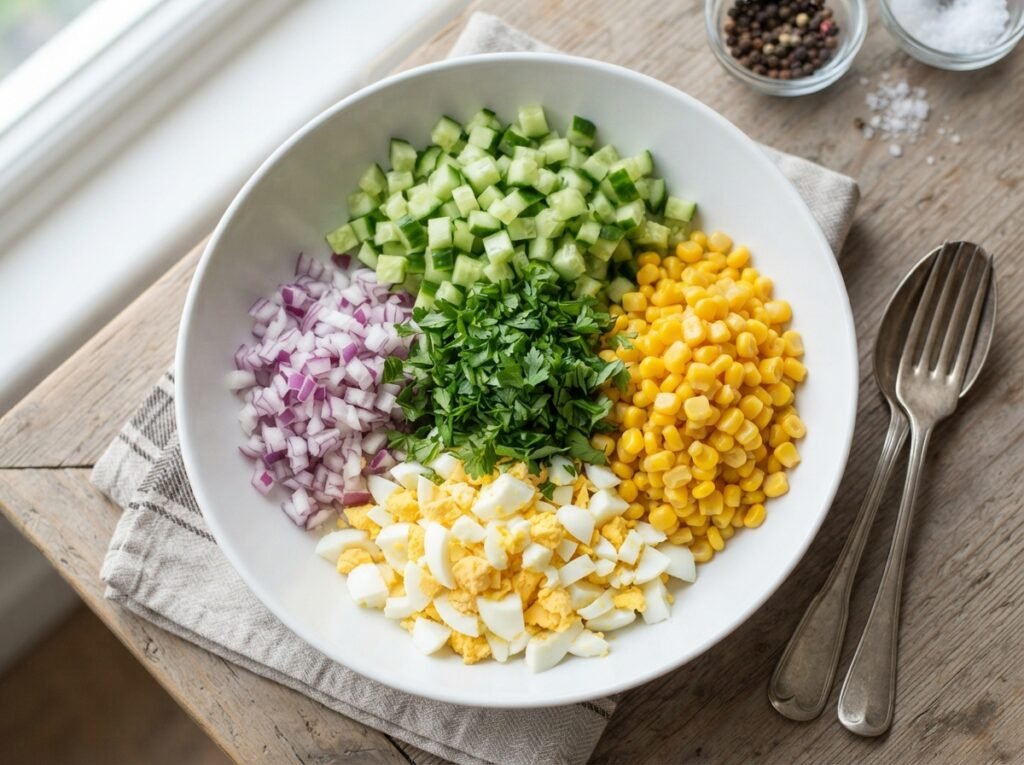
Finely chop the cucumber, red onion and parsley. Combine them in a bowl with the chopped eggs and the sweetcorn.
Ten grams of red onion sounds like nothing. It isn’t. Raw onion in a mild creamy salad is doing the sharp-edge work, and any more than this would take over. Weigh it.
Step 4: The Dressing
Whisk the quark, mustard, honey and tomato flakes together until smooth.
Taste it now, before it touches anything. Quark is sharper than yogurt and much sharper than mayo, and the balance point between “bracing” and “sour” is narrow. If it’s puckering, more honey. If it’s flat, more mustard. This is thirty seconds of work and it’s the whole flavour of the dish.
Pour it over the cold vegetables and eggs and fold it through gently.
Note what isn’t in the bowl yet.
Step 5: Assemble — Potatoes Last
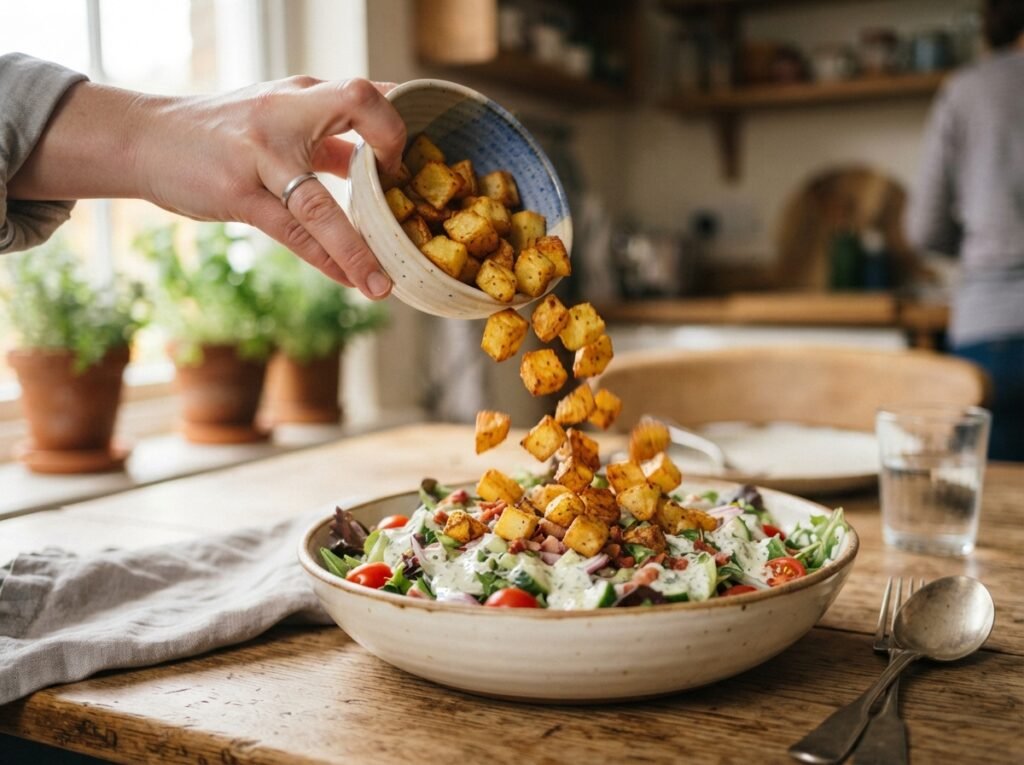
Add the crispy potatoes and the soy puffs on top, at the end, right before you eat.
The original instruction is to fold them through. Don’t.
You just spent twenty minutes and a night of planning building a crisp shell on those potatoes. That shell is about a millimetre deep and it is hygroscopic — it pulls moisture out of whatever it touches. Fold a hot crispy potato into cold wet quark dressing and it starts rehydrating on contact. Within a couple of minutes the crunch you engineered is gone and you’re eating a normal potato salad with extra steps.
So: dress the cold stuff, top with the hot stuff, and eat it straight away. The original is right that this is a serve-immediately dish. It’s just wrong about the folding.
Macros
| Per portion | |
|---|---|
| Calories | 615 kcal |
| Protein | 46 g |
| Carbohydrates | 69 g |
| Fat | 14 g |
I checked these against the ingredient list rather than taking them on trust, and they hold up — my own calculation lands around 626 calories and 44–46g of protein, which is well within the variance you’d expect from different potato varieties and quark brands. That’s worth saying out loud, because fitness recipes routinely round their protein up and their calories down. This one didn’t.
Where the 46g comes from is spread sensibly: the quark (~18g), the eggs (~12.5g), the potatoes themselves (~5g), the soy puffs (~5g), the corn and mustard making up the rest. No single ingredient is carrying it, which is why the substitutions above don’t break it.
Is this genuinely healthy? More defensibly than most things wearing the label. 46g of protein, 14g of fat, a real volume of vegetables, whole eggs, and — if you do the overnight chill — a carbohydrate load that’s measurably gentler than it looks. <cite index=”67-1″>Chilling starchy foods after cooking is a rare case of nutrition news that sounds too good to be true and isn’t: it can help you feel more satisfied on fewer calories while supporting gut health.</cite>
The honest counterweight: it’s still 69g of carbohydrate, and <cite index=”59-1″>portion control still matters because total carbohydrate intake matters</cite>. And if you have digestive conditions, more resistant starch isn’t automatically better — <cite index=”64-1″>it isn’t ideal for some people with digestive issues that are sensitive to extra starch, and it’s worth exploring with your healthcare team</cite>. <cite index=”62-1″>Individual responses vary, and anyone with specific digestive health concerns should speak to a registered dietitian.</cite>
Who This Doesn’t Work For
- You want dinner in twenty minutes tonight. The full version needs the potatoes cooked yesterday. You can make it same-day — you just lose the upgrade.
- You’re low-carb or keto. 69g of carbs. It’s a potato salad.
- You’re avoiding dairy. The quark is the recipe.
- You have IBS or sensitivity to fermentable starch. More resistant starch means more fermentation in the large intestine. That’s the mechanism working as intended, and for some people it’s uncomfortable. Talk to someone qualified.
- You want to meal-prep it assembled. You can prep every component. You cannot pre-assemble it — the potatoes go on last or the dish doesn’t exist.
Troubleshooting
“My potatoes went soft in the salad.” You folded them in instead of topping with them. On top, at the table, at the last second.
“They didn’t crisp in the air fryer.” Crowded basket, or the dice was too big. Single layer, small cubes.
“The dressing is too sharp.” Quark is sharper than you expect. More honey, a little at a time. Taste before it hits the bowl, not after.
“The dressing went watery.” Wet cucumber. Salt the diced cucumber for ten minutes and pat it dry if yours is particularly juicy.
“The eggs won’t peel.” You skipped the cold water bath. Straight from the pan into cold water, and give it a few minutes.
“Do I really have to wait overnight?” No. You’ll get a perfectly good salad. You just won’t get the thing that makes this version worth writing about.
The Verdict
This is one of the better high-protein recipes going around, and its central idea — quark instead of mayonnaise — is genuinely clever. It earns its 46 grams honestly, which is rarer than it should be.
But it was built for texture and macros, and in optimising for those it walked past something free. Cooked-and-cooled potatoes are one of the few genuine, measurable nutritional wins available in everyday cooking, and potato salad is the single best dish for capturing it. This version, by using freshly cooked hot potatoes, captures none of it.
Cook them tonight. Chill them overnight. Crisp them tomorrow.
Same salad, same crunch, same 46 grams — and the potatoes quietly doing something extra on the way through.
7. FAQ
Are cold potatoes healthier than hot potatoes?
On one specific measure, yes. Cooling cooked potatoes triggers retrogradation, where starch molecules re-crystallise into a form digestive enzymes struggle to break down. Chilled potatoes contain roughly 40% more resistant starch than freshly cooked hot ones. That resistant starch acts as a prebiotic and feeds gut bacteria. The wider health claims are softer than often reported — insulin responses drop measurably, but the only controlled trial found no significant difference in total blood sugar over three hours.
Does reheating potatoes destroy the resistant starch?
No, though sources disagree on how much survives. One measurement puts reheated potatoes at 3.45g of resistant starch per 100g against 3.00g for freshly cooked hot and 4.27g for chilled — so reheating keeps roughly a third of the gain. Some dietitians argue reheated potatoes retain even more than that. Everyone agrees cook-then-cool beats cook-and-eat-hot, so chilling overnight is worth it either way.
How do you make potato salad high in protein without mayo?
Replace the mayonnaise with quark, plain Greek yogurt or blended cottage cheese. Quark is the thickest and highest in protein — 150g brings roughly 18g of protein for about 100 calories, where the same volume of mayonnaise brings zero protein and around 1,000 calories. Add mustard for tang and a little honey to balance the sharpness. Hard-boiled eggs push the protein higher still.
How long do you need to chill potatoes for resistant starch?
Around 12 to 24 hours in the fridge. It isn’t a brief rest on the counter — the effect needs real time at real cold. The potatoes must also be cooked all the way through before cooling, since the process depends on fully gelatinised starch re-crystallising as it drops in temperature.
Can you make crispy potato salad ahead of time?
You can prep every component ahead, but you can’t assemble it. The crisp shell on the potatoes rehydrates within minutes of touching a wet dressing. Keep the dressed vegetables and the potatoes separate, and combine them at the table immediately before eating.
Is resistant starch good for everyone?
Not automatically. It’s generally beneficial — it feeds gut bacteria and may support blood sugar management and satiety — but individual responses vary, and it isn’t ideal for people with digestive conditions that are sensitive to extra fermentable starch. Anyone with specific digestive health concerns should speak with a registered dietitian rather than self-experimenting.