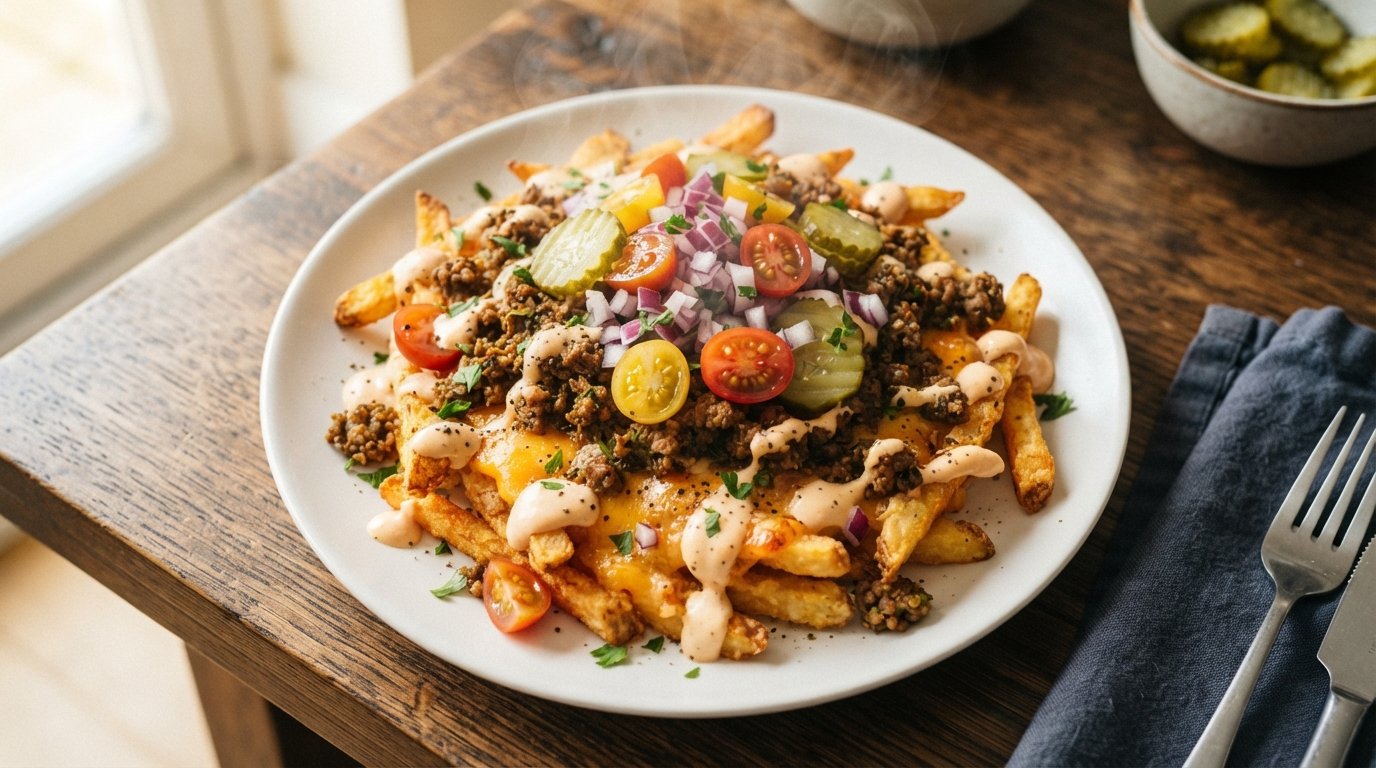
Big Mac Fries With 50g of Protein — And Why the Sauce Isn’t Quite Right Yet
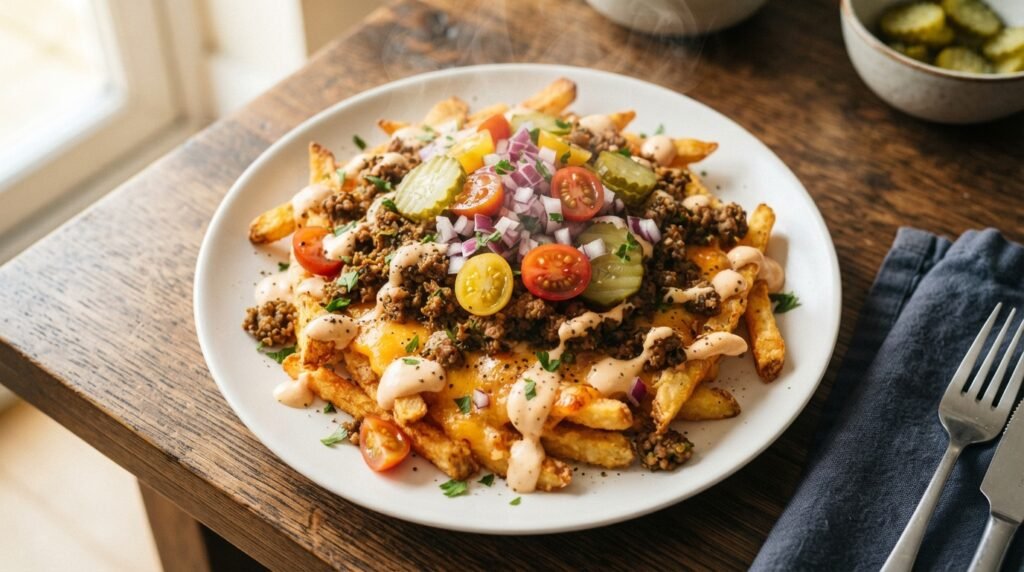
Big Mac fries are what happens when you take everything off the burger except the bun and drop it onto a plate of chips. Melted cheese, savoury mince, pickles, onion, tomato, and that unmistakable orange-pink special sauce. Roughly 630 calories and around 50 grams of protein — and it’s vegetarian.
Here’s the part nobody else will tell you: the high-protein sauce doesn’t actually taste like Big Mac sauce. Not straight out of the bowl. It’s close, it’s good, it’s tangy — but there are specific things missing, and once you know what they are you can fix it in about fifteen seconds.
That’s what this article is really about. The fries are easy. The sauce is where the honesty lives.
The 40-Second Answer
Big Mac fries are loaded fries topped with browned mince, melted cheese, pickles, onion and tomato, finished with a copycat Big Mac special sauce. This high-protein version swaps mayonnaise for quark, delivering roughly 630 calories and around 50g of protein — about double the protein of standard loaded fries with a fraction of the fat.
Key Takeaways
- Quark beats Greek yogurt and mayo for a high-protein special sauce — thicker, and it doesn’t run.
- The sauce needs four additions the basic version misses: onion powder, garlic powder, a splash of vinegar, and paprika. That’s the gap.
- Sauce goes on last, at the table. Loaded fries die from the sauce down.
- Air fryer, not oven. Crispier base, and the fries need all the structural help they can get.
- Vegetarian by default. Plant-based mince, no compromise on the macros.
- ~630 kcal · ~46–50g protein · ~63g carbs · ~17g fat — estimates, heavily brand-dependent.
First, an Honest Note on the Name
This is a copycat. It’s not a McDonald’s product, this site has no affiliation with McDonald’s, and “Big Mac” is their trademark — used here only to describe what this recipe is imitating.
That matters more than legal housekeeping, because the actual McDonald’s formula has never been public. <cite index=”23-1″>The recipe for McDonald’s special sauce has never been officially released.</cite> What is public is the ingredient declaration, and it’s instructive: the real sauce is built on <cite index=”23-1″>soybean oil, sweet relish, water, egg yolks and distilled vinegar</cite>, plus a long tail of spices, stabilisers and colourings. <cite index=”27-1″>There are around 33 ingredients on the official list.</cite>
Read that again. Soybean oil and egg yolks. The real thing is mayonnaise. It is, structurally, a fat emulsion.
So when a recipe tells you a yogurt-based sauce “tastes exactly like the real thing,” treat that with suspicion. It can taste very good and very close. It cannot taste identical, because you’ve removed the ingredient that was carrying the flavour. That’s a real trade, and this article isn’t going to pretend otherwise.
What it will do is get you closer than the version you’ve probably seen.
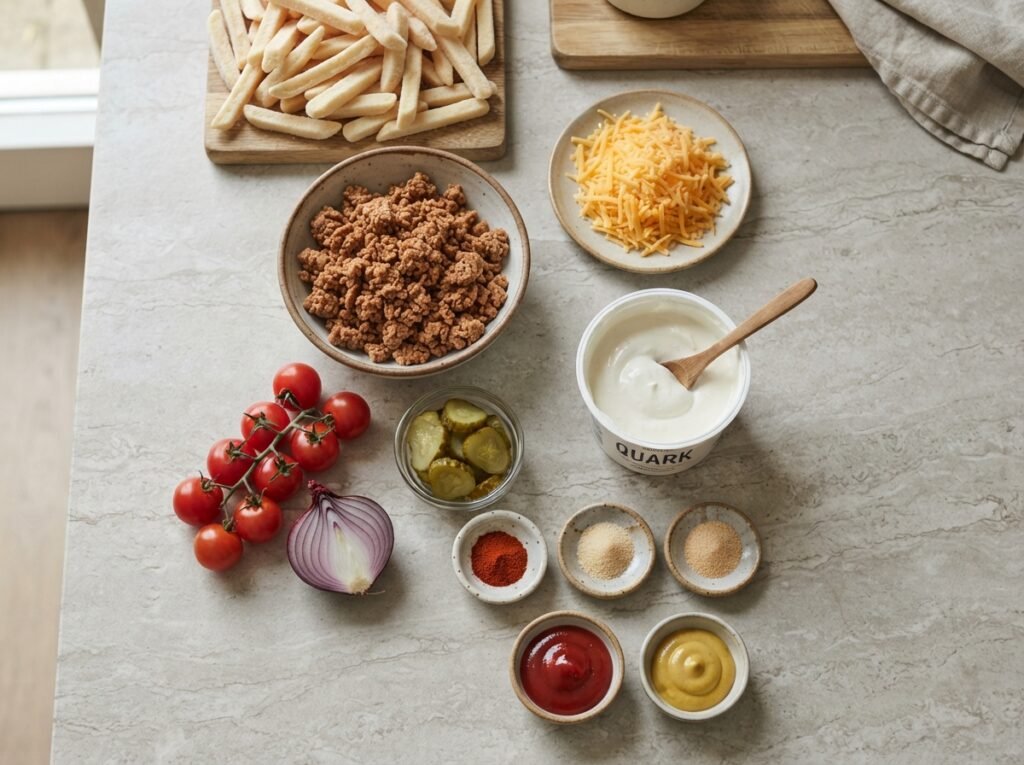
Ingredients
Serves 1 — this is a full meal, not a side
For the fries:
- 200g frozen fries
- 90g plant-based mince
- 45g light grated cheese
- 50g cherry tomatoes
- 10g red onion
- 60g pickled gherkins
For the high-protein special sauce:
- 100g quark (low-fat / Magerquark)
- 25g zero-sugar ketchup
- 10g yellow mustard
- A splash of pickle brine, from the jar
The four upgrades that fix it (see the sauce section):
- ¼ tsp onion powder
- ¼ tsp garlic powder
- A pinch of paprika
- A few drops of white vinegar
- 1 tsp sweet pickle relish (optional but the single biggest improvement)
Substitution notes:
No quark? It’s a European staple and hard to find in much of the US. Plain 0% Greek yogurt is the closest swap — slightly thinner and tangier, but it works and it’s what most English-language high-protein sauce recipes use. Blended cottage cheese is the other option: <cite index=”24-1″>blending it is essential if you want a silky, thick texture rather than a grainy one</cite>. Quark stays the best choice if you can get it, purely because it’s thicker than both — and a thick sauce is a structural advantage on loaded fries, for reasons that’ll become clear.
Want it non-vegetarian? Lean beef mince works and pushes the protein slightly higher. But the plant-based version isn’t a compromise here — it’s leaner, it browns fine, and the sauce and pickles are doing most of the flavour work anyway. This dish was never really about the beef.
Yellow mustard, not Dijon. This isn’t a preference. <cite index=”26-1″>Yellow mustard is the tangy backbone of this flavour profile, and Dijon is too sharp — it changes the taste noticeably.</cite>
Step 1: Cook the Fries — Air Fryer, Not Oven
Cook the fries according to the packet. In an air fryer, that’s around 15 minutes.
Use the air fryer if you have one, and this isn’t laziness — it’s load-bearing. You’re about to put wet sauce, wet tomatoes, wet pickles and melted cheese onto these fries. Every fry needs to arrive at the plate as crisp as it can possibly be, because from that moment it only goes one direction.
Oven fries are fine. Air fryer fries are crisper. On a dish that’s actively working against crispness, take the free win.
Don’t crowd the basket. Same rule as everything in an air fryer: circulating air is the entire mechanism. A packed basket steams. Two batches beat one bad one.
Step 2: Brown the Mince
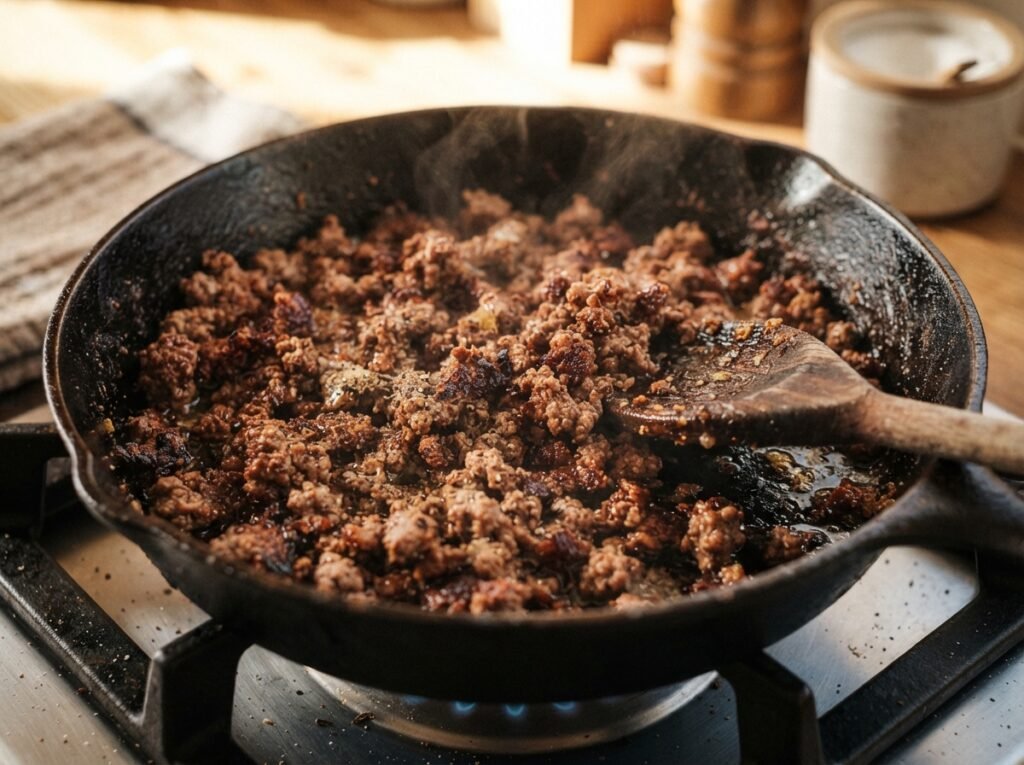
Fry the mince until properly browned, then spread it over the fries.
Browned, not just heated through. Grey mince tastes like grey mince. You want actual colour on it — that’s Maillard browning, and it’s a meaningful chunk of the savoury depth that makes this taste like a burger rather than like mince on chips. Hot pan, don’t stir it constantly, let it sit and catch.
With plant-based mince this matters even more. It has less inherent flavour to fall back on, so the browning is doing proportionally more of the work. This is the single step that decides whether the vegetarian version tastes like the real thing or like a substitute.
Step 3: Melt the Cheese
Scatter the grated cheese over the mince and fries, then melt it — microwave, or briefly under a hot grill.
Short and hot. You want the cheese melted, not the fries reheated into limpness. Thirty to sixty seconds in a microwave, or two minutes under a grill. The moment it’s glossy, it’s done.
Light grated cheese protects the macros, and it’s a fair trade — but reduced-fat cheese melts less generously and browns less. If you want the visual, a grill finish gets you closer than a microwave will.
Step 4: The Sauce — And the Four Things Missing
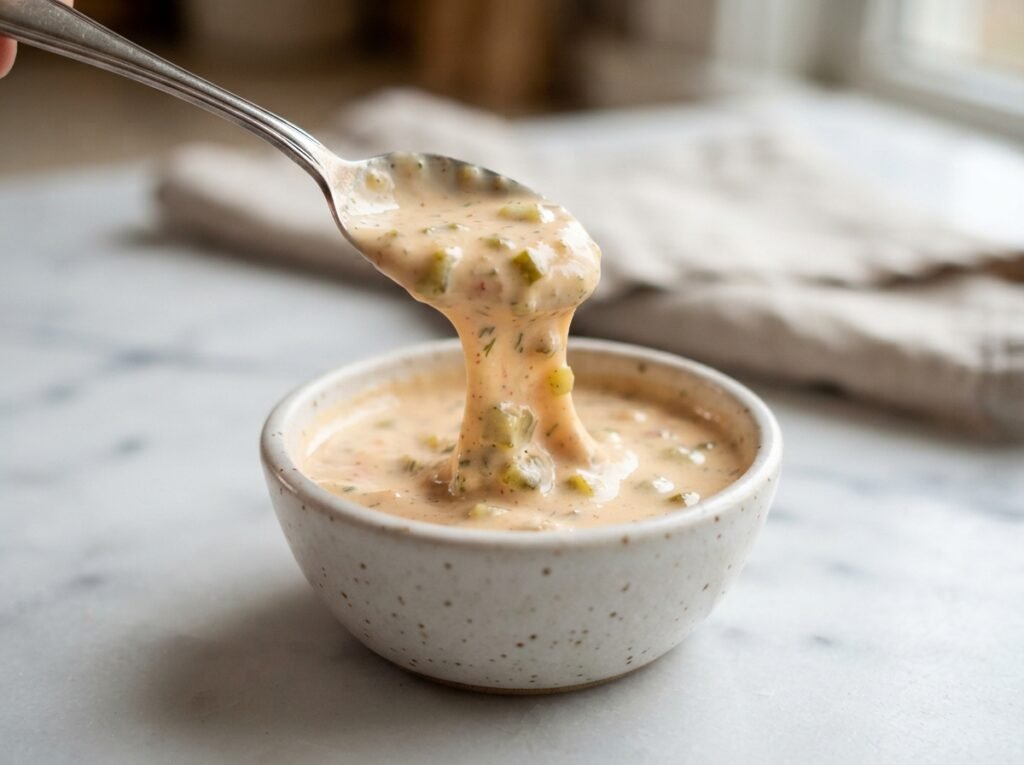
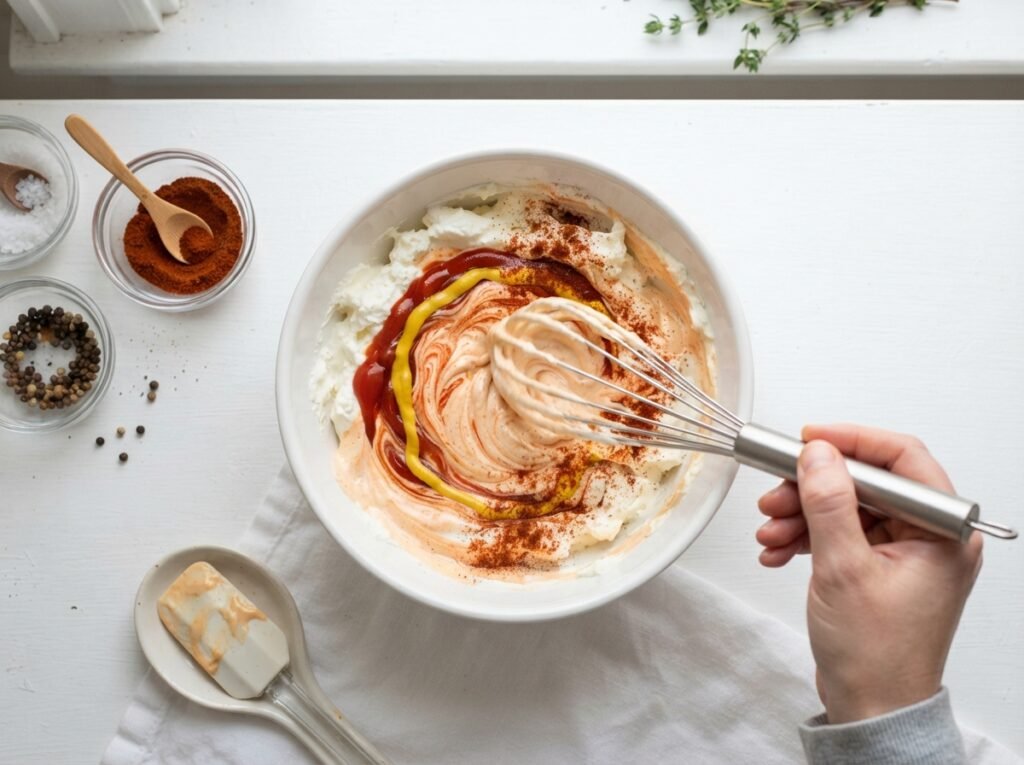
Whisk the quark, ketchup, mustard and a splash of pickle brine together until smooth.
That’s the version circulating on social media. It’s good. It’s tangy, creamy, pink-orange, and it has about twelve grams of protein in it.
It’s also not Big Mac sauce, and here’s precisely why.
Compare it against what actually defines that flavour. Working copycat recipes converge on seven components: mayonnaise, sweet pickle relish, yellow mustard, white vinegar, garlic powder, onion powder and paprika. Each has a job, and the detail work is well documented — <cite index=”26-1″>the white vinegar is described as the specific element that makes a sauce taste like Big Mac sauce rather than just a mayo-based condiment, and the paprika gives it the signature light orange hue and a subtle smokiness</cite>. <cite index=”26-1″>The garlic and onion must be powder, not fresh — fresh is too sharp for this sauce.</cite>
Now count what the quark version has: a creamy base ✓, mustard ✓, and pickle brine standing in for relish.
Missing: onion powder, garlic powder, vinegar, paprika, and any actual relish. Five of the seven. That isn’t a small gap — that’s most of the flavour architecture.
So add them:
- ¼ tsp onion powder + ¼ tsp garlic powder — the savoury depth. Biggest single jump.
- A few drops of white vinegar — the brightness that reads as “Big Mac” rather than “burger sauce.”
- A pinch of paprika — colour and a whisper of smoke. Regular, not smoked.
- 1 tsp sweet pickle relish — optional, but it’s the texture. Brine gives you tang; relish gives you the little chunks the real sauce has. <cite index=”26-1″>Sweet relish is correct here — dill relish shifts the balance.</cite>
Fifteen seconds of work. Enormous difference.
One more thing: let it sit. Multiple recipe developers land independently on the same finding — this sauce improves with time. <cite index=”24-1″>Chilling it for at least an hour lets the flavours develop</cite>, and <cite index=”26-1″>it continues to get better over the first two to three days</cite>. Meal-prepping? Make the sauce the night before. It’s genuinely better.
Where ketchup fits. The source uses it, this version keeps it, and you should know it’s a deviation. <cite index=”23-1″>Ketchup is not in McDonald’s Big Mac sauce</cite> — developers add it for flavour and colour. <cite index=”31-1″>One notes the original doesn’t include it but considers the addition a genuine improvement.</cite> Keep it. Just don’t believe anyone who calls it authentic.
Step 5: Assemble — Order Matters More Than You Think
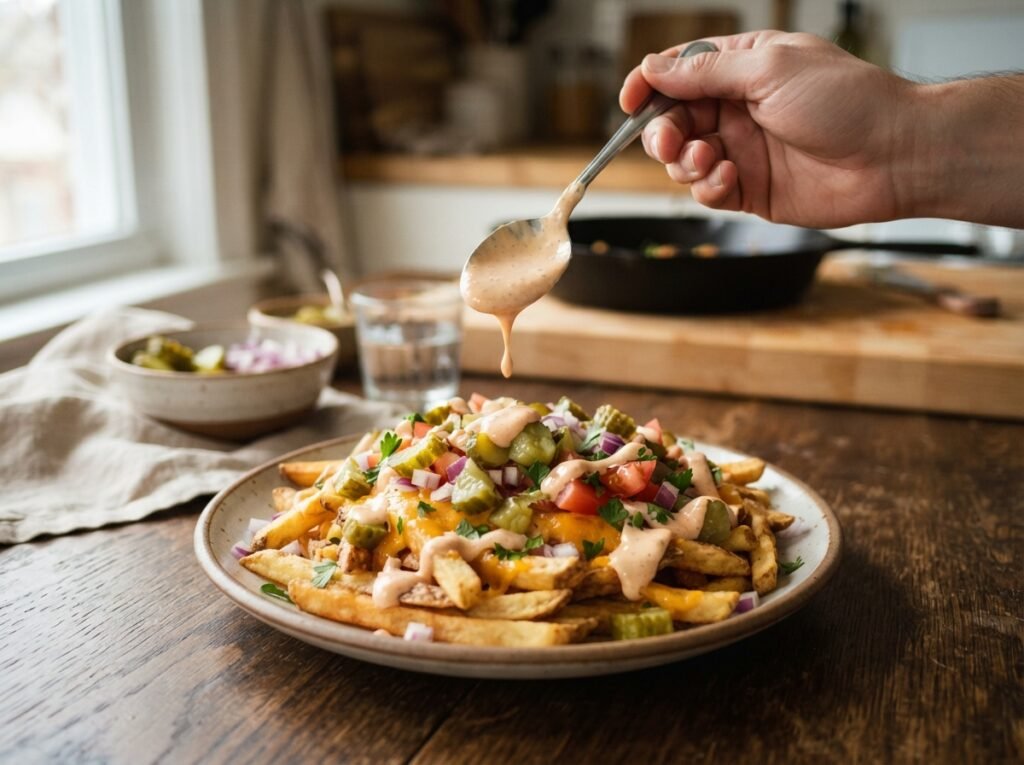
Top the cheesy fries with the tomatoes, onion and pickles. Add the sauce last, right before you eat.
This is where loaded fries live or die, and no other recipe mentions it.
Your fries have a crisp shell perhaps a millimetre thick. Sauce is water and protein. The instant they touch, the shell starts rehydrating from the sauce down. Give it four or five minutes and the top layer has gone from crisp to soft — you’re eating chips in dressing.
So:
- Sauce goes on at the table, not in the kitchen.
- Dot it, don’t drown it. Blanket coverage soaks everything. Dotted, you get sauce in every bite and dry fries underneath.
- Pat the pickles dry. They come out of a jar of liquid. That liquid has no business on your fries.
- Eat it now. Loaded fries have a five-minute window. That’s not a flaw, it’s the format. Plan around it.
Taking it to work? Fries in one container, sauce in another, assemble at your desk. It’ll never be as good as fresh, but sauced-in-advance loaded fries reheated at lunch is genuinely grim.
Macros (Approximate)
| Approx. | |
|---|---|
| Calories | ~630 kcal |
| Protein | ~46–50 g |
| Carbohydrates | ~63 g |
| Fat | ~17 g |
Read these as ranges, not facts. Frozen fries vary enormously between brands — 100g can be anywhere from 120 to 180 calories depending on cut and oil content. Your mince, cheese and quark all move the numbers. Weigh your own and run them through a tracker if precision matters.
The 50g figure is achievable but it’s the ceiling. Realistically you’re looking at mid-to-high forties with typical supermarket products. Still an excellent number.
Where the protein actually comes from is the interesting part: the mince (~15g), the cheese (~13g), the quark in the sauce (~12g), and the fries themselves (~5g). No single hero ingredient — which is why swapping any one component doesn’t wreck it.
Is this actually a healthy fast food alternative? Partly, and it’s worth being precise about which part.
A standard plate of loaded fries — chips, beef, full-fat cheese, mayo-based sauce — runs well over 1,000 calories with maybe 25g of protein. This lands at 630 with roughly double the protein. That’s a genuinely large win, and it comes almost entirely from one swap: the sauce base. Mayonnaise is around 100 calories a tablespoon and contains no protein whatsoever. The mayo-based copycat sauces dominating search results sit around <cite index=”29-1″>150 calories and 0.3g protein per 2-tablespoon serving</cite>. The quark version delivers roughly 12g of protein for about 70 calories across the whole batch.
That single substitution is doing most of the heavy lifting in this entire recipe. Everything else is assembly.
What it isn’t. It’s not low-carb — 63g of carbs from a plate of chips is exactly what you’d expect. It’s not low-sodium either; between the pickles, cheese, ketchup and brine, this is a salty plate. It’s a high-protein, moderate-calorie comfort meal that beats the thing it’s replacing. That’s the honest category, and it’s a good one.
Who This Doesn’t Work For
- You’re keto or low-carb. It’s a plate of chips. There’s no version of this that isn’t.
- You want it to taste identical to McDonald’s. It won’t. It’ll taste like a very good homemade version — a different and arguably better thing.
- You’re meal-prepping lunches. Assembles fresh or not at all.
- You’re avoiding dairy. Quark and cheese are both structural. The mince is the easy part.
- You can’t find quark. Greek yogurt works — just know the sauce will be thinner and you’ll need to be even more careful about drowning the fries.
Troubleshooting
“My sauce is too runny.” Too much pickle brine, or you used yogurt instead of quark. Add brine drop by drop, never in a pour. If it’s already thin, a spoonful more quark rescues it.
“It doesn’t taste like Big Mac sauce.” You skipped the upgrades. Onion powder, garlic powder, vinegar, paprika — in that order of importance. And chill it an hour.
“My fries went soggy.” You sauced in the kitchen instead of at the table, or blanketed instead of dotting, or your pickles were wet. Usually all three.
“The sauce tastes sour, not tangy.” Quark is sharper than mayo — that’s the trade. A tiny pinch of sugar or a teaspoon of sweet relish rounds it out. Relish is the better fix because it does two jobs at once.
“The plant-based mince tastes bland.” You didn’t brown it hard enough. It has less to give than beef, so it needs the colour more, not less.
“The cheese didn’t melt properly.” Reduced-fat cheese resists melting. Grill it rather than microwaving, or accept the trade and move on.
The Verdict
Big Mac fries are one of the better ideas in the high-protein fast-food genre, because the thing being copied was never really about the bun. It was about the sauce, the pickles, the onion, the cheese. All of that transfers to a plate of chips without losing anything — which is also why the vegetarian version works so well. The beef was never the point.
The quark sauce is the real innovation here, and it’s better than the Greek yogurt versions circulating in English: thicker, higher in protein, and it stays where you put it. But out of the bowl it’s incomplete. Four small additions and an hour in the fridge take it from “nice tangy sauce” to something that’ll make you pause.
Then dot it on at the table and eat it immediately. That part is not negotiable.
7. FAQ
What is Big Mac sauce actually made of?
McDonald’s has never officially released the recipe, but the published ingredient declaration is built on soybean oil, sweet relish, water, egg yolks and distilled vinegar, followed by spices, stabilisers and colourings — around 33 ingredients in total. Structurally it’s a mayonnaise-based sauce. That’s why a yogurt or quark version can get close but never identical.
Can I make Big Mac sauce high protein?
Yes, by replacing the mayonnaise base with quark, plain Greek yogurt or blended cottage cheese. Quark is the thickest and highest in protein of the three. The trade is real: you lose richness and gain tang, since fat was carrying the original flavour. Adding onion powder, garlic powder, a splash of white vinegar and a pinch of paprika closes most of that gap.
Are Big Mac fries vegetarian?
This version is. Plant-based mince browns well and the sauce, pickles and cheese carry the flavour, so nothing is lost — the beef was never what made a Big Mac taste like a Big Mac. Check your cheese if you’re strict about rennet, and use lean beef mince instead if you prefer.
Why do my loaded fries go soggy?
Because the sauce went on too early. A fry’s crisp shell is about a millimetre thick and rehydrates within minutes of contact with a wet sauce. Add the sauce at the table rather than in the kitchen, dot it rather than pouring, and pat the pickles dry before they go on.
Can I use Greek yogurt instead of quark?
Yes. Plain 0% Greek yogurt is the standard substitute and it’s what most English-language high-protein Big Mac sauce recipes use. It’s thinner and tangier than quark, so use less pickle brine and be more careful about how much sauce hits the fries.
Are Big Mac fries a healthy fast food alternative?
Compared to what they replace, meaningfully so. A conventional plate of loaded fries runs over 1,000 calories with roughly 25g of protein; this lands around 630 with close to double the protein, almost entirely because the mayo-based sauce is swapped for a quark one. It’s not low-carb and it’s not low-sodium — it’s a high-protein comfort meal that beats the original on macros.