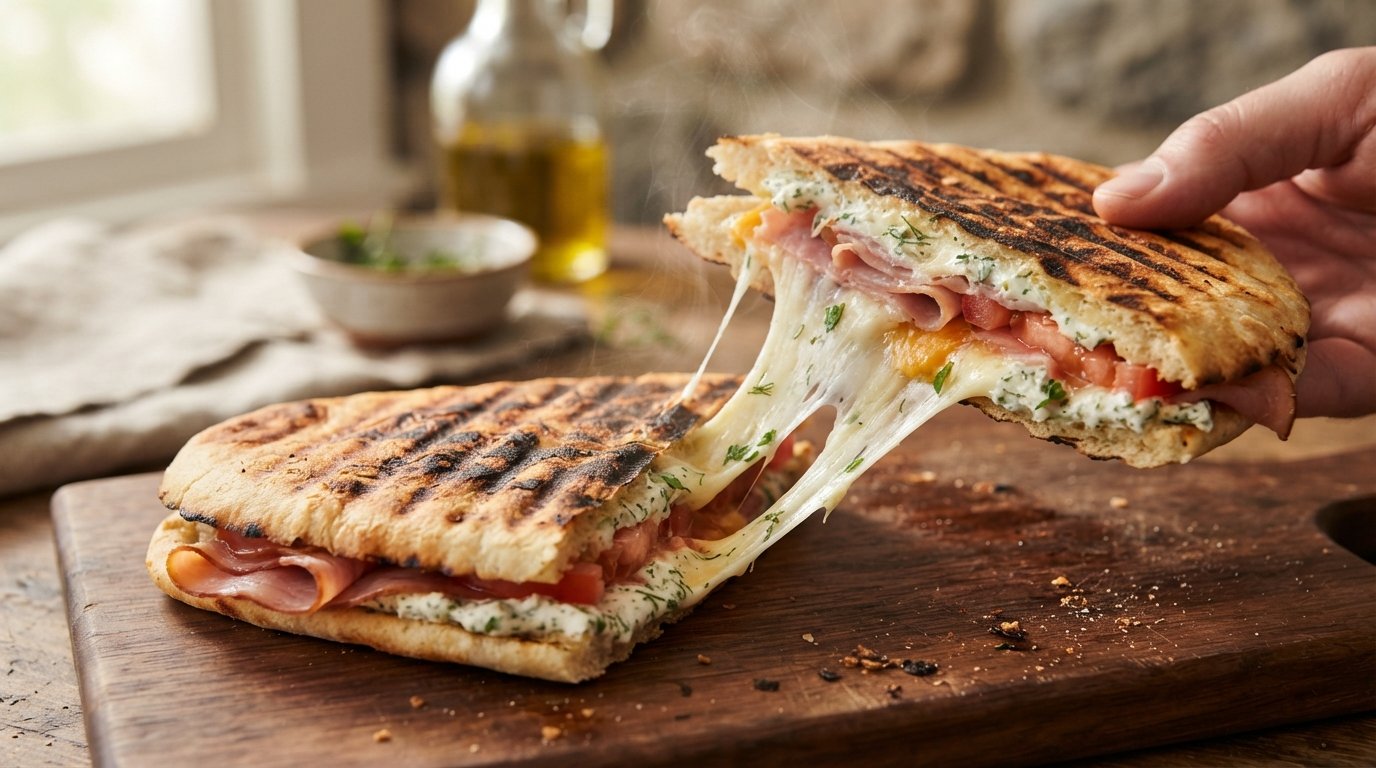
Ham and Cheese Flatbread — “Grill Until Golden” Is Why Yours Isn’t Working
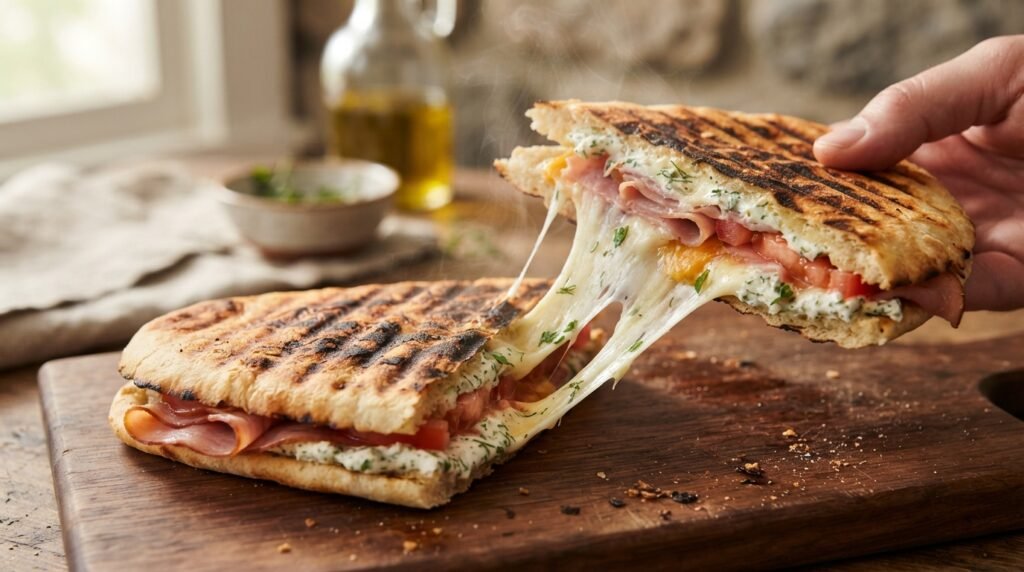
Ham and cheese flatbread from a contact grill is one of the great five-minute dinners: split a flatbread, load it with herb cream cheese, ham, tomato and a fistful of grated cheese, press it, eat it. Crisp outside, molten inside, one appliance, no washing up.
The recipe going around gives you exactly one instruction: grill until it’s as brown as you like it.
That instruction is the reason yours isn’t working.
Browning is something that happens on the outside of your sandwich, in about ninety seconds, on a hot plate. This sandwich’s actual problem is the inside — nearly 400 grams of cold ham, cold cream cheese and cold grated cheese sitting in the middle of a thick flatbread. Cook to the colour and you’ll pull out something beautifully bronzed with a cold, unmelted core.
Colour is a liar here. Here’s what to use instead.
The 40-Second Answer
Ham and cheese flatbread is a split flatbread filled with herb cream cheese, ham, tomato and grated cheese, then pressed in a contact grill. Because the filling is thick and cold, use a low setting for around 10 minutes rather than high heat — high heat browns the bread long before the centre melts. Deseed the tomato and keep it in the middle layer.
Key Takeaways
- Low and slow, not hot and fast. This is a thick sandwich, not a grilled cheese.
- Deseed and blot the tomato. It’s the only genuinely wet thing in here.
- The cream cheese goes against the bread. It’s a moisture barrier, not just flavour.
- Cheese touches the bread too — it’s the glue that holds the whole thing together.
- Rest it 60 seconds before cutting. The cheese needs to set or your filling escapes.
- Don’t overfill. It’s the single most common way to wreck a pressed sandwich.
The Heat Fork: Which Sandwich Are You Actually Making?
This is the thing nobody tells you, and it’s the difference between this recipe working and not.
A contact grill is asked to do two completely different jobs depending on what’s inside. Panini Happy — which has more sandwich-pressing miles on it than anywhere else online — puts the fork plainly: <cite index=”77-1″>for a thin panini like a simple grilled cheese, where all you need is to melt the cheese and toast the bread, medium-high heat around 375°F and three minutes is perfect. For a more substantial sandwich with meat that needs heating through, use a low setting around 200°F and grill for about ten minutes.</cite>
Read your filling list again. 150g of cream cheese. 120g of ham. 120g of grated cheese. A whole tomato. Inside a flatbread.
You are emphatically making the second sandwich.
Most of the internet will tell you 375°F, because most of the internet is describing a grilled cheese. <cite index=”73-1″>Set the panini press to medium-high, usually around 350°F to 375°F, which crisps the bread without burning it</cite> is standard advice — and it’s correct advice for a two-slice melt. It is the wrong advice for this. At 375°F your flatbread hits perfect golden in about three minutes while the ham in the middle is still fridge-cold.
The rule to actually carry away: if the filling is thin and just needs to melt, go hot and fast. If the filling is thick and needs to heat through, go low and slow. Colour is not doneness. Colour is just colour.
And there’s a diagnostic for when you get it wrong: <cite index=”78-1″>if the bread is browning too fast but the filling isn’t warm, reduce the heat and extend the cooking time.</cite> That’s not a workaround. That’s the correct setting arriving late.
Ingredients
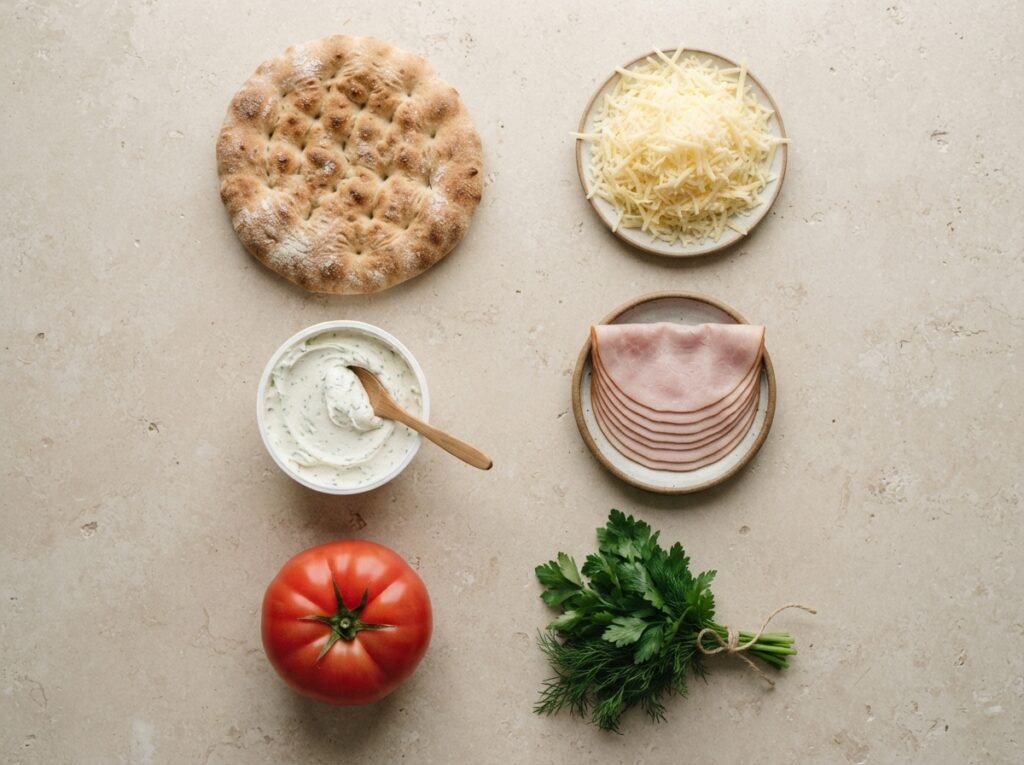
- 1 flatbread (Turkish pide-style, or any large soft flatbread)
- 150g herb cream cheese
- 120g grated cheese
- 1 large tomato
- 120g cooked ham
- Fresh or dried herbs
Vegetarian? Drop the ham and it still works — the cream cheese and cheese are carrying most of it anyway. Grilled peppers, artichoke or mushrooms fill the gap. If you go meat-free you’ve also just changed which sandwich you’re making: without cold ham in the middle, you can move up the heat and cut the time considerably.
About the cheese. “120g of cheese” tells you nothing, and it’s the vaguest line in the original. What you want here is meltability first. The professional move is to hedge: <cite index=”78-1″>combine two cheeses — one chosen for meltability, like provolone, and one chosen for flavour, like asiago.</cite> Gouda, young Emmental, mozzarella or provolone all melt generously. Aged hard cheeses taste better and melt worse. Mix them and stop choosing.
About the flatbread. Sturdy bread survives pressing; soft bread surrenders to it. <cite index=”70-1″>Thicker, sturdier breads hold up better during pressing and take grill marks well without going soggy.</cite> A proper Turkish-style flatbread is ideal — it’s structural. Thin wraps and soft sandwich bread will flatten into a pancake under a press.
About the herb cream cheese — this is the clever bit. It reads like a flavour choice. It isn’t only that. <cite index=”70-1″>Spreading a thin layer of butter, pesto or aioli inside the bread creates a moisture barrier</cite> — a fat layer that stops wet fillings soaking into the crumb. Herb cream cheese does exactly that job, and it’s why this sandwich holds up better than its tomato content suggests it should.
The recipe didn’t know it was doing this. But it means the cream cheese has to go against the bread, on both cut faces, not dolloped in the middle. Put it in the centre and you’ve thrown away a free defence.
Step 1: Deal With the Tomato
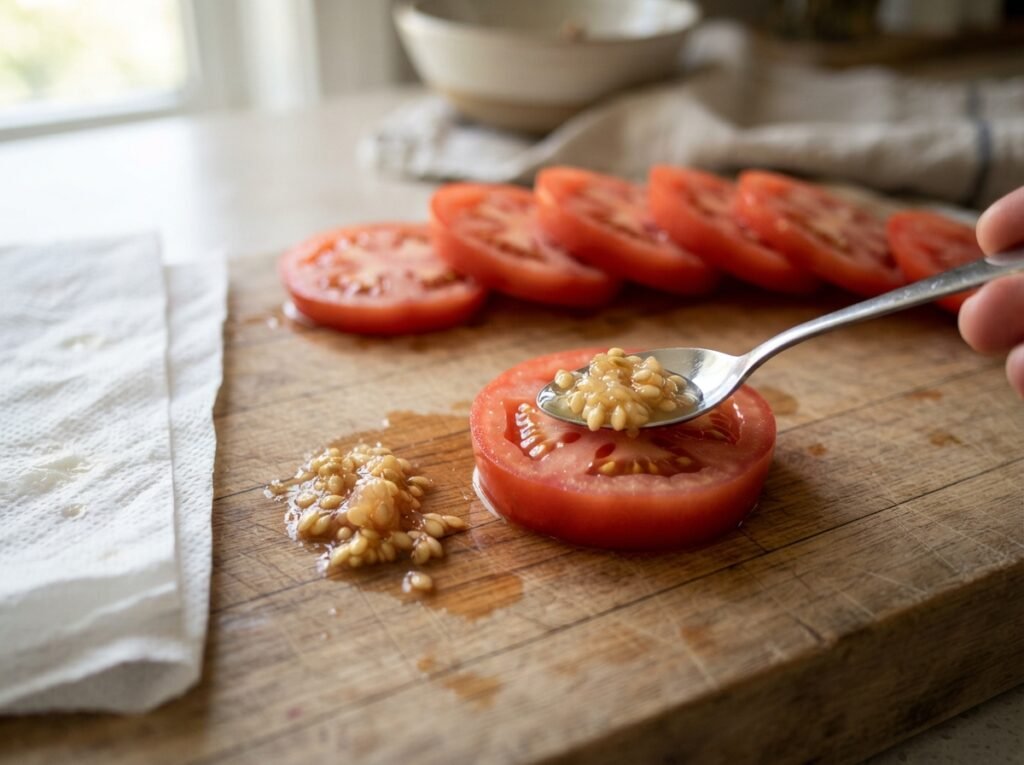
Slice the tomato, scoop out the seeds and the watery jelly, and pat the slices dry.
One large tomato is the only genuinely wet thing in this sandwich, and pressed sandwiches and water are enemies. <cite index=”76-1″>Tomatoes and other juicy fillings aren’t natural candidates for panini, where crispness is the point — but they’re not off the table, you just have to contain the moisture, and removing the seeds from tomatoes is how you do it.</cite> <cite index=”70-1″>Lightly patting down anything high in moisture is the other half of it.</cite>
If your tomato is a particularly juicy specimen, go further: salt the slices, let them sit and drain for a few minutes, then blot them dry. <cite index=”74-1″>Salting and blotting tomatoes before they leak is standard practice</cite> — most sandwiches don’t go soggy because they’re badly made, they go soggy because water reached the bread too early.
Ninety seconds of work. Enormous difference.
Step 2: Build It in the Right Order
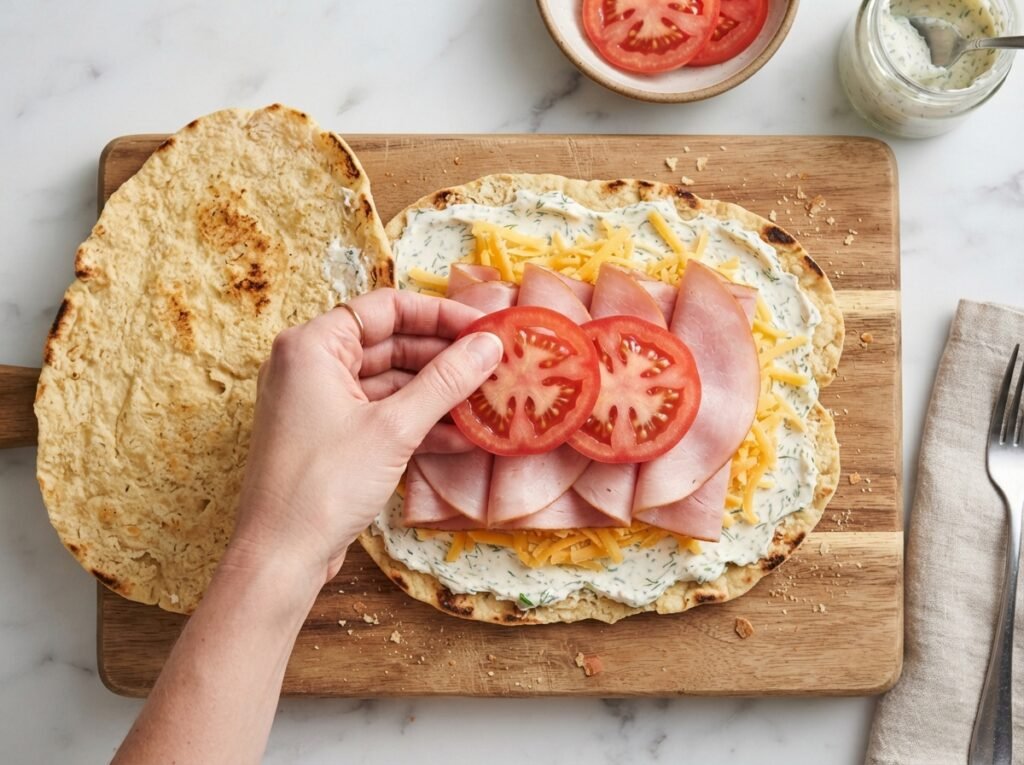
Split the flatbread horizontally. Then, from the bottom up:
- Herb cream cheese — spread across the bottom face, right to the edges
- Grated cheese — a layer, directly on the cream cheese
- Ham — folded, not flat
- Tomato — the middle, always the middle
- Herbs
- The rest of the grated cheese
- Herb cream cheese on the underside of the top half
- Lid on
Three principles are doing the work here.
Wet things live in the centre. This is the most-repeated rule in serious panini writing and it comes from the top: <cite index=”76-1″>the tip is credited to chef Tom Colicchio — put your wet ingredients in the centre of the sandwich.</cite> <cite index=”78-1″>High-moisture ingredients like tomatoes and fresh mozzarella go in the centre, never directly against the bread.</cite> Your tomato is sandwiched between cheese and cheese. It can leak all it likes; it never touches the crumb.
Cheese against the bread is glue. <cite index=”70-1″>Placing cheese near the bread acts as a glue that holds the sandwich together</cite> — as it melts it bonds the filling to the crust instead of letting the whole thing slide apart when you cut it.
Fold the ham. Flat sheets of ham create a slick plane the sandwich shears along. Folded ham has texture and grip and eats better.
Leave a border. <cite index=”73-1″>Use just enough to cover the bread evenly and leave a small border around the edges to prevent spills.</cite>
Step 3: Press It — Gently, Low, and Longer Than You Think
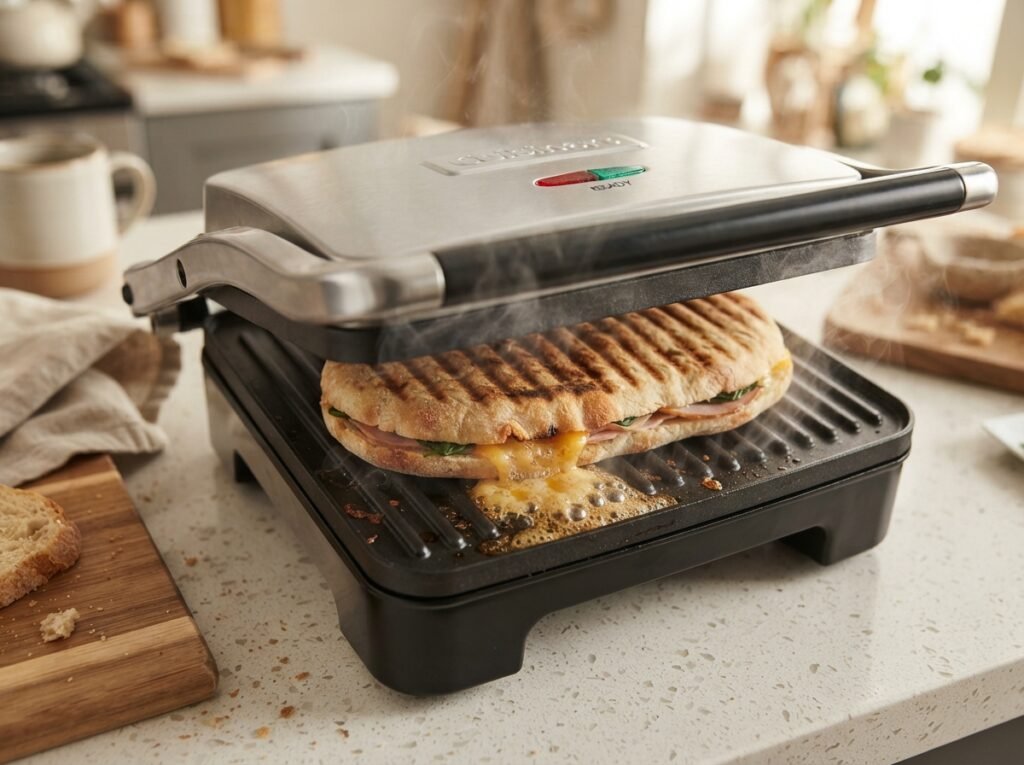
Preheat the grill. Place the flatbread on. Lower the lid slowly until it makes contact — don’t press down.
<cite index=”77-1″>Lower the lid slowly until it makes full, secure contact, because over-pressing squeezes the fillings out and leaves you with bread on bread.</cite> The weight of the lid is enough. As the cheese melts the sandwich will flatten by itself. <cite index=”73-1″>Close the press gently — pressing too hard squeezes out the filling.</cite>
Now, low heat, around 10 minutes, per the fork above.
Check it. <cite index=”77-1″>Lift the lid and look periodically — and if you start to hear the sizzle of cheese on the grates, that’s a sure sign it’s melted.</cite> That sizzle is a better doneness signal than any colour on the bread, because it’s coming from the inside.
A note on overfilling, because you’re close to the line. The professional benchmark is unforgiving: <cite index=”78-1″>chefs work to roughly a 3:1 bread-to-filling ratio, around 3 ounces of total filling for a standard 6-inch sandwich, and exceeding it causes uneven cooking and structural failure.</cite> Your filling here is close to 400g. A large flatbread is much bigger than a 6-inch sandwich so the comparison isn’t one-to-one — but you are near the ceiling, not comfortably under it. <cite index=”70-1″>Avoid overstuffing or the ingredients fall apart.</cite>
If yours keeps erupting: that’s the reason. Ease off the cream cheese before you ease off anything else.
Step 4: Rest It — 60 Seconds
Take it off. Wait a minute before you cut it.
This feels absurd when there’s molten cheese in front of you, and it’s the step everyone skips. <cite index=”78-1″>Resting for 60 seconds lets the cheese set slightly, which prevents the ingredients separating</cite> — cut it the second it’s off the plate and the molten cheese is still liquid, so it runs, and the filling follows it out onto the board.
<cite index=”75-1″>Letting it rest also makes it easier to slice, because the bread is less likely to tear.</cite>
Sixty seconds. Then cut it with a serrated knife.
And eat it now. <cite index=”77-1″>Panini taste best straight off the grill while the bread is still crisp and the filling is hot.</cite> This is not a make-ahead food. If you’re feeding several people, build them all in advance and press them to order.
Leftovers? There’s one rule: <cite index=”77-1″>a toaster oven is the best way to reheat — around 8–10 minutes at 275°F — and do not microwave it, because it turns the bread chewy and soggy.</cite> A microwave undoes every single thing this recipe is for.
Why This Works Better Than It Should
Step back and look at what’s actually been engineered here, mostly by accident.
The flatbread is structural, so it survives the press. The cream cheese is a fat barrier on both cut faces, so the crumb never gets wet. The grated cheese is glue on both sides of the filling, so nothing slides. The tomato is quarantined in the centre between two cheese layers, so its water has nowhere to go. And the ham is thick and cold, which is the one thing that dictates your heat setting.
Every element has a structural job. The original recipe lists them as a shopping list, but they’re a system — and once you see the system, you can improvise inside it without breaking it. Swap the ham for grilled peppers and you’ve removed the cold-mass problem, so go hotter and faster. Swap the herb cream cheese for pesto and you keep the barrier. Swap the flatbread for a wrap and the whole thing collapses, because you removed the structure.
That’s the difference between following a recipe and understanding one.
Who This Doesn’t Work For
- You want it in five minutes flat. Five minutes is the prep — which the original says honestly. The press is the other ten.
- You don’t have a contact grill. A heavy pan on top of a grill pan works, but you lose the heat control that this specific sandwich needs most.
- You’re watching calories. 150g of cream cheese and 120g of cheese. This is a comfort dinner and it isn’t pretending otherwise.
- You’re meal-prepping. Press to order or don’t bother.
- You’re using a thin wrap. Wrong bread. It’ll flatten.
Troubleshooting
“The bread was golden but the middle was cold.” Heat too high. This is a thick sandwich — low setting, around ten minutes. Colour isn’t doneness.
“It went soggy.” Tomato seeds. Deseed, blot, and keep the tomato in the centre layer, never against the bread.
“The filling squirted out everywhere.” You pressed down. Let the lid rest under its own weight — or you overfilled it, which is the other likely answer.
“It fell apart when I cut it.” You didn’t rest it, or there was no cheese layer touching the bread to glue it together. Probably both.
“The cheese didn’t melt but the bread burnt.” Same problem as the first one. Lower the heat and give it longer.
“My reheated leftovers were rubbery.” Microwave. Toaster oven only, low and slow.
The Verdict
This is a genuinely excellent quick dinner, and the recipe circulating is right about everything except the one instruction it actually gives you.
“Grill until golden” is advice built for a grilled cheese. This is not a grilled cheese. It’s a thick, cold-cored, wet-filled sandwich, and it needs the opposite treatment: low heat, real time, and patience while nothing appears to be happening.
Deseed the tomato. Cream cheese against the bread. Cheese against the cream cheese. Lid down gently. Low heat, ten minutes, listen for the sizzle. Rest it sixty seconds.
Then eat it immediately, standing up, which is the only correct way.
7. FAQ
What temperature should a panini press be for a ham and cheese flatbread?
Lower than you’d expect. For a thin sandwich where you only need to melt cheese and toast bread, medium-high — around 375°F — for about three minutes is right. But a thick sandwich with cold meat that needs heating through wants a low setting, around 200°F, for roughly ten minutes. A loaded ham and cheese flatbread is firmly the second kind, and cooking it hot browns the bread long before the centre is warm.
Why is my panini soggy?
Water reached the bread too early. Tomatoes are the usual culprit — remove the seeds and watery jelly, salt and blot the slices if they’re especially juicy, and keep them in the middle layer of the sandwich rather than against the bread. A layer of fat against the crumb, like cream cheese, butter or pesto, acts as a moisture barrier and stops the crust absorbing anything.
Where should you put tomato in a panini?
Always in the centre, never touching the bread. The tip is credited to chef Tom Colicchio, and it’s the most consistently repeated rule in serious panini writing. Sandwich the tomato between layers of cheese so any liquid it releases is trapped between two fatty layers instead of soaking into the crumb.
How long should you rest a panini before cutting it?
About 60 seconds. It lets the melted cheese set slightly, which stops the filling separating and running out when you cut. It also makes the bread easier to slice without tearing. It feels unnecessary and it isn’t.
How do you reheat a pressed flatbread sandwich?
In a toaster oven, around 8 to 10 minutes at 275°F. Never in a microwave — it makes the bread chewy and soggy and undoes the entire point of pressing it. Better still, don’t reheat it: build sandwiches ahead and press them to order.
Can you make this ham and cheese flatbread vegetarian?
Yes, and easily — the cream cheese and grated cheese carry most of the flavour. Grilled peppers, artichokes or mushrooms replace the ham well. It also changes the cooking: without cold meat in the middle there’s much less mass to heat through, so you can move up the heat and cut the time down considerably.