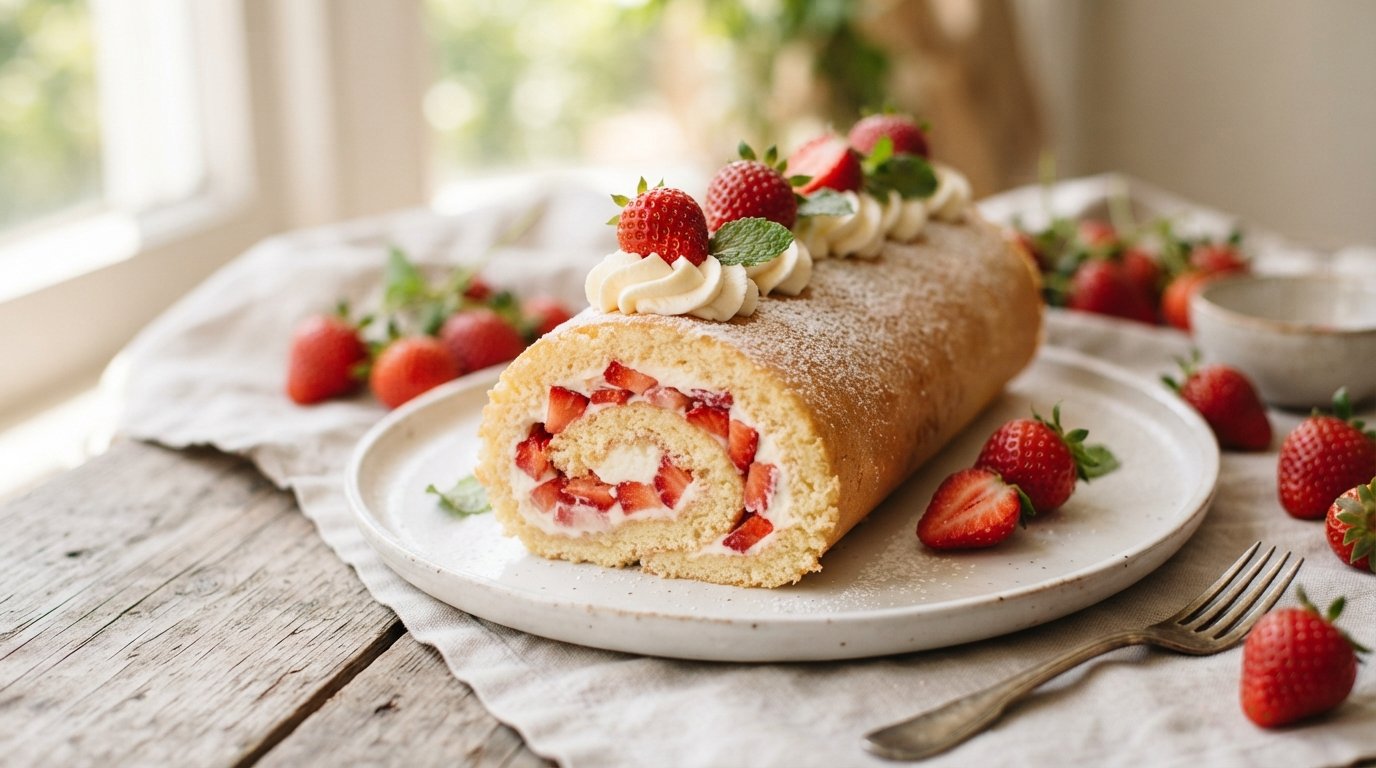
Strawberry Swiss Roll — The One Missing Word That Cracks It
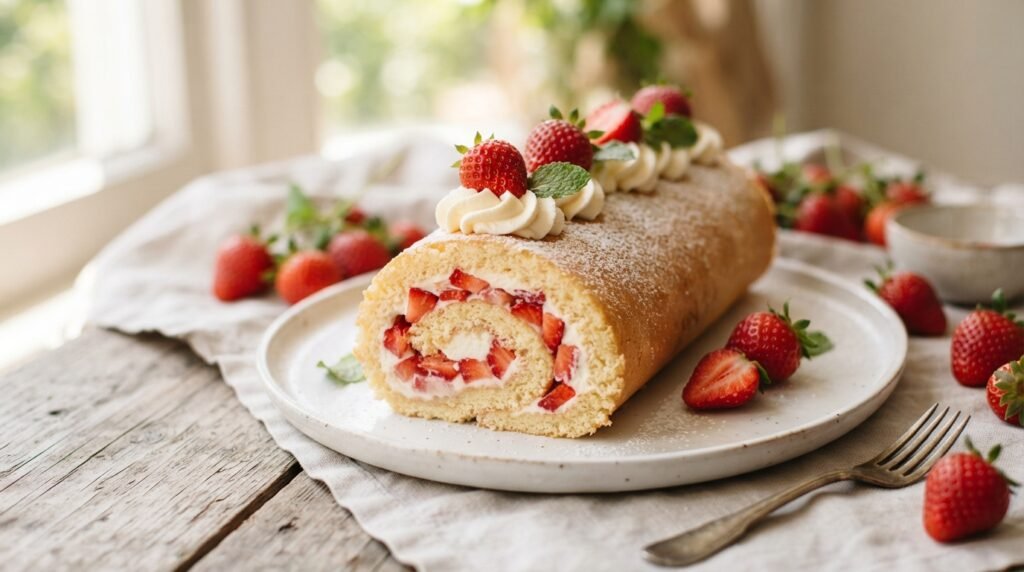
A strawberry Swiss roll is a thin whisked sponge, a mascarpone cream, and 300g of strawberries rolled into a spiral. It takes about half an hour of actual work and it looks like it took a great deal more.
It also cracks, tears, or welds itself to your tea towel for one reason more often than any other — and it’s a missing word, not a missing skill.
The recipe you’ve probably seen says: turn the sponge out onto a clean kitchen towel.
It should say: turn the sponge out onto a clean, sugared kitchen towel.
That one word is the difference between a sponge that peels away cleanly and a sponge that bonds to cotton and tears in half when you unroll it. And it’s the start of a much bigger point about this cake, which is that almost everything that goes wrong with a Swiss roll is a moisture problem wearing a costume.
The 40-Second Answer
A strawberry Swiss roll is a thin sponge baked at 200°C for around 10 minutes, turned out onto a sugar-dusted towel, rolled warm and left to cool in that shape, then unrolled, filled with mascarpone cream and strawberries, and re-rolled. The sugar stops the sponge sticking; rolling it warm sets the curl so it doesn’t crack later.
Key Takeaways
- Sugar the towel. Not optional. It’s the barrier between sponge and cloth.
- Overbaking is the main cause of cracking. 10 minutes is a guide; springback is the test.
- Roll it warm and cool it rolled. The sponge learns the shape and stops fighting you.
- Don’t overfill. Pressure inside the roll is what splits the seam.
- Cracks are cosmetic. Genuinely. Seam-side down and a dusting of icing sugar fixes almost everything.
Why Swiss Rolls Crack (It’s Not the Rolling)
Everyone blames the roll. The roll is the symptom.
<cite index=”80-1″>The biggest single reason a Swiss roll cracks is that the cake is too dry — overbaking pulls out the moisture and the elasticity and leaves you with a brittle sponge that resists rolling.</cite> That’s it. That’s the answer to the question most people are actually asking.
And the margin is brutal, because the sponge is thin. <cite index=”83-1″>Around 10 to 12 minutes at 200°C is right for a Swiss roll, and overbaking by even a couple of minutes is the main cause of cracking.</cite>
Which means the recipe’s 200°C and 10 minutes is correct — and I want to be clear about that, because it’s easy to assume a viral recipe is wrong about everything. It isn’t. The temperature and the time are exactly what the baking authorities specify.
What it doesn’t give you is the test, and the time is worthless without it. Ovens vary by 20°C or more and a thin sponge notices.
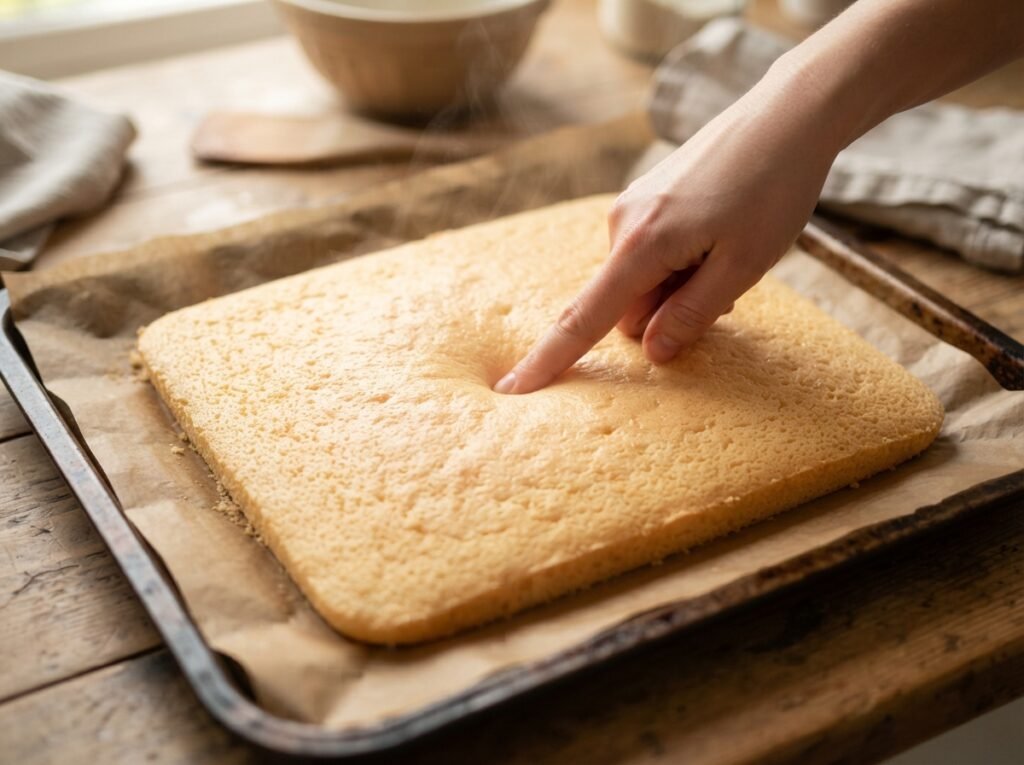
The test: <cite index=”80-1″>bake it just until it springs back when gently pressed in the centre and starts to pull away from the edges of the pan — take it out while it’s still supple, not browned or dry.</cite> <cite index=”83-1″>Take it out the moment the top springs back to a light touch.</cite>
Set a timer for 9 minutes and then use your finger. Not the clock.
The Sugared Towel — The Missing Word
Now the main event.
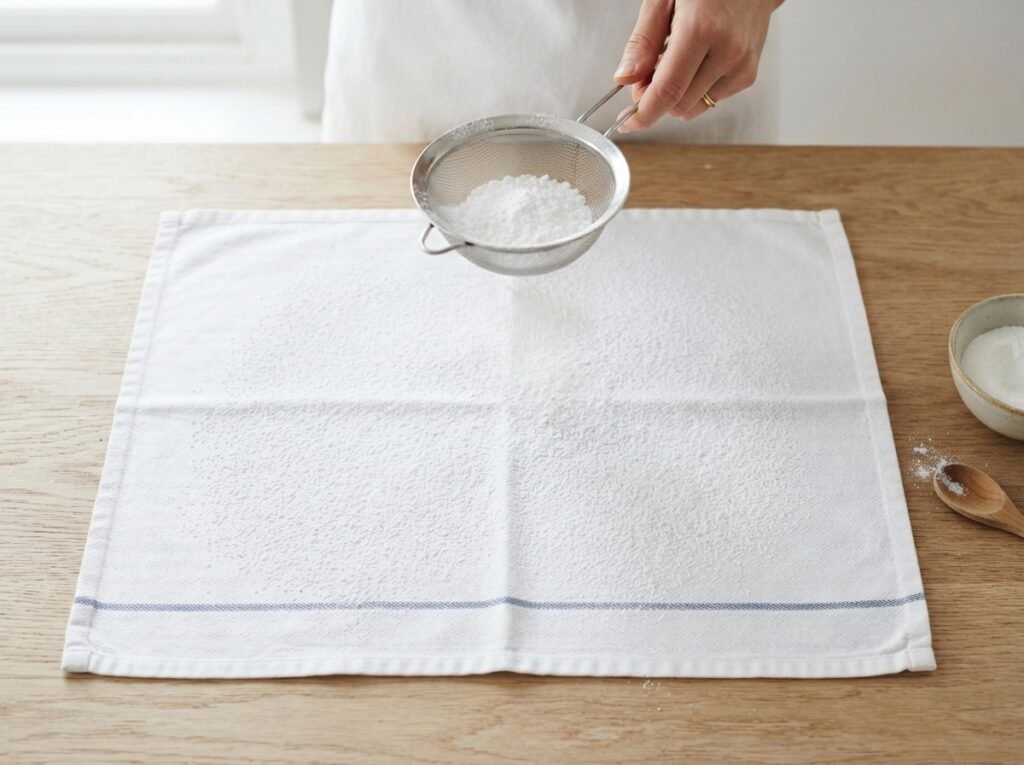
<cite index=”80-1″>Lay a clean kitchen towel on the counter and sprinkle it generously with powdered sugar or cocoa powder. Immediately turn your warm cake out onto the towel and peel off the parchment.</cite> That sugar is not seasoning. <cite index=”80-1″>Whether you’re rolling with a towel or parchment, sticking leads to tears and cracks — powdered sugar, or cocoa for a chocolate sponge, acts as a barrier and gives you a clean release.</cite>
Every serious source says the same thing. <cite index=”86-1″>Dust the tea towel liberally with sugar, icing sugar or cocoa to create a barrier before turning out the sponge</cite> — and the sugar should <cite index=”86-1″>cover a slightly larger area than the pan the sponge baked in.</cite> There’s a bonus, too: <cite index=”86-1″>it also adds a delicious crunch.</cite>
Why it’s necessary is worth thirty seconds. You are turning a hot, steaming, sugar-heavy sponge face-down onto absorbent cotton. The steam wets the cloth, the sugar in the sponge’s surface dissolves into that moisture, and you have effectively made glue. <cite index=”82-1″>When a Swiss roll sticks to the towel it’s usually down to too much moisture or not enough powdered sugar.</cite>
The sugar layer sits between the two and takes the hit.
Use the right cloth. <cite index=”82-1″>Cotton is the best choice — smooth, absorbent and flexible. Terry cloth or anything textured grips the cake and causes tearing.</cite> A smooth tea towel. Not a bath towel.
And there’s a legitimate alternative if the towel business irritates you: sugared parchment works just as well. <cite index=”83-1″>Roll the sponge up loosely from the short end with the sugared paper rolled inside it.</cite> Just pick a lane — <cite index=”81-1″>don’t mix methods halfway; choose one workflow and follow it end to end.</cite>
When Do You Actually Roll It? The Bakers Disagree
Here’s something nobody in this category will tell you: there is a genuine, unresolved argument about this, and it explains most of the contradictory advice you’ve read.
Camp one — roll it immediately. This is the majority and it’s the source recipe’s position. <cite index=”84-1″>Work with the sponge as soon as it’s baked; letting it cool too much causes cracking. Turn it out onto sugar-dusted paper and roll it up straight away.</cite> <cite index=”83-1″>Roll it within a few minutes of it leaving the oven, with sugared paper inside. It cools in that shape, so when you unroll it to fill, it won’t crack.</cite>
Camp two — wait 3 to 5 minutes. <cite index=”82-1″>The best time is 3 to 5 minutes after it leaves the oven: still warm, not hot, definitely not cold. Rolling too soon, while it’s too hot, can cause sticking and tearing. Rolling when it’s too cool causes cracks.</cite>
Camp three — wait 10 minutes, in the pan. This is the contrarian position and it’s argued well: <cite index=”86-1″>most recipes call for rolling instantly after baking, but that traps steam in the tea towel and makes the sponge stick to the material.</cite>
So: immediately, 3–5 minutes, or 10 minutes. Three credible bakers, three answers.
Here’s what they actually agree on, which is more useful than picking a winner:
- Warm, never cold. Every camp. <cite index=”86-1″>Cold, and the sponge will crack.</cite>
- Never chill it before rolling. <cite index=”81-1″>Roll warm or at room temperature, not cold.</cite>
- The two failure modes are opposite. Too hot → steam → sticking. Too cold → rigid → cracking.
So the disagreement isn’t really about time — it’s about which failure your kitchen is more prone to. If your sponges keep sticking, wait a few minutes longer. If they keep cracking, move faster. Both camps are optimising against a different enemy, and neither is wrong.
My read, for what it’s worth: sugar the towel properly and the sticking problem largely disappears, which frees you to roll early and beat the cracking problem instead. That’s why the sugar matters so much — it’s not just a fix, it buys you the flexibility to follow the majority advice safely.
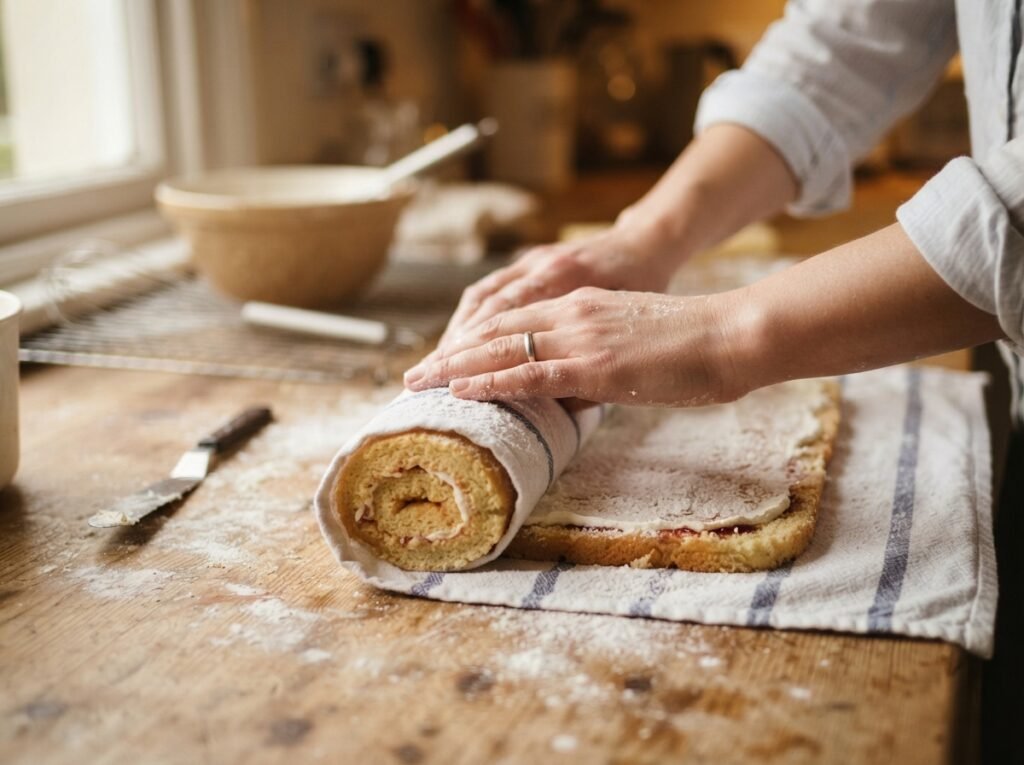
Either way: let it cool completely rolled. <cite index=”80-1″>Roll the cake and towel together into a loose log from the short end and let it cool in that shape. This sets the sponge into the rolled position, so when it’s filled and re-rolled it won’t resist or crack.</cite>
The sponge learns the curve. That’s the whole trick.
Ingredients
For the sponge:
- 5 eggs
- 110g sugar
- 1 sachet vanilla sugar (or 1 tsp vanilla extract)
- A pinch of salt
- 30g cornflour
- 80g plain flour
- 1 tsp baking powder
- Plus: caster or icing sugar for the towel — the step the original forgot
For the cream:
- 200g whipping cream
- 200g mascarpone
- 2 sachets cream stiffener
- 3 tbsp sugar
Plus:
- 300g strawberries
Three ingredient notes.
The baking powder is a departure, and that’s fine. A classic Swiss roll doesn’t have any. <cite index=”83-1″>A classic Swiss roll is light on flour and leans on whisked eggs for its structure.</cite> <cite index=”84-1″>The traditional sponge is three ingredients — sugar, eggs and flour, with no butter or fat at all.</cite> The teaspoon here is insurance against under-whipped eggs. It works, and if you’re nervous, keep it. One thing to watch: <cite index=”86-1″>if you use self-raising flour, omit the baking powder</cite> — otherwise you’re double-leavening and the sponge will rise and collapse.
Cream stiffener (Sahnesteif) is a German staple and hard to find elsewhere. If you can’t get it, you’re less stuck than you think — you already have 200g of mascarpone in the bowl, and mascarpone is a firm, high-fat cheese that does real stabilising work on its own. Cornflour or a little icing sugar whisked into the cream is the usual substitute. What matters is that the filling is stable, and that’s not optional: <cite index=”81-1″>for same-day serving, whipped cream works; for overnight storage you want stabilised whipped cream, buttercream or a firmer filling that won’t weep or slide.</cite>
Pat the strawberries dry. Nobody tells you this and it’s the same principle as everything else here. 300g of cut fresh strawberries release juice, that juice thins your cream and soaks the sponge from the inside, and a roll is a sealed tube — the water has nowhere to escape. Cut them, spread them on kitchen paper for a minute, blot the tops. Ten seconds of work.
Step 1: The Eggs — And the Test the Recipe Doesn’t Give You
Whisk the eggs, sugar, vanilla sugar and salt on the highest setting for about 10 minutes, until pale and voluminous.
This is where the sponge’s flexibility is created. <cite index=”83-1″>The air you whisk into the eggs and sugar is what makes the sponge flexible — whisk until pale, thick, and holding a ribbon trail for a few seconds. Underbeaten eggs give you a dense sponge that won’t bend.</cite>
Read that again, because it reframes the whole recipe: under-whipped eggs don’t just make a flat cake. They make a cake that cracks. The whisking and the rolling are the same problem.
Ten minutes is the source’s guide and it’s a good one. But here’s the actual test, and it’s better than any timer — <cite index=”85-1″>pinch a bit of the mixture and rub it between your fingers. If you can feel sugar grains, keep beating.</cite> When it’s smooth, the sugar has dissolved and you’re there.
Two tests, thirty seconds, no guessing.
Step 2: Fold — Don’t Stir
Sift the cornflour, flour and baking powder over the top and fold them in gently.
<cite index=”83-1″>Too much flour, or overmixing once it’s in, builds gluten and makes the sponge tough rather than tender. Fold it through gently and stop the moment it disappears.</cite> <cite index=”86-1″>Fold, don’t stir — we want to keep the air we’ve just whipped in.</cite>
You spent ten minutes putting air into those eggs. You can take it all back out in twenty seconds of enthusiastic stirring.
Weigh the flour. <cite index=”86-1″>Too much flour creates a dry sponge that will crack when rolled.</cite> Cups are not your friend here.
And tap the tray. <cite index=”86-1″>Tap the tray before baking to release air bubbles — trapped bubbles affect the sponge’s structure and can cause it to crack once rolled.</cite> Small step, free win.
Step 3: Bake, Turn Out, Roll
Spread the batter evenly on a lined baking tray. Bake at 200°C for around 10 minutes — until it springs back, not until the timer says so.
Turn it out onto your sugared towel. Peel the parchment off while it’s still warm — <cite index=”81-1″>peel slowly and at a low angle, while the cake is still warm; peeling too late, after it’s cooled and firmed, is when it tears.</cite>
Roll it up loosely with the towel inside, from the short end. Leave it to cool completely in that shape.
Step 4: The Cream
Briefly whip the cream, mascarpone and sugar together, add the stiffener, and whip to finish. Set aside about 5 tablespoons for decorating.
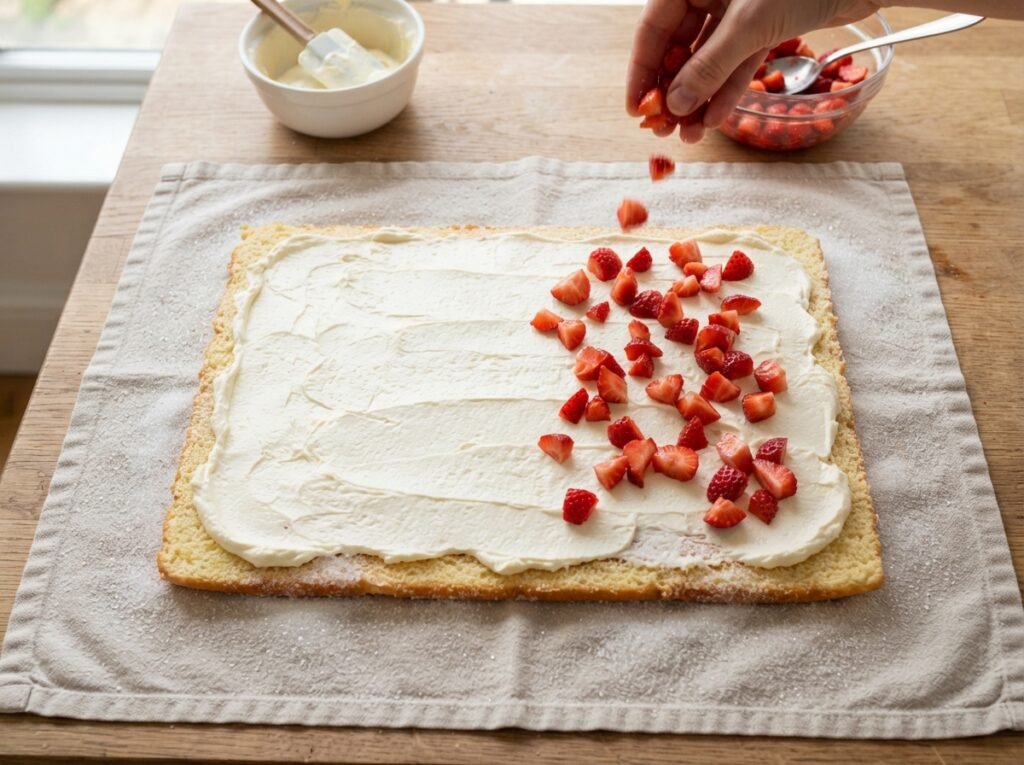
Then unroll the cooled sponge gently, spread the cream, scatter the dried strawberries, and roll it back up.
Don’t overfill. This is the last trap. <cite index=”80-1″>Too much cream creates pressure inside the roll and causes cracks or bursts along the seam — spread an even, thin layer and leave about a ½-inch border at the edges.</cite> <cite index=”84-1″>Too much filling squeezes out when rolling; a thin, even layer works best.</cite>
400g of cream and 300g of strawberries is generous. If your first attempt bursts, this is why — and cream on the plate is a better outcome than cream in the seam.
Decorate with the reserved cream, garnish with fresh strawberries, and trim the ends — they’re always ragged, and a clean cross-section is most of the visual appeal.
A small upgrade the original suggests and you should take: a little lemon zest in the cream. Mascarpone and cream and sugar is a lot of richness in one direction, and the zest is the only thing cutting it.
If It Cracks Anyway — Read This Before You Panic
The anxiety around this cake is wildly out of proportion to the stakes, and no one says so.
<cite index=”83-1″>Small cracks close up once the roll is filled and sitting seam-side down. For bigger splits, a dusting of icing sugar or a glaze hides a multitude of sins. And if it’s broken badly, slice it and layer it into a trifle. A cracked Swiss roll is a presentation problem, not a flavour one.</cite>
<cite index=”81-1″>Cracks are usually cosmetic — frost or dust the outside and move on.</cite> <cite index=”82-1″>If it sticks or cracks, it’s not the end of the world. Patch it with filling, or serve it with a more rustic look.</cite>
Seam-side down. Icing sugar. Nobody will know. And if they do, they’re eating cake and strawberries, so they’ll cope.

Making It Ahead
The recipe says to eat it straight away, and fresh is genuinely best. But you have more room than that suggests.
<cite index=”86-1″>It keeps in an airtight container in the fridge for up to 5 days</cite>, and <cite index=”81-1″>you can refrigerate it — just wrap it tightly to prevent condensation, because condensation makes the surface sticky.</cite> The mascarpone-and-stiffener filling is exactly the stable kind that holds up to that; a plain whipped cream wouldn’t.
There’s also a genuinely useful trick nobody mentions: <cite index=”86-1″>an unfilled, rolled sponge can be wrapped in plastic and foil and frozen for up to 2 months.</cite> Bake the sponge whenever, freeze it rolled, fill it the day you need it. That turns a fiddly bake into a twenty-minute assembly job.
One thing worth knowing that isn’t in any of the sources: half an hour in the fridge before slicing gives you noticeably cleaner cross-sections, because the cream firms up and stops smearing as the knife passes through. Serve it cool, not cold.
Who This Doesn’t Work For
- You’ve never whisked a foam sponge. This is doable but unforgiving — there’s no fat to hide behind. <cite index=”84-1″>There’s less room for error in getting it just right.</cite> Make it once for yourself before you make it for guests.
- You want it low-sugar or light. 400g of cream and mascarpone. It’s a cake.
- You’re baking in a battered old tray. <cite index=”83-1″>If a tin warps in the heat, the edges dry out and overcook before the middle is done — and dry edges are exactly where a roll splits.</cite> Flat and heavy beats thin and buckled.
- You need it perfect first time. See the cracking section. Lower your stakes.
- Strawberries are out of season where you are. Use frozen at your peril — they release far more water on thawing. Raspberries are the better swap.
Troubleshooting
“It cracked when I unrolled it.” Overbaked. It’s almost always overbaked. Springback test next time, and pull it a minute early.
“It stuck to the towel.” No sugar on the towel, or you rolled it while it was still steaming hot, or you used a textured cloth. Usually the sugar.
“It stuck to the parchment.” You peeled too late. Peel it warm, slowly, at a low angle.
“The seam burst open.” Overfilled. Thin, even layer, half-inch border.
“The sponge was dense and wouldn’t bend.” Under-whipped eggs, or you stirred instead of folding. Ribbon trail, grain test, gentle folds.
“The cream went watery.” Wet strawberries. Blot them. Or the filling wasn’t stabilised enough for how long it sat.
“It’s cracked and I have guests in an hour.” Seam-side down, icing sugar over the top, breathe.
The Verdict
This is a good recipe. Better than most things that go viral — the temperature is right, the timing is right, and rolling it warm in a towel is the correct professional method that half the internet gets wrong.
It’s just missing one word, and the word is sugared.
Sugar the towel. Bake to springback, not to the clock. Whisk until the grains are gone. Fold, don’t stir. Blot the strawberries. Roll it warm, cool it rolled, don’t overfill it.
And if it cracks: seam-side down, icing sugar, say nothing. It has never once mattered.
7. FAQ
Why did my Swiss roll crack?
Almost always because the sponge was overbaked and dried out. A thin sponge goes from supple to brittle in a minute or two, and a dry sponge has no elasticity left to bend. Bake for 10–12 minutes at 200°C and take it out the moment the centre springs back to a light touch, not when the timer says so. Rolling it once it’s already cooled flat is the other common cause.
Why does my Swiss roll stick to the towel?
Because the towel wasn’t sugared, or the sponge was still steaming hot when it went down. You’re placing a hot, sugar-heavy sponge onto absorbent cotton — the steam wets the cloth, the surface sugar dissolves into it, and the two bond. Dusting the towel generously with sugar, icing sugar or cocoa first creates a barrier. Use a smooth cotton towel, never a textured one.
When should you roll a Swiss roll — immediately or after it cools?
Warm, never cold, but credible bakers genuinely disagree on exactly how warm. Some roll immediately out of the oven, some wait 3 to 5 minutes, and some rest the sponge in the pan for 10 minutes on the grounds that rolling it steaming hot traps moisture and makes it stick. What they all agree on: never chill it before rolling, and never let it cool flat. If yours keep sticking, wait longer. If yours keep cracking, move faster.
Do you have to roll a Swiss roll twice?
Yes, and it’s the whole technique. Rolling the warm sponge in a towel and letting it cool in that shape trains it into the curve, so when you unroll it to fill and roll it back up it doesn’t resist or crack. Skipping the first roll is why sponges split on the only roll that counts.
Can you make a strawberry Swiss roll ahead of time?
Yes. Filled, it keeps in an airtight container in the fridge for up to 5 days — wrap it tightly, since condensation makes the surface sticky. A mascarpone-based filling is stable enough for that where plain whipped cream isn’t. Better still, an unfilled rolled sponge can be wrapped and frozen for up to 2 months, then filled on the day.
What can I use instead of cream stiffener?
Cream stiffener is a German staple that’s hard to find elsewhere, but this filling already contains 200g of mascarpone, which is firm and high-fat and does real stabilising work on its own. A little cornflour or icing sugar whisked into the cream is the usual substitute. The goal is simply a filling stable enough not to weep or slide inside a sealed roll.